
What is scratching?
Published on Monday 18 May 2026
Ask someone to do an impression of a DJ and you’ll probably see them make a scratching motion. But what actually is scratching? And when does a DJ use it? In this blog, I’ll explain how scratching originated, what the basic technique is, and what you need. To start with that last part: ideally, two turntables and a DJ mixer, or the digital alternative: a controller or media players. Spin it!
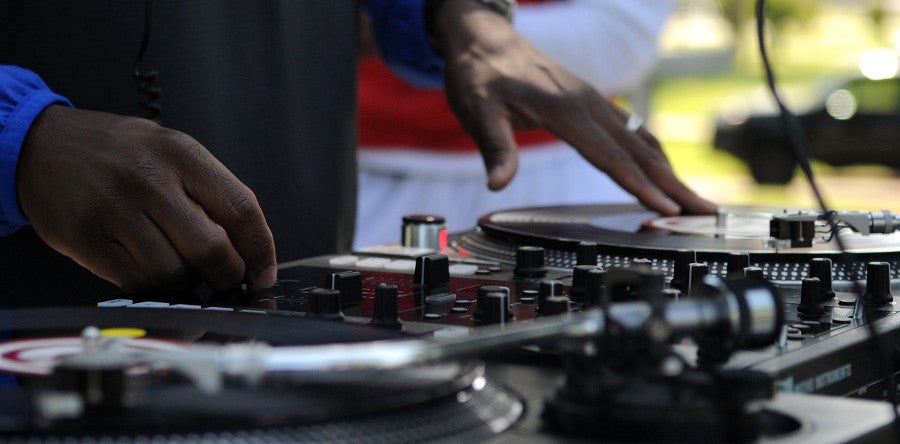
DJ as the centrepiece
When hip-hop emerged in the 1970s, the DJ was essentially the centrepiece of the four pillars on which hip-hop is built: turntablism, breakdance, rap and (to a lesser extent) graffiti. Numbers two and three can’t do without number one: the DJ and their scratch skills, also known as turntablism. To enable the b-boys (breakdancers) and rappers to do their thing, the DJ had to create a constant drum loop with as few other instruments as possible. Scratching also gave you an extra rhythmic technique that the DJ could apply. Who discovered scratching? Possibly Grandmaster Flash, but that’s not certain. What we do know is that he was one of the pioneers in this field, alongside Grand Wizzard Theodore, DJ Kool Herc and Afrika Bambaataa. They mainly used old funk, soul and R&B records combined with the newest technology at the time: direct-drive turntables. These started and stopped quickly, so you could switch fast.
Scratched breakbeats
Many of the records DJs used were perfectly suited to the technique, because they had a strong drum groove and moments where you could hear only the drummer, or just the drummer and bassist (a well-known example is Funky Drummer by James Brown). Rappers could go to town over these, and breakdancers could pull out their jaw-dropping moves. To get to these so-called breakbeats, DJs often played two copies of the same record at the same time, switching between the two turntables using a mixer. While one break was playing, the other record would be manually spun back—inaudibly. But if you did bring that sound up, you’d hear the music playing backwards as it rewound. DJs noticed that this actually sounded pretty cool, so it was often used as a standalone rhythmic technique: scratching.
How do you scratch?
Scratching is essentially simple: you find a moment in the music (for example, the start of your break) and repeat the first beat of that bar by pushing the record forwards and immediately pulling it back again. That gives you the characteristic scratch sound (‘waka-waka’), and you’ve instantly got your first fundamental trick: the baby scratch. (It’s also a good technique for bringing in a new record and beatmatching it with your current track.) Of course, you don’t necessarily have to do this at the start of a break. In fact, you can use any section you like and start building your own tracks. The way you scratch can also vary in lots of ways: moving back and forth, snapping back quickly, or scratching in combination with your crossfader so you only hear a tiny slice of your scratch or the other track each time.
Expand your knowledge
Know your music! If you DJ with vinyl, that means you need a memory like an elephant—or you’ll need to make reminders to help you identify the break. In the ‘early days’, that was done by marking usable start points on the record with a wax crayon, or by sticking round, transparent stickers onto the vinyl. You can still do that, of course, but there are now special scratch records with non-stop breakbeats. If you use a digital vinyl system (DVS), you can set hot cues in your software. By the way, this blog mainly focuses on scratching with turntables, where you hold the record still on a spinning platter. That’s a very different experience from a non-spinning platter, like the one on a DJ controller. You can usually scratch on those too, but the feel will clearly be different. Finally: if you scratch on a turntable, make sure there’s a slipmat under your record—otherwise you’ll wreck your vinyl. On top of that, scratching will feel much smoother this way.
Why have you (not yet) started scratching? Let us know below!





No comments yet...