
Acoustic guitar amp or small PA: which should you choose as a singer-songwriter?
Published on Tuesday 24 November 2026

An acoustic guitar amp or a small PA: as a singer-songwriter, you’ll run into that question as soon as the living-room gig becomes a pub gig. For a long time I played with a combo on a bar stool behind me, and later I had a column PA in the boot. In short: the combo wins as long as you’re on your own in a small venue, and the PA wins as soon as there’s more going on on stage.
The acoustic combo: everything in one little box
An acoustic combo is essentially a mini PA in a handy little cabinet. Almost always, alongside the jack input for your guitar, there’s an XLR input for your vocal mic, and you can use both at the same time. Guitar in, mic in, two volume knobs, done. As a solo artist, that’s all you need for an open mic or a small pub back room.
A combo like this generally doesn’t want to add its own tonal colour. Whereas an electric guitar amp is very much a flavour in itself, an acoustic combo tries (as a rule) to amplify your guitar and voice as naturally as possible. Whatever you put in simply comes out louder. Reverb is usually on board, sometimes chorus or delay, but it remains a tool.
That modesty is also its limitation: a combo is designed for small spaces. On a bigger stage, your signal goes straight into the house PA and the combo serves as your monitor at most. Handy: some combos have a speaker stand mount, so you can raise them above the heads of the audience.
» View all acoustic guitar amplifiers
» View all dynamic vocal microphones
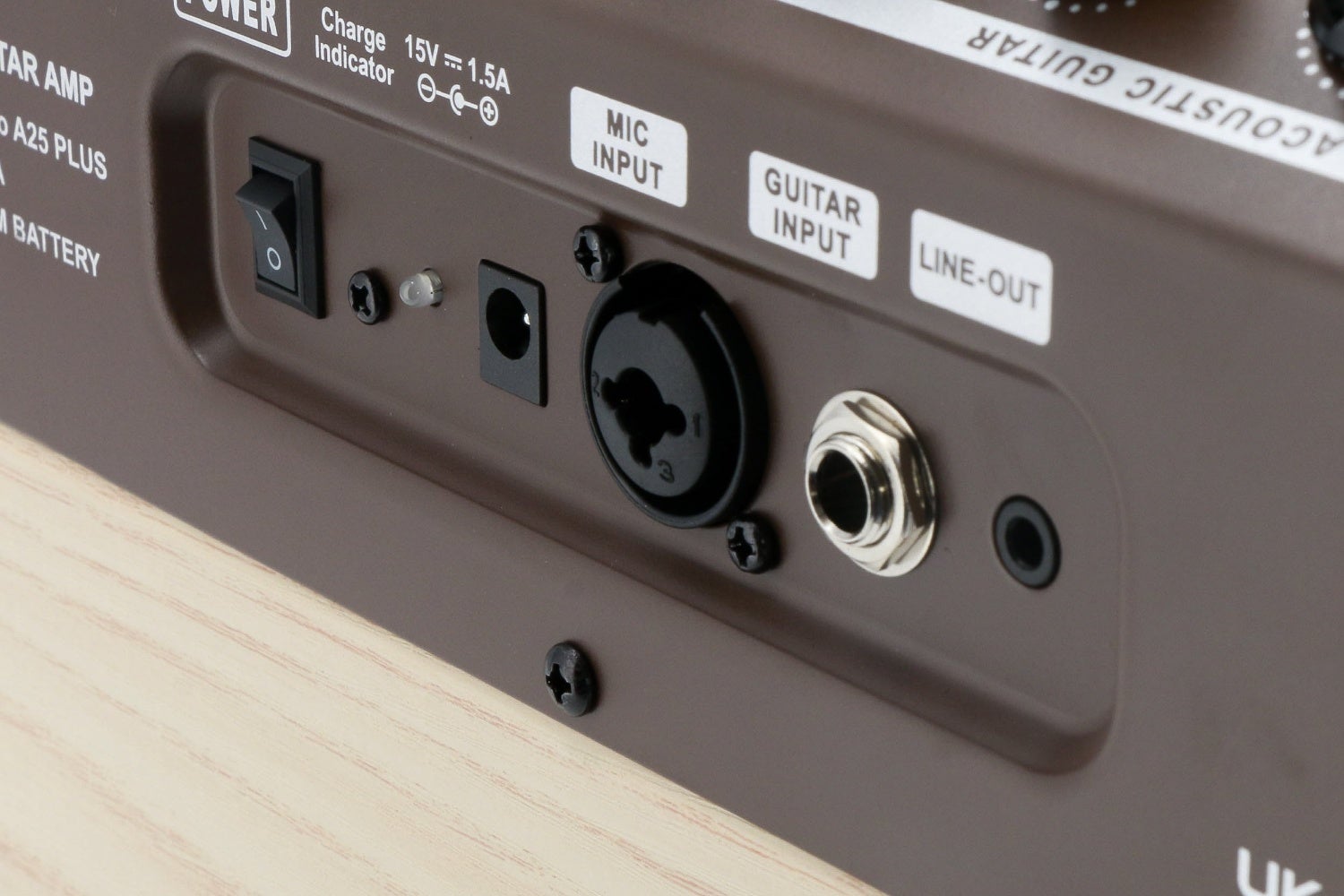
An acoustic guitar amplifier usually has only a few inputs
Feedback: who stands where?
Feedback doesn’t start in the amp, but with where you put it. That howling tone occurs when your microphone picks up the sound from the speaker and sends it back round. The closer the mic is to the speaker and the more it points towards it, the sooner things go wrong. Distance and direction make more of a difference than any knob.
That’s why my bar stool was OK, but not ideal. A combo diagonally behind you, not too high, with your mic pointing forwards and away from it: at pub volume that works, but turn the volume up or turn around for a moment and it’ll start howling. It’s safer to have the speaker in front of you, aimed at the audience, so that your mic sits behind it.
With a PA, the speakers are usually in front of you, and the same rule applies: keep your microphone behind the loudspeakers. If it still feeds back, many systems have a notch filter or automatic feedback suppressor that cuts out that one frequency. Nice to have, but it’s a sticking plaster. The correct setup remains the real solution.
» Amplifying an acoustic guitar – how do you prevent feedback?
» View all feedback busters
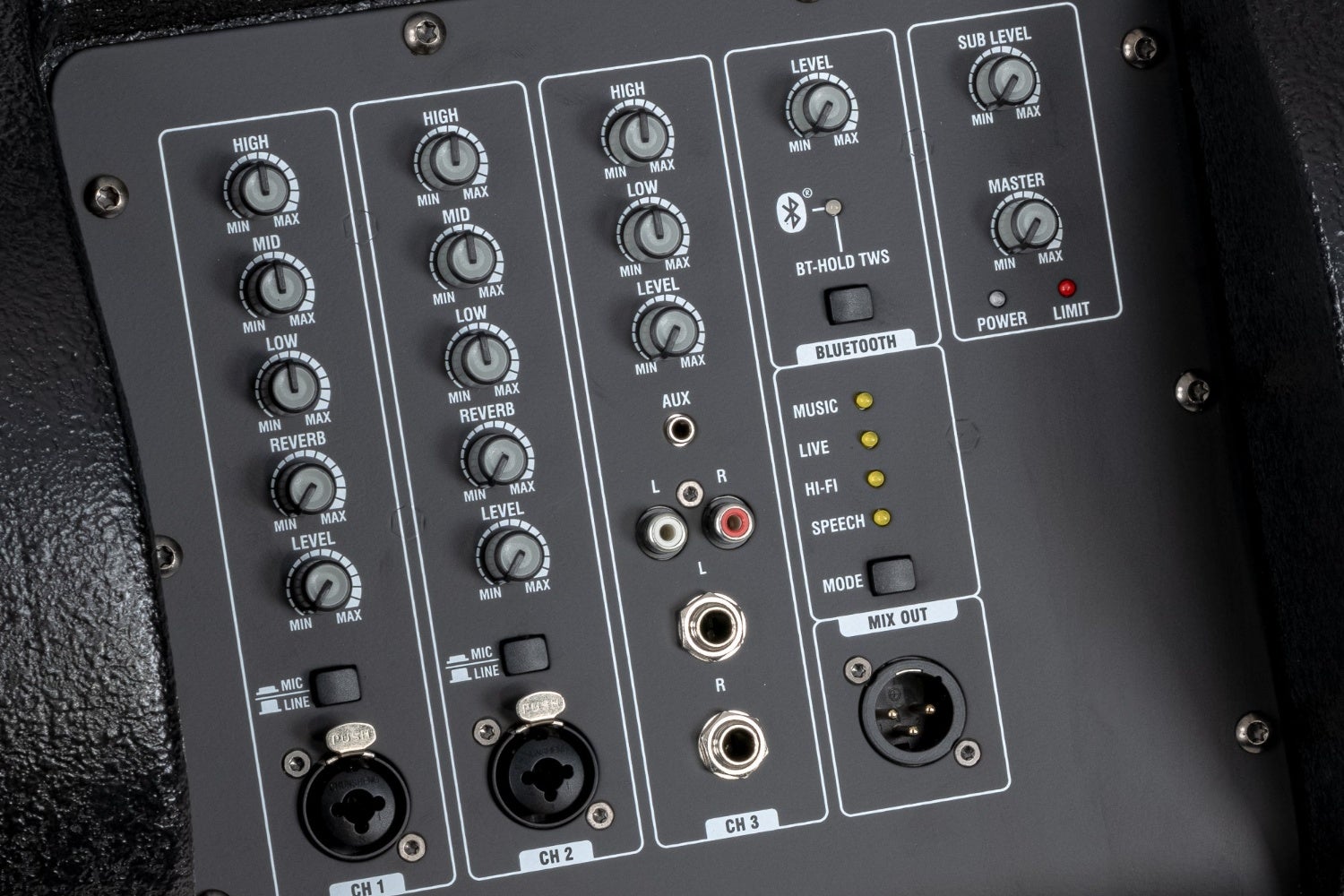
A column system usually has a more extensive mixer section than the average active speaker
Flexibility: the column PA or the standalone active speaker
A column PA consists of a base unit with a subwoofer on the floor, topped by a slim column with a row of small drivers (speakers) for the mids and highs. You see them everywhere these days. It’s usually a complete package: a built-in mixer with multiple mic and line inputs, often an instrument input too, Bluetooth for interval music and sometimes effects or app control.
That row of drivers behaves like a line source, something I only came to appreciate once I had one. The sound drops off less quickly over distance, around 3 dB per doubling of distance instead of 6 with a conventional speaker, and the vertical dispersion is tight. In practical terms: a compact ‘line array’ like this spreads the sound across the room much more evenly than a conventional speaker, giving better intelligibility for the whole audience.
That built-in mixer is also the big difference when it comes to growing with you. A second vocalist, a cajón player, a few backing tracks: with a reasonably well-equipped column system you can often still plug them in. With a combo, you’re maxed out after guitar and vocals.
The standalone active speaker sits somewhere in between. Compact and easy to pop on a stand, but check the inputs. If it only has one or two with a simple volume knob, you’ll soon need a small mixer to balance your voice and guitar. Suddenly you’re lugging three things around, which is exactly what you wanted to avoid.
» View all column array speaker systems
» View all active full-range speakers
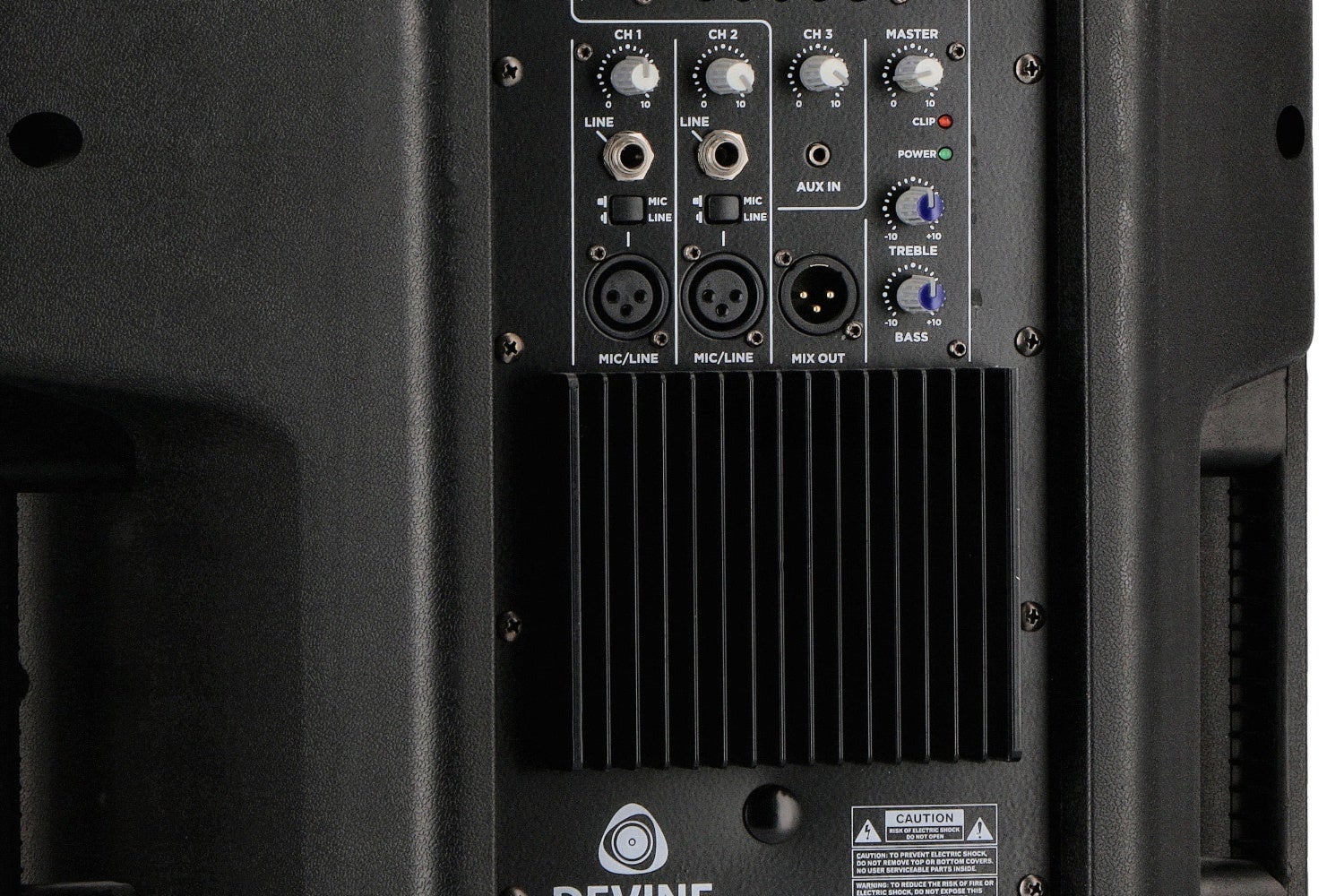
Quite a few active speakers already have a simple built-in mixer
No instrument input? Not enough inputs? Here’s how to expand your speaker
A piezo pickup under your guitar’s bridge prefers a high-impedance input, and by no means every active speaker has one. Plug your guitar straight into a line input anyway, and you’ll get sound, but nobody will be happy with it, because it’s thin and scratchy. A DI box or a standalone acoustic guitar preamp solves that: your guitar goes in, and out the other side comes a signal that goes to your mixer.
A fully fledged guitar preamp like this (as opposed to a simple DI box) often does more than just adapt the signal. An equaliser, a notch filter to tame that one howling tone and sometimes a boost for your solo: on a small stage, these are more useful than you’d think. I spent my first few years playing through a bare speaker, and only when I put a preamp in between did my guitar sound the way it does acoustically.
If, alongside guitar and vocals, you also want to connect a second microphone, a laptop with backing tracks or a guest player, and the built-in mixer doesn’t offer enough room, then a compact mixer with a few channels is the cheapest upgrade you can make. Everything comes together there, you set the volume and tone for each channel, and a single cable sends the mix to your speaker.
» View all acoustic guitar preamps
» View all analogue mixing desks

To get enough volume in a slightly larger venue, you can use two column systems at the same time
Price and the choice that suits you
There’s not much to say about price: in both camps it ranges from modest to hefty, and you mainly pay for the extras: subwoofer, extensive mixer, effects, app control. So don’t buy based on the price tag, but on what you’ll actually be doing over the coming year. A column with eight inputs, of which you use two, is an expensive luxury. A combo that turns out to be too small by your second gig is just as much money down the drain.
My advice: look at where you play. Open mics, birthday parties, a small pub room where you’re on your own with your guitar? Then a combo on a bar stool will make you happy every week. Do you play with a second musician, with backing tracks, or in rooms where the people at the back still want to hear something? Then a column PA is worth the money. And who knows, the combo might end up next to the column as a monitor. That’s how it went for me, too.






No comments yet...