
Dreadnought vs. jumbo: which big acoustic guitar is right for you?
Published on Thursday 1 October 2026
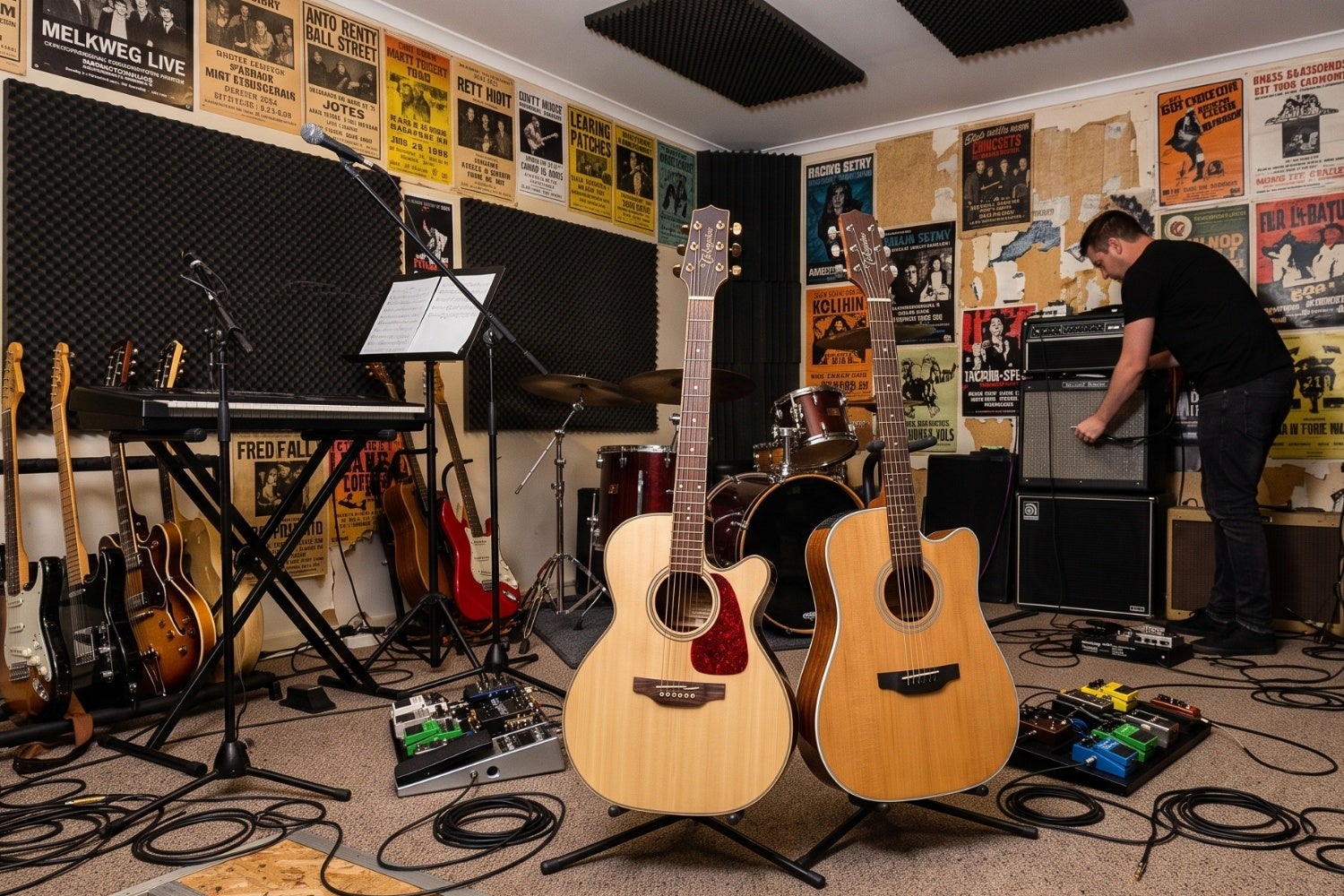
Dreadnought or jumbo: if you’re looking for a large acoustic guitar, you’ll end up choosing between these two sooner or later. Both are big and loud, with a hefty helping of bass. Yet the choice is less tricky than it seems: the dreadnought is the versatile standard, while the jumbo is a size bigger still and asks more of your body. Your arms and your ears will decide together which one it’ll be.
It all started with a Hawaiian order
The dreadnought is a Martin invention, but at first it didn’t carry the Martin name. The first examples were built to order for music retailer Oliver Ditson, where store manager Harry L. Hunt was keen on the idea of an extra-large guitar. The template was a guitar built in early 1916 for the Hawaiian virtuoso Mekia Kealakai: a sort of inflated 000 with a narrow waist.
That Hawaiian heritage is reflected in the setup. The Ditson Style 111 came with a standard nut plus a nut extender, an attachment that raises the strings so you can glide over them with a slide. The shape also differed from what you know today: the shoulders sloped more steeply and were more rounded.
It wasn’t a hit. Of the 571 Ditson guitars made between 1916 and 1921, only 14 were dreadnought-sized. Hunt asked Martin to build more in 1923, but by 1930 only 18 examples of the Style 111 had been made. Martin itself was long convinced that anything bigger than a 000 would produce too much bass (ironically, that low end is now exactly what the dreadnought is known for).
» View all dreadnought guitars
» View all jumbo guitars

From problem child to standard model
It wasn’t until 1931 that Martin entered the dreadnought in its books under its own name. In the logbooks from that spring, a D-21 appears first, followed by the D-1 and D-2, which were later renamed the D-18 and D-28. Demand came from radio performers who wanted bigger, louder instruments. Even then, though, things were slow to take off. A bit like a sourdough starter: for days nothing seems to happen, and then suddenly it starts bubbling.
1934 brought the most important change. The first dreadnoughts had 12 frets clear of the body; after that, it became 14. Those two extra frets give you more room to play higher up the neck. Martin couldn’t simply slide the neck further out to achieve this, because the bridge would then no longer sit in the acoustically correct position.
The solution lay in the body. Martin effectively squashed the upper half: the curves near the neck were shortened and straightened, so that the neck joined the body at the 14th fret. This gave rise to the square shoulders that replaced the earlier sloped shoulders. With that shape, the dreadnought gained the silhouette it became famous for.
Today the dreadnought is the most common body shape. Walk into any guitar shop and I’d bet that most of the acoustic guitars on the wall are this model. It has a pronounced low end and feels at home in a wide range of genres. Gibson builds dreadnoughts too, with the J-45 (sloped shoulders) and the Hummingbird as the best-known examples.
» View all dreadnought guitars
The jumbo: a size bigger still
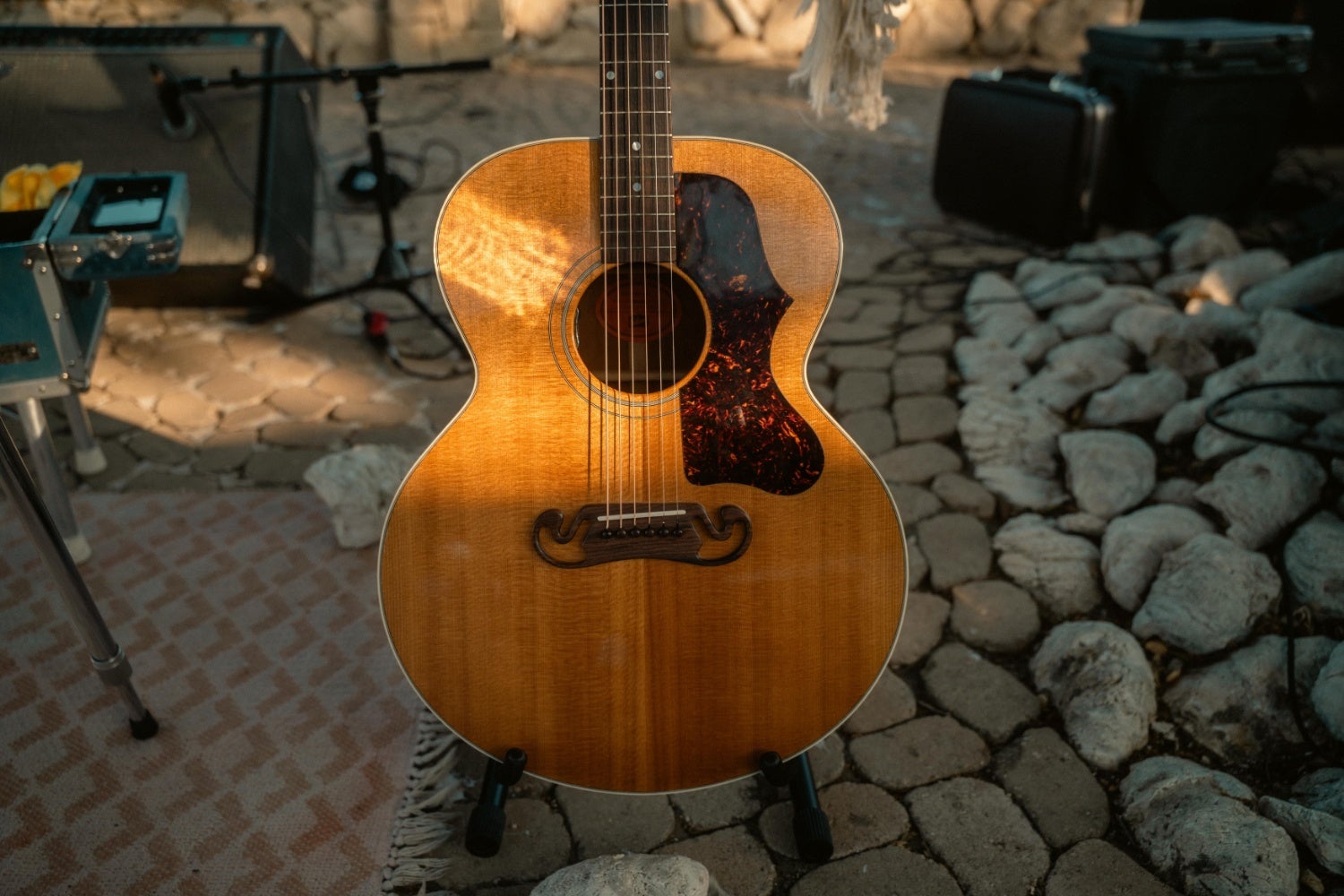
If the dreadnought still feels too modest, the jumbo is where you’ll end up. The jumbo against which all others are measured is the Gibson SJ-200, also known as the J-200 or the ‘King of the Flat-Tops’. With a 17-inch lower bout, around 43 centimetres, it really is a size up from the dreadnought. The most commonly told story is that it began life in 1937 as a special order for Ray Whitley, although its precise origins are still up for debate.
You can hear those extra centimetres. A jumbo is known for a big, loud sound with plenty of bass and projection, along the lines of the dreadnought but taken a step further. Heard someone claim that a jumbo always sounds warmer, or brighter? Take that with a pinch of salt, because tonewood and construction matter at least as much. And think about transport: a jumbo is like an extra-large suitcase. It holds a lot, but you’ve also got to lug it around.
» View all acoustic guitar cases and bags
» View all jumbo guitars

Which big guitar is right for you?
Try this simple test in the shop. Pick up a dreadnought first, then a jumbo, and play the same song on both for a few minutes. Pay particular attention to how far your strumming arm has to reach around the lower bout. If it still feels natural after a few songs, the size isn’t a problem for you. If you notice yourself compensating with your shoulder, you already know pretty much all you need to.
That might sound obvious, but a guitar that doesn’t feel comfortable is one you’ll pick up less often. And while you can still tweak the sound with different strings or a different playing technique, the size of the body will never change.
If you’re after one guitar that can handle just about anything, the dreadnought is the logical choice. It sounds full, has plenty of bass and happily fits into a wide range of styles. There’s a reason you’ll find it on every shop wall.
Would you rather have maximum volume and a deep low end, and doesn’t the extra size put you off? Then the jumbo is your guitar. My personal advice: let your ears have the final say, but only after your arms have cast their vote.
» View all acoustic guitars
» How to hold a guitar – Posture for playing standing up and sitting down






No comments yet...