
Guitar slides: should you choose glass, steel or brass?
Published on Monday 12 October 2026
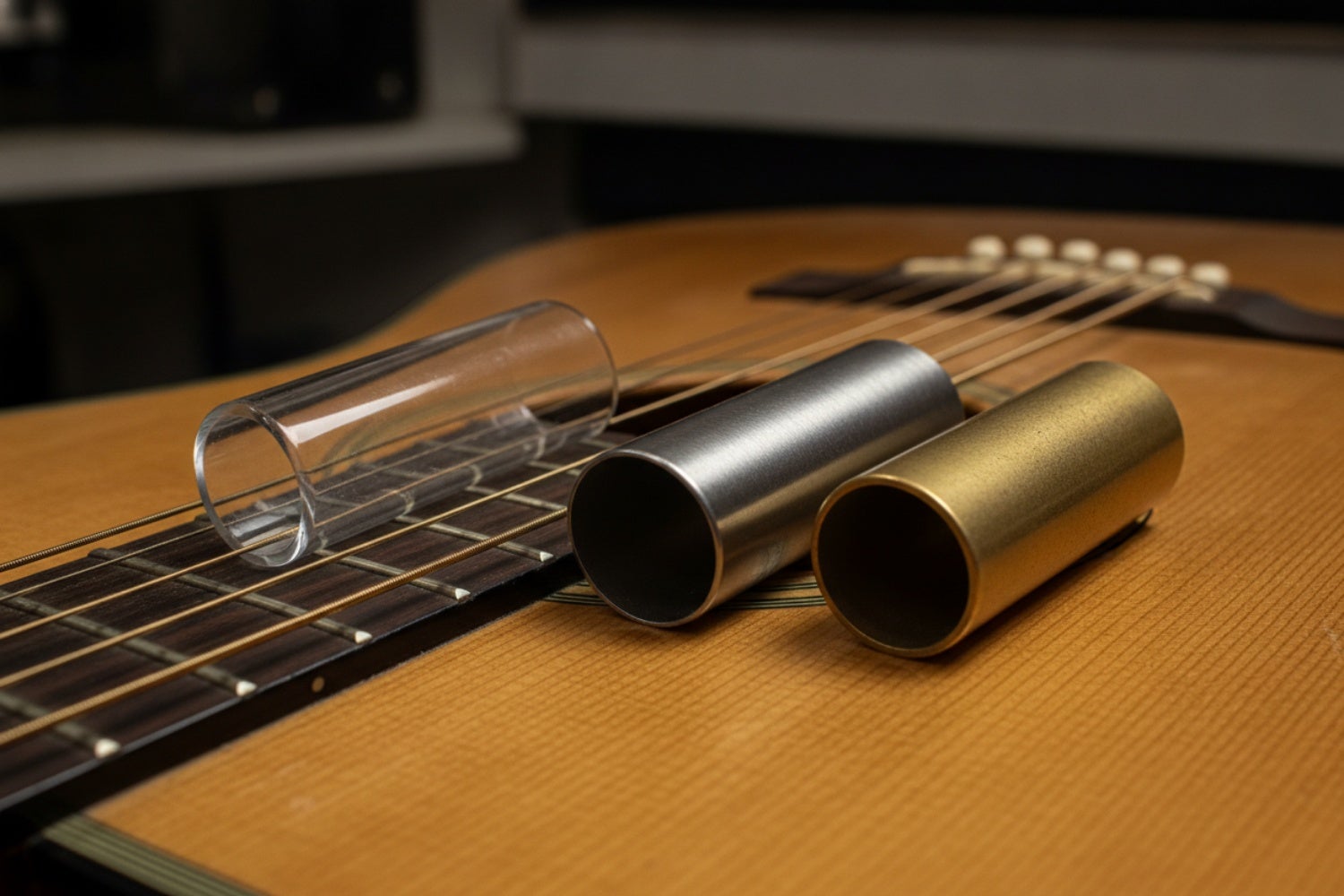
A guitar slide might look like a simple tube, but its material says a lot about how it behaves. Glass, steel and brass differ mainly in weight and character. How heavily does it sit on the strings, how bright does it sound and how quickly can you move it? Choose the slide that suits your strings and your playing style, not the material with the prettiest shine.
Glass: light and wonderfully agile
Most slides are made of glass or metal. Ceramic is a lesser-known alternative. Glass is usually the lightest of the bunch, although that’s not a hard and fast rule: a thick-walled glass slide can turn out heavier than a thin-walled steel one. As a rule, a glass slide sits on your little finger or ring finger without tiring your hand, and you can glide effortlessly from one position to the next.
That’s why blues guitarist Roy Rogers reaches for a light, short glass slide for fast riffs. He finds a larger one too cumbersome for that. If you play lots of short licks and quick position changes, that low weight will serve you well.
There are two caveats, though. Glass can break, and plenty of guitarists have seen their slide lying in pieces on the floor. On top of that, a glass slide needs a bit of mass. A very thin one can easily sound weedy.

Steel: bright, cutting and unbreakable
According to Roy Rogers, metal slides have more bite, and stainless steel really lets you hear it. It sounds brighter than glass, sometimes even bordering on shrill. In a busy band mix, that might be exactly what you’re after.
The big practical advantage is that steel doesn’t break. As a teenager, Sonny Landreth even sawed a piece off a motorbike handlebar to use as a slide. That piece of metal is longer and heavier than glass, and according to him it gives a bigger sound and a wider vibrato.
Later, during his acoustic set, Landreth noticed that his notes weren’t cutting through enough. He went back to metal, dug out the old motorbike handlebar and, by his own account, has played with it ever since. If you want notes that rise above the rest when playing acoustic, metal is well worth a try.

Brass: heavy, full and slightly mellower
Brass is heavier than glass, often considerably so, although shape and size obviously play a part too. You can hear that extra mass in a fuller sound. Tonally, brass sits below steel: it’s slightly mellower, with fewer sharp edges.
A heavy slide like this works best on an instrument that can push back. On a resonator with heavy strings, brass is no problem at all. On light strings with a low action, however, it gets tricky, because the slide can easily press the strings down onto the frets. According to Rogers, heavier strings also produce a stronger tone, so a heavy slide and heavy strings make a logical pairing.
» View all resonator guitars
» View all resonator strings

How to find the right slide for you
Grab a glass slide and a metal slide and play the same lick with both on your own guitar. Play it slowly with plenty of vibrato first, then up to speed. Pay attention to how the slide feels on your finger and which sound you like best.
That test will tell you more than any comparison chart, because choosing a material largely comes down to comfort and personal taste. Rogers himself also advises simply trying a few out. What fits one player like a glove feels like a lump of lead to another.
Pay attention to the fit as well. Most players wear the slide on their little finger or ring finger. It should stay firmly in place without pinching. And whatever you choose, muting is part of the deal. When playing single notes, mute the other strings with your picking hand.
In addition, rest your index finger on the strings behind the slide. When you play a note with a slide, the string vibrates on both sides of the slide. Without a finger behind it, the section of string between the slide and the nut will ring out dissonantly, resulting in a messy, rattling sound. Your index finger mutes exactly that section, so only the note you want to hear rings out.
» Which guitar slide is best for me?
» Open tunings for guitar: give them a try!





No comments yet...