
Who was Les Paul?
Published on Thursday 14 May 2026
In this blog, we’re not answering the question “what is a Les Paul?”, but who was Les Paul? Guitarist and inventor Les Paul (1915 – 2009) made an important contribution to the development of the electric guitar (the famous Gibson Les Paul) and to popular music, both musically and technically.

Inventor and musician
Pretty much anyone involved in making pop music or jazz knows the Gibson Les Paul, the guitar model that Gibson Guitar Corporation linked to Les Paul’s name. Les Paul is sometimes called the inventor of the electric guitar. But it’s a bit more nuanced than that, because others were working on it at the time too. Either way, Les Paul undoubtedly made a major contribution to the development of the electric guitar. And that contribution wasn’t purely technical, because Les Paul is also seen as one of the most influential guitarists of the last century. As guitar phenomenon Joe Satriani put it: “Les Paul is the origin of the guitar hero.” And guitarist Jeff Beck said: “I’ve copied more licks from Les Paul than I care to admit.” Les Paul didn’t just help shape popular music as a guitar pioneer. He was also a songwriter, and he’s regarded as the inventor of multitrack recording and overdubbing. Les Paul continued making music and performing well into old age. For example, he played weekly at New York jazz club Iridium until June 2009. Les Paul received multiple musical honours. In 2009, he died from complications of pneumonia.
From country to jazz
Les Paul was born on 9 June 1915 as Lester William Polsfuss, in Waukesha (Wisconsin, USA). He later came up with his stage name Les Paul himself (derived from his real name). At the age of eight, he learnt to play the harmonica. After trying the banjo briefly, he switched to guitar. Even at a young age, he was a semi-professional country musician. In 1934, he moved to Chicago. There, he developed as a jazz guitarist, strongly influenced by jazz guitar legend Django Reinhardt. In 1939 he went to New York. Shortly afterwards, he built his first electric guitar, which we’ll get to in a moment. Meanwhile, he continued developing as a guitarist and accompanied artists including Nat King Cole, Bing Crosby and The Andrews Sisters. In 1948, he suffered a near-fatal car accident, in which his right elbow was severely damaged. The doctors could only save it by fusing it completely. At Les Paul’s request, his elbow was fused at an angle of around 90 degrees, so he could keep playing guitar. In 1945, Les Paul met country & western singer Colleen Summers. They decided to form a duo (and later also got married), with Colleen taking the stage name Mary Ford. The duo scored hits like How High the Moon, Bye Bye Blues and Vaya Con Dios. In the 1950s, they had their own TV show.

Electric guitar
So what contribution did Les Paul make to the development of the electric guitar? For that, we first need to go back to the 1920s. At the time, there was a growing need to make the guitar—still entirely acoustic back then—sound louder. For that reason, guitars got bigger and were fitted with steel strings. But eventually, there was a limit. The idea emerged to capture the sound of the strings using built-in magnetic elements (so-called pickups) and to amplify that sound electrically. In 1931, guitar maker Rickenbacker was the first to produce such a guitar in a way that could be manufactured on a factory scale. But because the guitars had a hollow resonant body (hollow body), there was a technical limitation on how far you could amplify them. Hollow guitars are highly sensitive to feedback. So people started experimenting with guitars built with a solid body (solid body). Les Paul was one of the people working on that. Incidentally, this experimenting almost proved fatal: in 1940, he was electrocuted so badly that he needed two years to recover. But in the end, he was among the first to build a solid body guitar. That was in the early 1940s. He took it to guitar manufacturer Gibson several times, but they showed no interest. Les Paul’s solid body guitar was in danger of fading into obscurity.
The rise of Fender
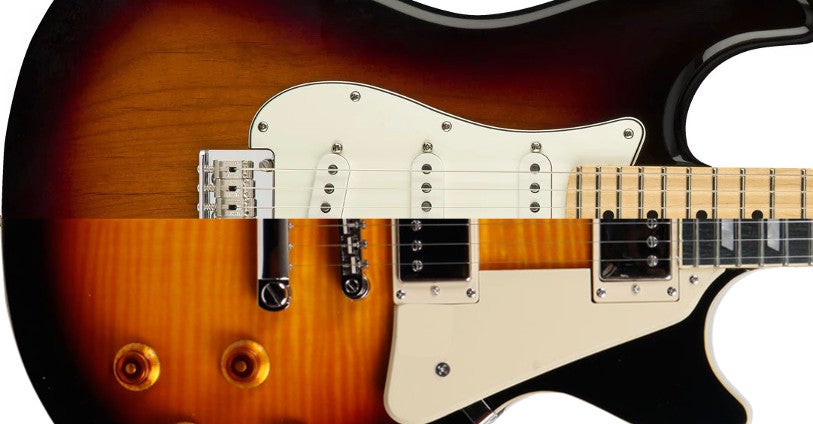
In the early 1950s, guitar maker Leo Fender emerged as a sort of Henry Ford. Ford made history by being the first to successfully mass-produce the car. Leo Fender did the same for the solid body electric guitar. He designed a production process that enabled large numbers of electric guitars to be made at the lowest possible cost. That was the Fender Telecaster. This made the electric guitar affordable for more people—especially young players. On top of that, the Telecaster’s cutting sound proved a great fit for blues, R&B, country and rock ’n’ roll. More and more musicians discovered the Fender Telecaster. That made Gibson realise they needed to bring out a solid body guitar too. So they got back in touch with Les Paul, and together they developed Gibson’s first solid body electric guitar. Les Paul’s name was attached to the instrument, and that’s how the first Gibson Les Paul came onto the market. This guitar is still made today, and over the years Gibson has expanded the Les Paul series with multiple models. Other well-known electric guitars from Gibson include the SG, Firebird, ES 335 and Explorer. The popular brand Epiphone—acquired by Gibson back in 1957—makes (very good) budget versions of various Gibson models.
Blues rock and Eric Clapton
Still, the Gibson Les Paul didn’t do all that well at first. By the late 1950s, Gibson even considered stopping production. But in the early 1960s, the Gibson Les Paul was ‘rediscovered’, particularly by British blues artists. Blues rock took off, and the Gibson Les Paul turned out to be an excellent match for the style—provided you turned the volume knob all the way up, because that’s what gave the guitar the gritty edge these artists were looking for. When Eric Clapton, among others, switched to the Gibson Les Paul, the rescue of this guitar model was effectively sealed. After Eric Clapton, other famous guitarists embraced the Gibson Les Paul. Think Carlos Santana, Jan Akkerman, Neil Young, Jimmy Page (Led Zeppelin), Slash (Guns ‘n’ Roses), Keith Richard (Rolling Stones), Billy Gibbon (ZZ Top) and Gary Moore.
Les Paul kept making music throughout his life. In 2006, he won two Grammy Awards for his album Les Paul & Friends: American Made World Played. In 2008, he received the American Music Masters Award during a major concert held in his honour.
No comments yet...