
Choosing a saxophone mouthpiece: tip opening, chamber, material and when to upgrade
Published on Friday 16 October 2026

A new saxophone mouthpiece is the cheapest way to become a different saxophonist, and also the easiest way to throw money away. Tip opening, chamber and baffle each do something different to your sound, and the material does less than you might think.
What the tip opening does to your playing
The tip opening is the distance between the reed and the tip of the mouthpiece. Tiny as that gap is, it largely determines how the mouthpiece feels. It controls how much air you can blow into the chamber and how far the reed vibrates. A small opening gets a note sounding quickly, while a large opening demands more control and gives you more room to bend your tone and let it grow.
I like to compare it to a tap. A thin trickle is easy to control, but a tap turned on full splashes everywhere until you learn to regulate it. That’s why the mouthpiece supplied with a beginner sax often has a modest opening, marked with a low number such as a 4. It lets your tone speak while your embouchure is still developing.
The tip opening is linked to the facing: the continuous curve from the point where the reed leaves the table to the tip rail. That curve differs from brand to brand and determines the resistance and how the mouthpiece responds across the registers. It also determines which reed suits it: a larger opening generally calls for a softer reed, a smaller one for a harder reed. So if you switch mouthpieces, check whether your reeds are still a good match.
» Browse all saxophone reeds
» Browse all saxophone mouthpieces
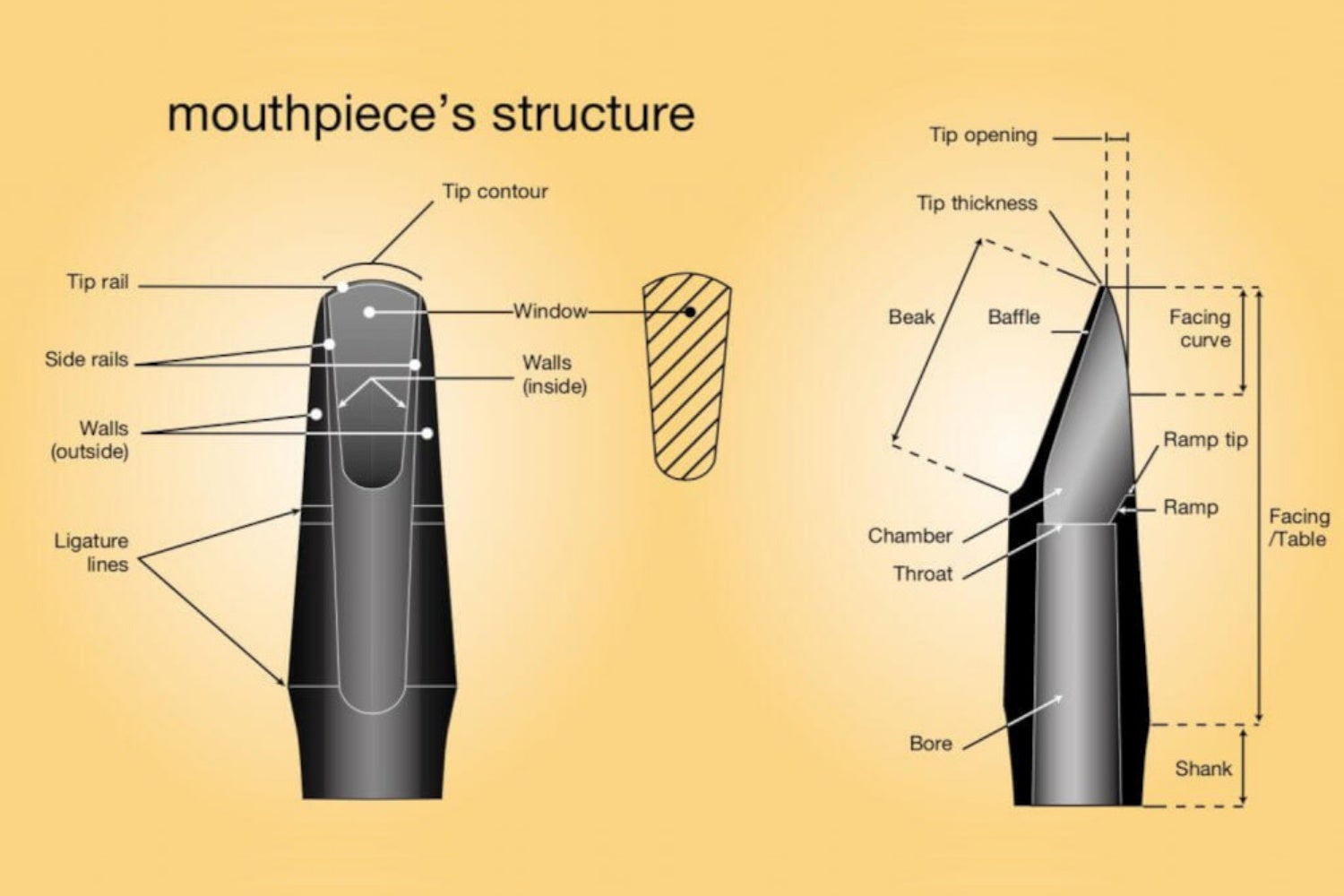
The parts of a saxophone mouthpiece (source: Vandoren Paris – vandoren.fr/en/mouthpieces-technical-elements)
Chamber and baffle: where brightness comes from
The inside of the mouthpiece mainly determines how bright, loud and cutting you sound. Two elements matter most here. The baffle is the wall directly behind the tip, the first thing your air hits, and the chamber is the cavity behind it, before the air travels into the neck of your sax. In a sense, you only really hear how those two are shaped from the back of the hall.
The rule of thumb: a high baffle and a small chamber make the sound brighter and usually louder, with more projection. A low baffle and a large chamber make it darker and rounder, but it doesn’t carry as far. It’s the difference between talking in a tiled bathroom and in a living room full of curtains and cushions: the same voice, a completely different result.
You can estimate the chamber size yourself. Look inside the mouthpiece: if the cavity in the middle is wider than the bore (the part that slides over the cork of the neck), you have a large chamber. If they’re the same width, it’s a medium chamber. Does jazz always have to come from a large chamber and pop from a high baffle? I don’t think so. But it does explain why one mouthpiece sounds ‘vintage’ and another sounds ‘modern’.
Ebonite or metal: less difference than the shine suggests
Ebonite, or hard rubber, is latex from a tree mixed with sulphur. Metal gleams, feels heavier and tends to be associated with rock and funk. That image is only half right. Brightness and volume come from the baffle, the chamber and the side walls, not from the material around them. So there are plenty of dark, mellow metal mouthpieces and bright, loud ebonite ones.
The real difference is in your mouth. Metal is denser and heavier, so a metal mouthpiece can be made thinner and smaller. An ebonite mouthpiece is almost always thicker and requires you to open your mouth wider. Some players find that a full, stable grip, while others find it too big a mouthful. That comfort, far more than the sound, is the reason to choose one over the other. And you can only feel it by playing.
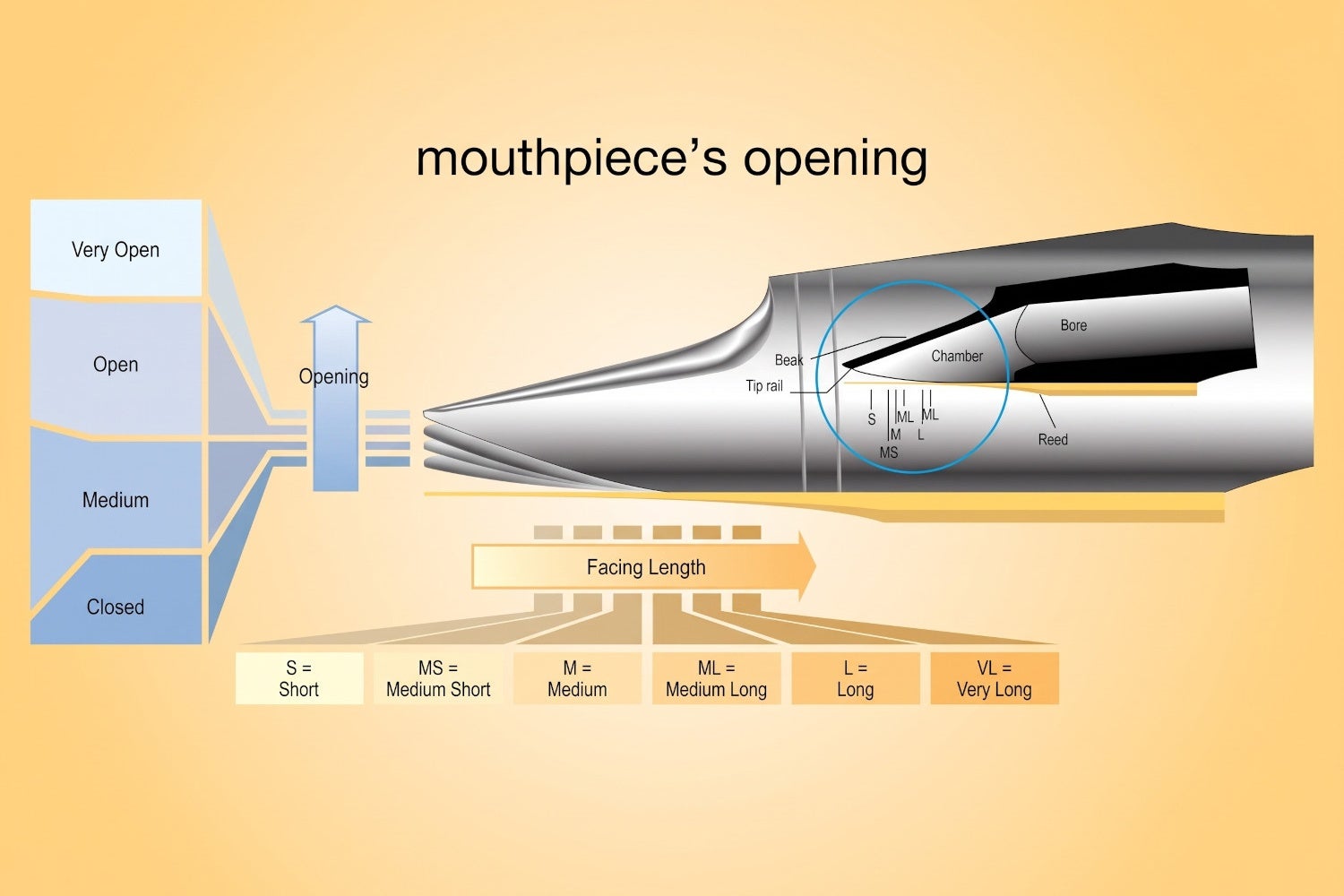
The tip opening of a saxophone mouthpiece (source: Vandoren Paris – vandoren.fr/en/mouthpieces-technical-elements)
Caring for your mouthpiece and how long it lasts
Ebonite is soft enough to be refaced by a mouthpiece maker, which is exactly why it also wears and warps faster than metal. A metal mouthpiece lasts longer and is less easily damaged. Both are vulnerable at the tip and the rails: one knock against a music stand and the facing is no longer what it was. That’s why a cap is no luxury.
Hard rubber has another quirk: it doesn’t like sun or heat. Leave it on the windowsill or rinse it in hot water and it turns green or brown, starts to smell and can warp. You may know that sulphurous whiff of an old mouthpiece. So clean ebonite with cold water and mild soap, and store it in the case, out of the light.
When should you move on from your first mouthpiece?
You rarely get a well-founded answer to that question, and I’m not going to put a specific number of years on it either. The mouthpiece that came with your sax is designed to get you playing without a struggle. As long as your tone is still wobbly and you’re learning something new about your breath support in every lesson, a different mouthpiece won’t solve anything. You’ll just be moving the problem elsewhere.
You’ll recognise the tipping point by a different kind of complaint. Not ‘I can’t do it’, but ‘it doesn’t sound the way I want’. Perhaps you hear on a recording that you sound smaller than you thought, or you’re after a sound this mouthpiece simply can’t produce. That’s the moment to start trying alternatives, ideally with your teacher alongside you.
A move up in tip opening should be a step, not a leap. If you go from a small opening straight to the largest model, you’ll end up with a mouthpiece that needs more air than you have. Go just one size up instead and give it a few weeks.

How to try out mouthpieces
In the end, you don’t buy a mouthpiece based on a description. You have to experience it. If you’re trying out a different mouthpiece at someone else’s, use your own sax, ligature and reeds, so that only the mouthpiece changes. Play the same things on each mouthpiece: a few long notes, something in the low register, something high, and a melody you know by heart.
Don’t rely on your own ears alone, either. Because of bone conduction, your tone sounds different in your head than it does to the audience, and a smaller mouth opening makes you feel you’re playing brighter and louder than the room actually hears. Record your playing with a good-quality audio recorder (not your phone) from a few metres away, or ask someone with a good ear to listen in.
And… don’t choose on first impressions. The mouthpiece that feels great straight away is often the one closest to your old one.
» Browse all wind instrument care products
 Want to turn LPs into MP3s? Here’s How to Digitise Your Vinyl
 How to Breathe: For Vocalists & Musicians
 How to Tune Up & Play a Guitarlele
 Everything You Need to Know About Making a Podcast
 Setting Up the Band with a PA System? Here’s What You Need to Know
 Playing Keys in a Band: What You Need to Know
No comments yet...