
Is the accordion hard to learn? Here’s how to get started
Published on Friday 20 November 2026

Learning to play the accordion is harder than it looks at a party, but it’s far from impossible: your left hand works by feel, the bellows decide whether you get any sound at all, and both have to work together with your right hand. Accept that and practise step by step, and you’ll be playing a little tune sooner than you think. Pianists have a head start, though it’s smaller than they’d like.
What makes the accordion tricky: bellows, basses and coordination
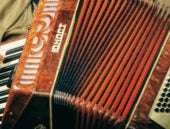
The bellows are the first thing to go wrong. On a piano, you strike harder and the note sounds louder. On an accordion, a key simply opens a valve; how hard you press makes no difference to the volume. Pull or push the bellows faster, and it gets louder. That means you can run out of road halfway through a musical phrase because the bellows are fully open or closed. The bellows are your breath, and you need to learn to plan them.
Then there’s the left hand. It sits behind a strap and can’t see the buttons, so you play blind, like a typist who never looks at the keyboard. That’s why the C button has a small dimple, and often the E and A flat as well. The buttons are arranged in fifths, so the first, fourth and fifth degrees of a key sit next to each other, and the pattern is the same everywhere: what you learn around C also works around G, for example.
The real stumbling block is combining both hands with the bellows. The right hand on its own is fine, and the left hand on its own works too after a bit of puzzling. Put them together, with the bellows having to move in the right direction at the same time, and everything falls apart. That happens to every beginner accordionist. Repetition sorts it out!

How long does it take, and do you need to read music?
How long it takes depends on what you call ‘playing’. A simple melody with a few basses underneath isn’t years of work. Playing a little waltz with an alternating bass fluently takes longer, and if you’re aiming for the repertoire of a skilled musette player, you’ll be kept busy for a lifetime. Nobody can promise a fixed timeline with this instrument. One thing is certain, though: short, frequent practice beats hours at a time every now and then.
You don’t have to read music (although it’s a useful extra). Playing by ear is really part and parcel of the accordion; folk music, where you often see this instrument, was largely passed down that way. Joe Derrane, honoured as a National Heritage Fellow in 2004, was given a second-hand accordion at the age of ten and never needed a conservatoire. Still, sheet music helps: tutor books are full of it, and it makes finding new pieces quicker. If need be, start with just the chord symbols above the melody; behind the rows of single bass notes are buttons that play a ready-made three-note chord, in major, minor, seventh or diminished.

Coming from the piano? A head start on the right, back to square one on the left
Pianists will find a familiar sight on a piano accordion: black and white keys in the same order, just a little narrower. If you’ve played the piano for years, a few scales are enough to get a feel for the distances. You’ll find the melodies straight away, and you get the keys and reading a melody line thrown in for free.
But the head start ends with the right hand. On the piano, your left hand knows the same keyboard as your right; on the accordion, it’s given a block of buttons it can’t see. The instrument hangs sideways against your body, and the bellows are a limb no pianist has ever had to think about. For the first few weeks, play as if you’ve never seen a key before and start with the left hand: that’s the side that needs to catch up.
» The accordion: more popular than you think

Your first accordion: keys or buttons, and how many basses?
On the right-hand side, you choose between a piano keyboard and buttons. The piano accordion is the most common and the logical step for pianists. Button accordions come in two flavours: diatonic, where a button gives a different note on the push than on the pull (the melodeon), and chromatic, with a B or C system. These sound the same; only the fingering differs. You can recognise the B system by three white buttons per diagonal row, and the C system by two.
On the left-hand side, the number of basses is what counts. 120 basses is the standard for all keys, but an instrument like that is pretty heavy. Models with 96, 72 or 32 basses are lighter and plenty for a beginner; at first, your left hand only uses a handful of buttons around the C anyway. Weight is no minor detail: an accordion that digs into your left shoulder after every fifteen minutes of practice will end up staying in its case before long. Adjust the shoulder straps properly and set the bass strap (using the adjustment wheel) so that it sits snugly against your wrist.
Digital accordions measure bellows pressure with a sensor, let you adjust the bellows resistance and come with orchestral sounds on board. Great fun, but you still have to learn the bellows, the blind basses and the coordination. Nobody has ever been able to do that for someone else.




No comments yet...