
Soprano, alto, tenor or baritone? How to find your voice type and range
Published on Thursday 29 October 2026

You can’t work out your voice type from a single high note and a single low note. Measuring your range with a keyboard is a great start, but your vocal colour and the part of your range where your voice feels at home count for at least as much. And the final word often belongs to someone who hears you sing, not to you.
Roughly how far each voice type reaches
Almost every choir starts with the same four main sections: soprano, alto, tenor and bass.
• Roughly speaking, a soprano sings from middle C up to the C two octaves higher.
• An alto from the F below that up to the F two octaves higher.
• A tenor from the C an octave below middle C up to the C above it.
• A bass from low E up to the E just above middle C.
So that’s roughly two octaves per voice type, neatly staggered in relation to one another.
Between alto and soprano sits the mezzo-soprano, and between tenor and bass sits the baritone, giving you the six most common voice types in the classical tradition. A mezzo sits a few notes below the soprano, a baritone a few notes above the bass, and as it happens, these two are actually the most common voices of all. But bear in mind: range isn’t everything. More on that shortly.
Some choirs divide things up even further. An eight-part choir often splits the four main parts into soprano 1 and 2, alto 1 and 2, tenor 1 and 2, and bass 1 and 2. Our conductor once moved someone from tenor 2 to bass 1 halfway through a rehearsal, purely on the basis of their sound. That says nothing about how well you sing, only about where you sound best.
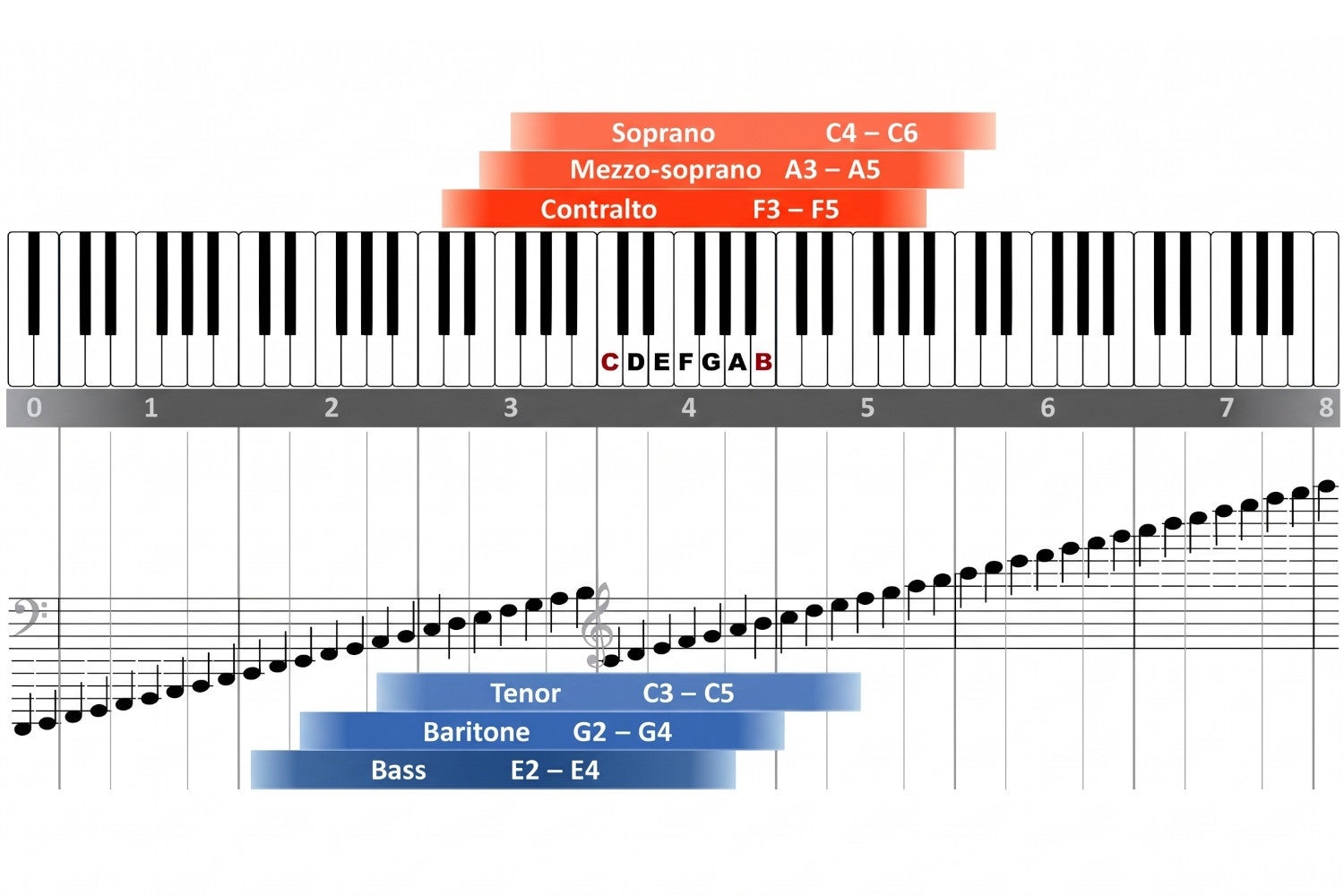
Based on Dimash’s range of voice-2022 by Tösö8 (Wikimedia Commons), used under CC BY-SA 4.0. Adapted by Bax Music, available under CC BY-SA 4.0.
Measuring your range with a keyboard or tuner
Grab a keyboard, or a tuner or app that shows which note you’re singing. First, find a note you can hit without thinking, roughly your speaking voice with a bit of air behind it. From there, work your way down key by key until the note turns into a grumble or disappears altogether. Write down the last clean note. Then do the same going up, until your voice starts to strain or crack. Those two notes make up your range.
A tuner comes in handy if you don’t have a keyboard at home, or if you’re not sure whether you’re really hitting the note you’re playing. You sing, the display shows which note comes out, job done. Tenors and basses, take note: be careful about what you count. Do you switch to falsetto on the highest notes? Then your range will suddenly look much bigger than it really is. Only your normal, full voice counts.
You might also want to jot down the date. My range on a Monday morning after a weekend with little sleep is a very different range from the one I have on a Wednesday evening after a good warm-up. On top of that, it shifts with technique and age. What you measure is a snapshot, not a final verdict.
Range is not the same as vocal colour
This is where people often go wrong. Two singers can hit exactly the same lowest and highest notes and still have different voice types. One sounds dark and heavy in the middle, the other light and bright. That’s vocal colour, or timbre, and you can already hear it when someone speaks an ordinary sentence.
Then there’s your tessitura: the part of your range where your voice feels at home and doesn’t have to work hard. Think of it like a house. You can get up into the loft, but you don’t live there. A baritone can certainly reach a high note, he just doesn’t want to hang around up there for an entire song. And finally, the point where your voice flips from one register to another also tells you something about where you belong. That point isn’t a fixed wall in your throat; it shifts as your technique develops.
Research into opera voices shows that the brilliance in a voice, the ‘ring’ that lets a singer carry over an orchestra, sits slightly higher in the frequency spectrum for higher voice types than for lower ones. You can hear that difference yourself, too: a baritone sounds rounder, a tenor lighter, even on the same note. So the six familiar categories – soprano, mezzo, alto, tenor, baritone and bass – describe sound just as much as pitch.
And those categories are flexible. They come from opera, where the German Fach system matches singers to roles. The average choir even trims it down to four parts, and in pop music hardly anyone pays attention to them, except perhaps when choosing repertoire. The categories overlap, and there’s no single system that everyone uses. If you fall somewhere in between, there’s nothing strange about that. You could, for example, be a high or low baritone.

Let someone else have a listen
In my first choir, I sang with the sopranos, simply because I could manage it and I quite liked the challenge of those high notes. It was only at my next choir that the conductor immediately told me my vocal colour and comfortable range meant I belonged with the altos. That’s when I realised: just because you can do something doesn’t mean it suits you. I hadn’t been able to hear that myself at first. (Conversely, there are also people who are a little afraid of the high notes and end up in a section that’s too low for them as a result. It’s a matter of getting used to it and developing your voice.)
So here’s my advice: by all means measure your range, as it gives you something to go on. But let a singing teacher or choir conductor have the final word. They can hear your vocal colour, see where you tense up, and know that a beginner’s voice often reveals less than it’s actually capable of.

Changing the key of a song to suit your voice
If a song sits just a touch too high, there’s no need to give up on it. Simply shift it down. Most keyboards have a transpose button for exactly that: each step moves the whole song by a semitone, without you having to learn different keys. If you play guitar, a capo does the same thing upwards, and to go down you use different chord shapes. Singing along to a recording? Most music software can shift the pitch while keeping the tempo the same.
The rule of thumb: find the highest note of the melody and put it where you can still hit it nicely, not where you can only just reach it. Of course, ‘nicely’ is a subjective term, and it’s important to stay objective. A better question to ask is: ‘Does my voice suddenly start to sound strained on that high note?’ Then check that the lowest note doesn’t end up uncomfortably low. But what if both ends sound unconvincing? Then you’ve got nowhere left to go, and the song is simply too wide for your voice, at least for now.






No comments yet...