
Ukulele: What Kind of Instrument Is It?
Published on Thursday 14 May 2026
The ukulele (spelled ‘ukulele’ in English) is a small, four-string musical instrument fitted with nylon strings. You’ll recognise it by its bright, cheerful sound. Most of the time, you play chords on it—and those are relatively easy to learn thanks to the ukulele’s compact size and the small number of strings. Originally, you’d mainly come across ukuleles in folk music, but these days they also regularly show up in pop bands and as an accompaniment instrument for singers. In this article, you’ll read about ukulele history, tuning, types and much more.

Where does the ukulele come from?
The ukulele isn’t actually that old, but almost everyone knows the instrument comes from Hawaii. Photos of Hawaiian dresses and shirts featuring a ukulele are instantly recognisable. Exactly who invented the ukulele isn’t known, though. In any case, the ukulele was developed around 1880 by Portuguese immigrants who had come to Hawaii to work in the sugar cane fields. Portuguese woodworkers from Madeira (Manuel Nunes, José do Espírito Santo and Augusto Dias) based the new string instrument on the braguinha or machete—guitar-like string instruments from Madeira. King Kalākaua of Hawaii thought it was a fantastic instrument, and thanks to him the ukulele became a prominent instrument in Hawaiian folklore. Some people claim that ukulele means “jumping flea”, but the most likely explanation is “gift that arrived here”. In Hawaiian, uku means “gift” and lele is the word for “to arrive”. That’s the explanation given by Hawaii’s last monarch, Queen Liliʻuokalani, for the name ukulele. When Hawaii was annexed by the United States, the ukulele made the trip to America. At the Panama Pacific International Exposition in San Francisco in the autumn of 1915, the ukulele suddenly became hugely popular after a performance by Hawaiian musicians. In the 1920s, more than 100,000 were sold, mainly by guitar maker Martin. The ukulele turned out to be an easy instrument to play, and it was easy to take with you. After the Second World War, the instrument saw another revival, peaking in the 1950s at 15,000 ukuleles. After a period of absence, the ukulele is now back again thanks to Over the Rainbow as played by Hawaiian musician Israel Kamakawiwoʻole, and also thanks to Train’s Hey, Soul Sister.
Ukulele tuning
The most common tuning for the soprano and concert ukulele is C (GCEA). It’s recommended to learn ukulele using this tuning, because many modern learning methods and chord books are based on it. However, you’ll also occasionally come across D tuning (ADF#B), which is essentially the same but a whole tone higher. This makes the ukulele sound a bit brighter, which can be a reason to use this tuning in pop music. Want to know more about tuning a ukulele? Read our blog on this topic. The two tunings mentioned are also related to the guitar: the intervals are the same as the highest four strings of the guitar, but with the first string tuned an octave higher. Guitarists will also notice that the chord shapes have a lot in common. Just like with a guitar, different tunings are possible, including open tunings. Guitarists who want to try the ukulele can read our article Ukulele for guitarists.
Types of ukulele
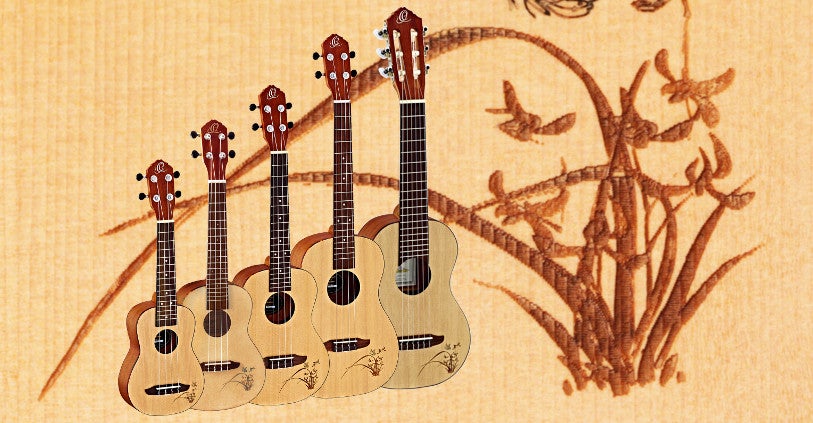
We generally distinguish roughly six types of ukulele: sopranino, soprano, concert, tenor, baritone and bass. The soprano is the original ukulele. The soprano has 12 frets, the concert and tenor have 15 frets, while the baritone has 19 frets. The larger the ukulele, the less of that original ukulele sound you get, but the sustain (how long the strings ring out) is greater. On the other hand, a smaller ukulele has more attack. In pop music, the soprano ukulele often adds the most character, and you can even play lovely blues on it. Other variants include the banjo ukulele, guitar ukulele, resonator, electric ukulele (only usable amplified) and electro-acoustic versions (standard acoustic ukuleles that can be amplified). More about the different ukuleles in our article on the subject! The ukulele mainly comes in three types of wood. Koa is the most authentic wood, since it originates from Hawaii. In addition, instruments are made from spruce and mahogany. Spruce has a brighter sound, while mahogany sounds a little darker. Koa sits somewhere in between. If you want to buy a ukulele, you don’t need to spend a fortune: for around £30 you can already get a nice instrument, for £100 you’ll have a very good model, and for roughly £300 you can get a truly excellent ukulele. For musicians who play in a band, buying an electro-acoustic ukulele is recommended, because amplifying via a microphone can quickly lead to feedback. Need help buying a ukulele? Have a look at the Ukulele Buyer’s Guide.
More possible than you think
The ukulele can do much more than many people think. Over the past years, various musicians have used the ukulele and given the once-maligned string instrument a revival. Eddie Vedder of Pearl Jam wrote a whole album: Ukulele Songs. Zach Сondon from the band Beirut uses the ukulele. Guitarist Jimmy Stafford of Train played the ukulele on the song ‘Hey, Soul Sister’. In an interview, Stafford said they originally wrote the song for guitar: “It was a nice song, but it sounded a bit like the rest of our songs. Nothing special—until someone suggested using the ukulele. I’d never played ukulele before, so I used a plectrum, but it didn’t play or sound right. Then I googled it, and it turned out you’re supposed to play the ukulele flamenco-style with your fingers. On top of that, I changed the tuning to make the sound fit the song better.” Stafford shows that the ukulele can add something unique to a song—and that even if you’ve never played the instrument, it’s easy to learn. Besides the musical greats mentioned above, George Harrison and Paul McCartney also played the ukulele—and closer to home, British entertainer George Formby is one of the best-known players of the ukulele family. So the ukulele is absolutely taken seriously by serious musicians.
Easy composing
“What many people don’t know is that the ukulele is the perfect instrument for writing a song,” says Marcel van der Zwet. He’s a talented and passionate ukulele player. “When you want to compose a song,” Marcel continues, “you quickly run into the bass notes. Those bass notes determine where you’re going. With a ukulele you have room to make music because there’s no bass. On top of that, it always sounds cheerful and good. So you have more freedom with a ukulele.” On his album, Eddie Vedder shows that the ukulele offers plenty of space to create complex melodies, which are harder to achieve on other instruments—precisely because of its open sound.
Even for punk
According to Marcel, the ukulele is suitable for every style of music—and anyone who takes the time to look online will see he’s right. “I play all sorts on it myself. Disco, rock, blues, country and Spanish music. You can use pure ukulele, but bands like Train and Beirut also use it as part of their signature band sound.” Eveline, Marcel’s girlfriend and also a ukulele player, adds: “The advantage of the ukulele is that you can play it nice and loud and high. If you tune it to D, it’s suitable for rock, but also for punk. If you have a band with guitar, bass and drums, the ukulele can add something really beautiful to the sound. It sits on top of the foundation. Ideally you should tune it in a higher D tuning. Then the ukulele sounds nicely sharp and high, and it fills out the music. There’s no other sound that’s the same as a ukulele—no competition. But then you shouldn’t go for a baritone ukulele, because that sounds too much like a guitar. With a ukulele, you can also respond better to what the band is doing, because there’s no dominant bass string.” Marcel thinks the song ‘Elephant Gun’ by Beirut is a good example of how the ukulele can be used. Throughout the whole song you can clearly hear the instrument above the accordion and trumpet without it being overly in-your-face. The ukulele carries the track.
Chords or melodies?
It’s fairly easy to play the ukulele—especially if you’re a guitarist. Eveline: “You shouldn’t play the ukulele like a guitar. A lot of guitarists are used to playing with a plectrum and strumming down a lot. With a ukulele, there are other ways to strike the strings—more with your fingers and with upstrokes.” “I often play with my index finger,” Marcel adds. “Or with my thumb. You can also do a flamenco-style roll with your whole hand. I often place the accent on the last note. Playing ukulele is a combination of playing chords and a little melody line that’s played on the last accent.” Playing ukulele with other musicians isn’t difficult either, Marcel and Eveline claim. Marcel: “Just start looking for which notes fit the music and play. It takes a bit of searching, but then you can easily solo. It fits surprisingly quickly. If you’re a musician, you can very quickly and directly add something fresh and new with a ukulele.” “You also feel challenged to do different things,” Eveline thinks. “Try translating one of your own songs to the ukulele. You might end up playing more of the essence of a song, and it can give something surprising to your own track.”
Learning to play ukulele
If you want to learn to play ukulele, a great place to start is the article Learn to play ukulele in 3 easy steps.



No comments yet...