Diction, Pronunciation and Articulation – Singers Can’t Do Without Them!
Published on Thursday 14 May 2026
Diction, pronunciation and articulation are often overlooked topics in the singing world. But that doesn’t make them any less important. In fact, they’re the foundation of good singing and a strong performance. Here’s how that works!

Everything in balance
“Singers are primarily focused on producing a beautiful sound,” says singer and vocal coach Sabine Brachthäuser. “That’s understandable and logical. At the same time, many singers don’t realise (or don’t realise enough) that good diction and articulation are important conditions for creating that beautiful sound. Their value is often underestimated.” In fact, the value of diction and articulation goes much broader and deeper than that. Sabine explains: “As a singer, you want to deliver a good performance, where all elements are in balance. A condition for a good performance is good diction. And for good diction, good articulation is a condition, combined with knowledge of pronunciation.”
Terminology
Diction, articulation and pronunciation. What do these terms actually mean? We’ll start at the end. Pronunciation is how a certain word is ‘supposed’ to be said in a certain language. There are rules for that. Of course there are dialects, and English has plenty too. But if you sing an English word, you’ll want to pronounce it the way English speakers do. More on that in a moment. Then articulation. Sabine explains: “Articulation is how we produce vowels and consonants. In other words, the technique we use to learn to pronounce words clearly and intelligibly. Our main tools for articulation are the lips, the tongue and the soft palate at the back of your throat. The jaw also plays a role.” When it comes to articulation, there’s enormous variation between people, Sabine notes. “We all speak the way we learnt from a young age from our direct surroundings. On top of that, other factors play a role. One person speaks faster than another, some people mumble, some people lisp, and so on. And when you move from speaking to singing, all sorts of things change as well.” And diction? “That’s how you sing a word or a sentence, and how you give that word or sentence meaning. With diction, you ‘fill’ a sentence with meaning.”
Diction
That last point touches on an important, distinctive aspect of singing. “Singing is the only instrument that can give meaning to music, simply because you’re (usually) singing words with meaning. No other instrument can do that. A ‘regular’ instrument can only produce sound.” Sabine is a passionate advocate of good diction. “It’s undeniably an important condition for being able to perform well. If your diction is right, then as a singer you become one with what you’re singing. The winning Eurovision Song Contest entry Amar pelos dois is a wonderful example of that. Singer Salvador Sobral was completely at one with himself, with the idea behind the lyric and with the music. His diction was so strong that many people found it the most beautiful song, even though most didn’t understand Portuguese. The song itself is beautiful, but Salvador’s interpretation made all the difference. Even if you don’t understand it, you believe every word. Diction is such a powerful tool that you can say something in a language the other person doesn’t understand—and they’ll still feel what you’re singing about.” Of course, we often sing in a language many listeners do understand. “I think lyrics are the most important thing in sung music,” Sabine argues. “That’s what I try to make clear to my students. They often think only in melody and use the lyric purely as a means to make notes. But it’s the other way round: the melody serves the lyric. ‘Know what you’re singing,’ is something I say regularly.” “So learn all your lyrics by heart and don’t sing from paper or an iPad. Automate the lyric—learn it to 150 percent. Only then can you fully focus on the stream of thought and on the music.” Balance in your performance is Sabine’s guiding principle. “That’s how you get the audience with you. ‘Performing in balance’ means the audience not only hears that you’re singing, but also understands what you’re telling them. A common mistake is putting too much emphasis on that one high note that happens to be on an unimportant word like ‘the’ or ‘and’. At that moment, the listener completely loses you for a second.”
Pronunciation
We mentioned it earlier: good pronunciation is an important part of diction. If only because good pronunciation improves intelligibility. And of course you want what you’re singing to land properly.
Singing in English
A lot of songs are in English. “If you sing in English, you don’t want to sound like a non-native speaker who’s struggling,” says Sabine. “There are plenty of examples of that. Nowadays it’s very easy to find the correct pronunciation of any English word: online, native speakers demonstrate how to pronounce words in countless places.” But there isn’t just one ‘English’, you might say. That’s true. In British English, a common reference point is Received Pronunciation (RP), sometimes called ‘BBC English’. And of course there are regional accents (Cockney, Scouse, Geordie, and so on)—but you’d need a very specific artistic reason to sing in a strong regional accent if you’re aiming for a broadly international pop sound.
American English
And American English? Yes, that exists too. But with American English there’s something interesting going on in singing, Sabine points out. “Many American singers lean more towards ‘British-style’ sung English than towards strongly rhotic spoken American English. This is mainly about the consonant ‘r’. In everyday speech, many Americans pronounce that r quite ‘thickly’, especially in more rural or strongly regional accents. But when singing, many Americans do it differently. They lean more towards a lighter, less intrusive r. Listen to Bruce Springsteen (for example ‘Born in the USA’) and Beyoncé. Both are unmistakably American, yet when singing they often choose that lighter r.” That’s not by accident, Sabine explains. “A lighter r is simply much easier to sing than a heavy, tight r. And it improves intelligibility. My advice is: choose the lighter r—even if you’re singing a song that’s originally American.” And another key tip: “If the r is at the end of a word, don’t pronounce it at all. That’s what many British singers do too.”
Articulation
Now for articulation. As explained, articulation is the technique that makes correct pronunciation possible—using the tongue, lips, soft palate and also the jaw.
‘Bodybuilder’ tongue
It’s often the tongue that gets in the way when good pronunciation doesn’t work. A classic example is a tongue-twister (more on that further down in the article). “The tongue is a strong muscle, originally meant to help with chewing and swallowing,” Sabine explains. “But it’s also a slow muscle. Think of it like an inflexible bodybuilder. The tongue is more likely to get in its own way than to help. Gross motor skills are usually fine, but when it comes to fine motor skills it often does its own thing. Especially if someone hasn’t developed fine tongue control well—for example by unconsciously copying unclear speech patterns as a child, like lisping. In those cases, speech therapy may be needed to correct it.” Before we dive into consonants, here’s a quick exercise to make your tongue more agile, which helps fine motor control. Do this: with the tip of your tongue, make a circle along the front of your teeth, as if you’re licking imaginary peanut butter off them. Do it five times anticlockwise and five times clockwise, then four each way, and so on down to one. “You’ll feel your tongue getting tired,” Sabine says. “Sometimes you feel it all the way into your throat or even your neck, because it’s all connected.”
Pronouncing m and n
There are voiceless consonants, like f, p, t, k and s, and voiced ones. “Many singers aren’t aware that m and n are voiced consonants,” says Sabine. “They don’t realise how much sound is actually on these consonants, which means they tend to ‘disappear’ while singing. That doesn’t help intelligibility.” There’s a fairly simple exercise to make you aware that m and n carry voice. Sabine explains: “Sing the following three syllables slowly on the same pitch: ‘mee-nen, meh-nen, mah-nen’. Make sure you keep producing sound constantly—also on the m and the n. The sound must not be interrupted. Then try making the m and the n louder than the vowels. Pretty tricky, but very enlightening if you can do it.”
Pronouncing l
Another voiced consonant is l. It’s trickier in singing than you might think, Sabine explains. “Many people in everyday speech produce a heavier, ‘darker’ l, especially when they’re speaking quickly or not very clearly. The downside of pronouncing things ‘thickly’ is that it costs a lot of energy. You close things off, and the sound sits too far back in your throat. That reduces intelligibility.” The advice is therefore to learn to sing with a lighter, clearer l. “That uses the tip of your tongue more. That improves the mobility of your tongue and therefore your intelligibility.” Sabine has an effective exercise to train this. Say: ‘lolly-lolly-lick’, several times in a row. “If you do that with a heavy l, it won’t work well. With a lighter l, like you hear in many European languages, it works better. Be aware of what your tongue tip is doing. If you do it correctly, your tongue tip touches the ridge just behind your upper front teeth when you pronounce the l.” As soon as you pronounce the vowel o, your tongue tip releases and drops down. “The key is to let the vowel find its own place—to give it time to be set properly. Pronouncing the vowels clearly in lolly-lolly-lick only works with a light l. The sound sits more in the front of your mouth, making it clearer.” Sabine’s advice: “Do this exercise every day.”
The w, the z and the t
Another voiced consonant: w. You produce it mainly with your lips, while letting air flow through. “For a good w, it’s important to have a good balance between the muscle tension in the lips and the amount of air you blow,” Sabine explains. “With too much air and too little lip tension, you’re just blowing. With too little air and too much lip tension, the voiced w turns into a voiceless f. By practising a good w, you also train breath control, which is important in singing.” Another voiced consonant is z. “That also requires the right balance between airflow and muscle tension. Too much tension turns it into a voiceless s.” Now a voiceless consonant: t. An exercise to feel what your tongue does on t is: say the English word ‘light’. First without the t, then with the t—and feel the difference. “You make the t with the tip of your tongue,” Sabine explains. “But it shouldn’t touch your front teeth, because then you get a ‘wet’ t (in other words: you start to lisp). For t, your tongue tip should touch the front part of your palate just behind the teeth.”
The p and ‘plosives’
Finally, the consonant p, which is a good lead-in to vowels, which we’ll get to next. “A badly pronounced p—and the same goes for f—can make a microphone ‘pop’. That’s something you definitely want to avoid as a singer. The popping happens because too much air is blown into the microphone, overloading it. The risk with p is building up too much air in a closed mouth before releasing the p. So p is also a consonant you control with breath management. Teach yourself to make p small: not too much (breath) energy, which also applies to k and f.” How do you practise it? “Say p-ee, p-ay, p-ah and make sure you build just enough lip tension to form the p. If, after the p, a lot of air rushes through your mouth (as if there’s a hidden h), you’re probably pushing too much from your belly. Shift your focus to a relaxed belly. And otherwise, see a vocal coach for more explanation.”
Vowels
Let’s list a few core vowels. For practical purposes: ‘ee’ as in see, ‘ay’ as in say, ‘ah’ as in father, ‘aw’ as in thought, ‘oo’ as in goose, and ‘er’ as in nurse. Then there are lots of sounds in between—and in practice, there are far more, as the vowel triangle below shows. Try moving slowly along a line from one vowel to another. You’ll come across plenty of in-between sounds. “Of course, in singing all sounds matter. But you could say vowels are what transport your tone,” Sabine says. “They’re the treble and bass controls of your vocal sound. They play a crucial role in projection—carrying your singing and communicating it. By shaping your vowels well when singing, you give your voice clarity and core. That improves intelligibility and projection. A dull voice doesn’t carry far; a clear voice does.”
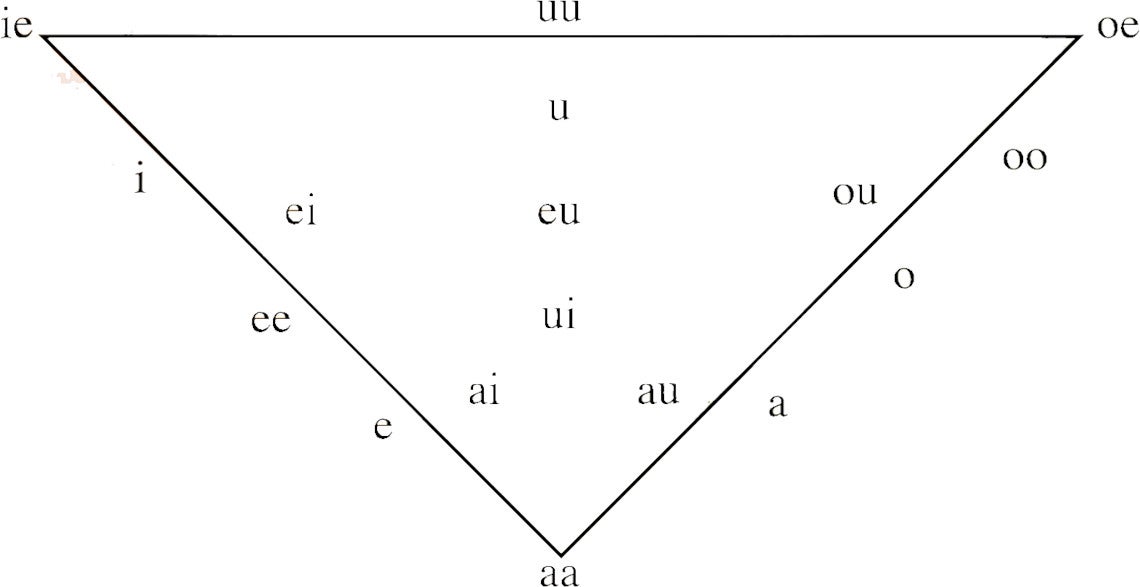
The vowel triangle shows where the main vowels sit in relation to each other. In reality, there are also vowels in the transition areas between the vowels shown here.
Tongue and resonant space
We already mentioned that the tongue often gets in the way when good pronunciation doesn’t happen. The tongue plays a big role in shaping vowels too. “You shape vowels by adjusting the resonant space, also called the ‘vocal tract’. By that we mean the space above your vocal folds up to your lips. As a singer, you have something special compared to other instruments: you can change the shape and length of your instrument’s ‘sound box’. No other instrument can do that.” The shape and dimensions of your ‘sound box’ are influenced by the position of the larynx (it can rise or lower—more on that another time), the tongue, but also the soft palate, jaw, mouth and of course the lips. “It’s a complex interaction that mostly happens unconsciously. After all, everyone has learnt to speak,” Sabine says.
Awareness
We’ve explained before that awareness is a great starting point for improving your singing. That also applies to shaping vowels. A good exercise to become aware of what, for example, your tongue does when forming vowels is simply to make those vowels and feel where your tongue is. Sabine explains: “Turn your attention inwards and feel which parts of your tongue make contact with your palate or your teeth. And what happens when you go from one vowel to another? Focus especially on ee, ay, ah, aw and oo. Take your time—it takes a while before you really notice what’s happening. Then repeat the exercise and now pay attention to your lip movement. The lips help a lot in forming vowels.”
Using ‘ee’ as a starting point
Back to ‘ee’. “This is an important vowel for articulation,” Sabine explains. “Feel your tongue position when singing ‘ee’. That position is a good starting point for singing other vowels. The goal is to stop your tongue from dropping too far back towards your throat on other vowels. That temptation is strong, especially on ‘ah’. It’s no coincidence that a doctor examining your throat often asks you to open wide and say ‘ah’.” Try it and notice how unpleasant it feels if you then try to sing. “You end up with a muffled, ‘gobbed’ ah. Your tongue root pushes against your larynx, which then gets stuck—especially on high notes, where your larynx naturally wants to rise. You prevent that dropping-back by keeping your tongue, when singing vowels, mentally close to the ‘ee’ position. Think of your tongue as relaxed, forward and slightly up. That makes it easier to sing high notes,” Sabine advises. An exercise to become aware of this is: sing ‘ee’ and then slide to another vowel. Go through all vowels from ee. So ee-ay, ee-ah, ee-aw, ee-oo. Try to keep the tongue position of ee as much as possible on the other vowel. Feel what happens. You’ll notice that on the darker vowels (especially ah and aw) your tongue wants to drop back. Try to prevent that as much as possible without tensing the tongue. That’s how you gradually learn to control it. One more note: for normal speaking you don’t need these tongue exercises. Then you simply do what you’ve always done—provided you’re clearly understood. But in singing, it helps because it improves projection. It also helps in public speaking. Another tip: don’t overdo it. It’s great to work consciously with your tongue and train it, but don’t overload it. So: dose it.
Diphthongs in English
Next step in awareness—especially useful if you sing a lot in English. English contains many diphthongs: single ‘vowel letters’ that are actually two vowel sounds. Take the word day. On paper you see a simple ‘ay’, but the sound is really closer to ‘eh’ moving towards ‘i’ (eh-i). The same is true for go in many British accents (often more like uh-oo). “This is built into the language and it isn’t a problem in itself—especially not in speech, where it happens automatically,” Sabine says. “But it’s important to be aware of it when you sing. At some point during the diphthong you switch from the first vowel to the second. Be aware of where you place that switch, so the vowel you want gets the emphasis and not the ‘glide’.” The word I comes up all the time in English lyrics. “That’s a diphthong (ah-i), even though it’s just one letter,” Sabine says. “It’s good to be aware of that and to make sure that when you sing it, most of your energy stays on the ah, not on the i. Many singers switch too quickly to the i.”
A scale on ‘ay’
Naturally, there are exercises to help you become more aware of this. For example: sing a short scale up and down on ‘ay’ (as in day). For instance c-d-e-d-c or c-e-g-e-c. Make each ‘ay’ long enough and try to keep it on the first part (‘eh’) for as long as possible, only adding the ‘i’ glide at the very end. Another exercise: sing the word day on a long note. The glide is unavoidable—but try to delay it for as long as you can. In singing, the aim is to keep the vowel you start with as stable as possible, and only switch right at the very last moment.
Good to know
Letting go of a heavy ‘r’
In the article, we explain the difference between a heavier, strongly pronounced r and a lighter r—and why the lighter option is often preferable in singing. In the UK, this can take some getting used to if you naturally speak with a strong regional r (for example in more rhotic accents). Many singers choose to soften the r and, when stylistically appropriate, drop the r at the ends of words. It tends to sing more easily, and it often helps intelligibility too.
Red lorry, yellow lorry…
Many of us know a classic playground tongue-twister: say as quickly and as often as you can, “red lorry, yellow lorry, red lorry, yellow lorry…” There’s a good chance you’ll start to stumble pretty quickly and it turns into “red lolly, yellow lolly.” It’s a great illustration of why mastering the technique of articulating consonants matters. It’s easy to explain why you end up in the wrong pronunciation at speed. Consonants are what get you into trouble. Your tongue has to move rapidly between r, l and the following vowels, and as the speed increases, it tends to default to the easier pattern. Sabine’s tip: “Try keeping your attention constantly on the first part of each phrase—red lor-, yel low lor-. You’ll notice it takes much longer before your tongue starts to go wrong. Basically, with this focus exercise you’re actively ‘steering’ your tongue’s articulation.” Sabine didn’t grow up with this particular tongue-twister. “But it’s a perfect illustration that the tongue is often the main culprit when pronunciation goes wrong. If you control your tongue well, you can say it quickly and clearly.”
Consonants: tricky, but we can’t do without them
Every word contains consonants. We need them, because they help define the word. But in singing they can sometimes get in the way—because consonants interrupt vowels, and vowels carry your tone. It often feels easier to sing without consonants. But then the lyric stops meaning anything. Not only that: consonants also shape the rhythm inside a word, so they’re excellent tools for timing. Try scatting without consonants—it just doesn’t work. You can barely make any rhythm.
Exercise: isolate the vowels
It’s not strange at all to occasionally sing a lyric without consonants—so only the vowels. It also helps when learning a melody. For example, the first line of ‘The Rose’ by Bette Midler: Some say love, it is a river, that drowns the tender reed. Sing this line without consonants. It takes a bit of thinking and experimenting, but it’s absolutely doable. Important: try to sing it smoothly. So glide from one vowel to the next. You’ll notice it’s a pleasant way to learn a melody. You focus on the vowels, so you place them better. The melody settles into your sensorimotor memory. Then add the consonants back in, and it sticks.
Lips: singing with a wide smile or a ‘kissy’ mouth
We’ve talked a lot about the tongue. But let’s not forget the lips. They play an important role in shaping vowels. Sing an ‘ee’ with very wide lips. Then relax your lips, and then purse them into an exaggerated ‘kissy’ shape. Do all of this while holding the same note. Can you hear and feel the difference? The sound of the ‘ee’ changes: it shifts slightly towards an ‘er/oo’-type colour and becomes a bit fuller. Wide lips can make a sound brighter. But at the same time, the sound may lose some core and strength. Pursed lips lengthen your oral space and therefore your resonant space by about one and a half centimetres. Compared to the length of your entire vocal tract, that’s close to twenty percent—so proportionally a lot. Singing with a wide mouth makes your ‘speaker box’ smaller, with all the consequences that brings. Many singers tend to sing with a permanent wide smile. It looks friendly—nothing wrong with that—but technically it often makes singing harder. You can practise this too. Stand in front of a mirror and place your index fingers on the corners of your mouth. Relax your lips and start singing. As soon as you move towards a smile, you’ll feel your fingers being pulled back. At that moment, think ‘narrow and long’ instead of ‘wide and flat’. Also try singing all vowels with very wide lips. What does that do to your tone? The lips have a subtle influence on your vocal sound. These exercises help you gain better control of your lip position and use it more consciously.