
Dressing your DJ booth: facade, Lycra cover and uplighting for a professional look
Published on Friday 23 October 2026
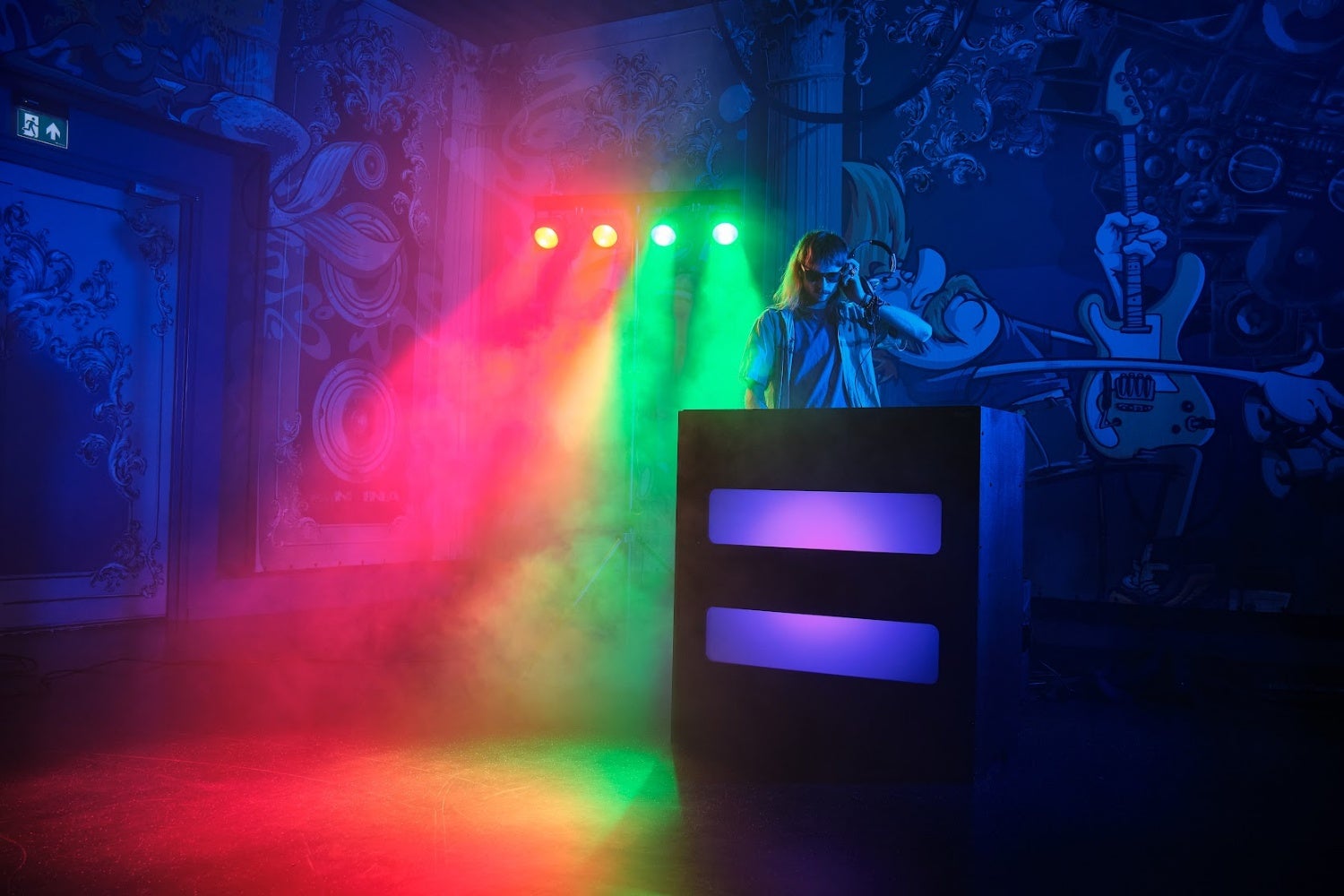
The DJ booth is the first thing guests see, even before you’ve dropped a single track. A bare canteen table with a tangle of cables underneath probably doesn’t match the vibe you want to give off as a DJ. With a facade, a white Lycra cover and a few lights, you can turn that table into a stage piece, without spending much money or time.
From folding table to DJ booth: what a facade does
A facade is essentially a front panel for your table. It hides what you’d rather not show: cables, flight cases, your bottle of water. More importantly, it’s about what it adds. A tidy front draws a line between you and the dance floor and gives your setup a face. That’s where the professional look comes from, not from the gear behind it.
Most facades consist of separate panels that you link together, so you can adjust the width to whatever table is available. More and more of these panels are designed to be lit from behind, with a surface of fabric or opal white plastic that lets light through. So when buying one, don’t just look at the size, but also at whether you can fit lighting into it.
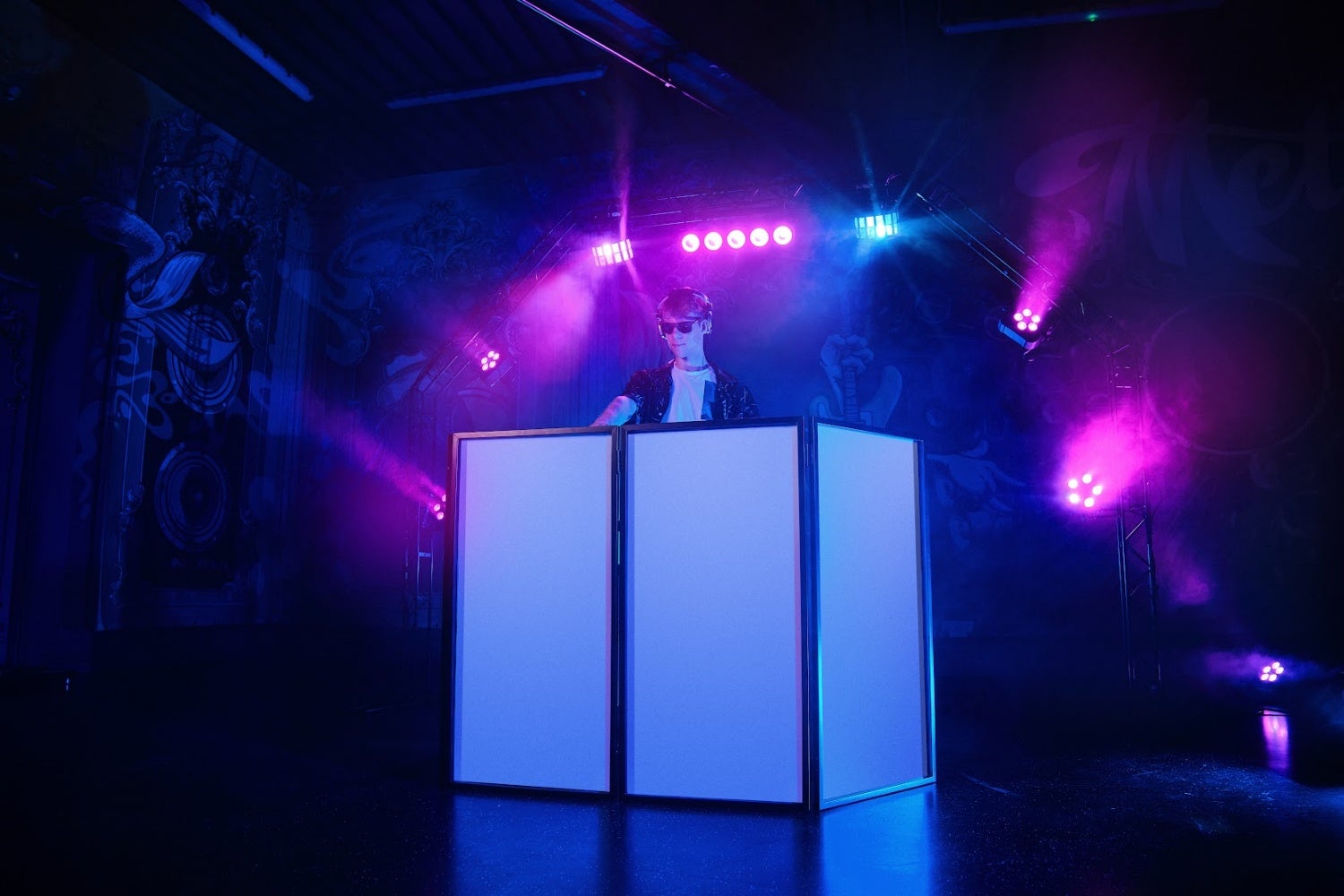
With a separate facade, you can make even the most basic booth look sleek
The white Lycra cover: a screen for your lighting
Stretch a white Lycra cover tightly over a table or the frame of your facade, and you instantly have an even, smooth surface. Lycra stretches, so it adapts to the shape without creasing, and the white lets light shine through. That combination is exactly why you want one: it’s not decoration, but the canvas your light lands on.
Think of it like a lampshade: without a shade you’re staring into a harsh bulb, with one you get a warm, even glow. An LED bar behind a white Lycra cover works the same way: instead of individual points of light, you see a single surface that changes colour. Don’t place the light right up against the fabric, or the individual LEDs will still show through. Just leave a little distance and the surface will be evenly lit.
A practical bonus: the cover is washable and folds up into a small bundle that fits in a bag. A spilled pint is no longer a disaster, and for the next party you simply pick a different colour on your lights rather than having to use a different coloured cover.
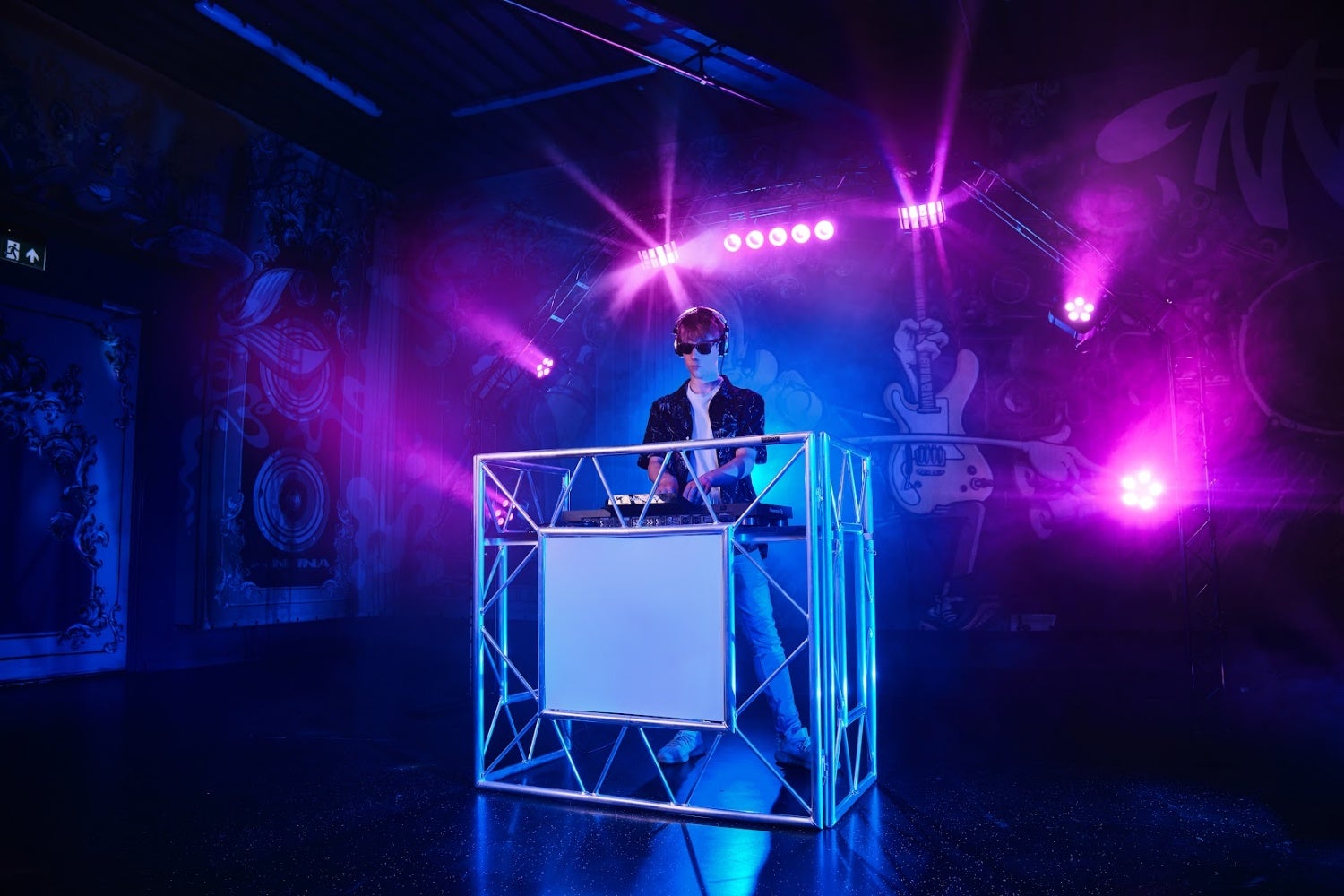
Here you can see a sturdy, rugged yet lightweight aluminium booth that takes up very little space in the car when dismantled
Uplighters and LED bars: colour in the booth and along the walls
There are two ways to light your booth: an LED bar lying behind the cover, or an uplighter (an LED spot that shines upwards from below) in a corner of the facade. A bar produces a wide, even surface, while a spot creates a cone that softens towards the top. In a wide facade you can combine them: bars behind the panels, spots in the corners.
You can use the same uplighters throughout the rest of the venue. Place them against walls, next to pillars or under an arch, and the room takes on the same colour as your booth. That’s why uplighting has become a staple at weddings: the booth is no longer an island, but the centrepiece of a venue with a consistent atmosphere.
If your budget allows, go for battery-powered versions. Plug sockets are scarce at wedding venues, and a cable running across a walkway is never a good idea. Battery-powered PARs can be placed wherever you like. Newer models feature six colours (red, green, blue, amber, white and UV) and often a wireless DMX receiver too, so you can control them from your booth via a transmitter or app.
Then there are colour changes to the music. Virtually every LED PAR or bar has a mode in which it reacts to sound by itself. Handy, but twelve lights all doing their own thing can quickly look like a funfair. If you want the whole room to switch colour at the same time on the drop, link them together in a master/slave setup or have them controlled by a single DMX controller. That way you decide the moment, not the light.
» View all battery-powered lighting
» View all LED bars
» Battery-powered PARs and wireless DMX: a light show without cables
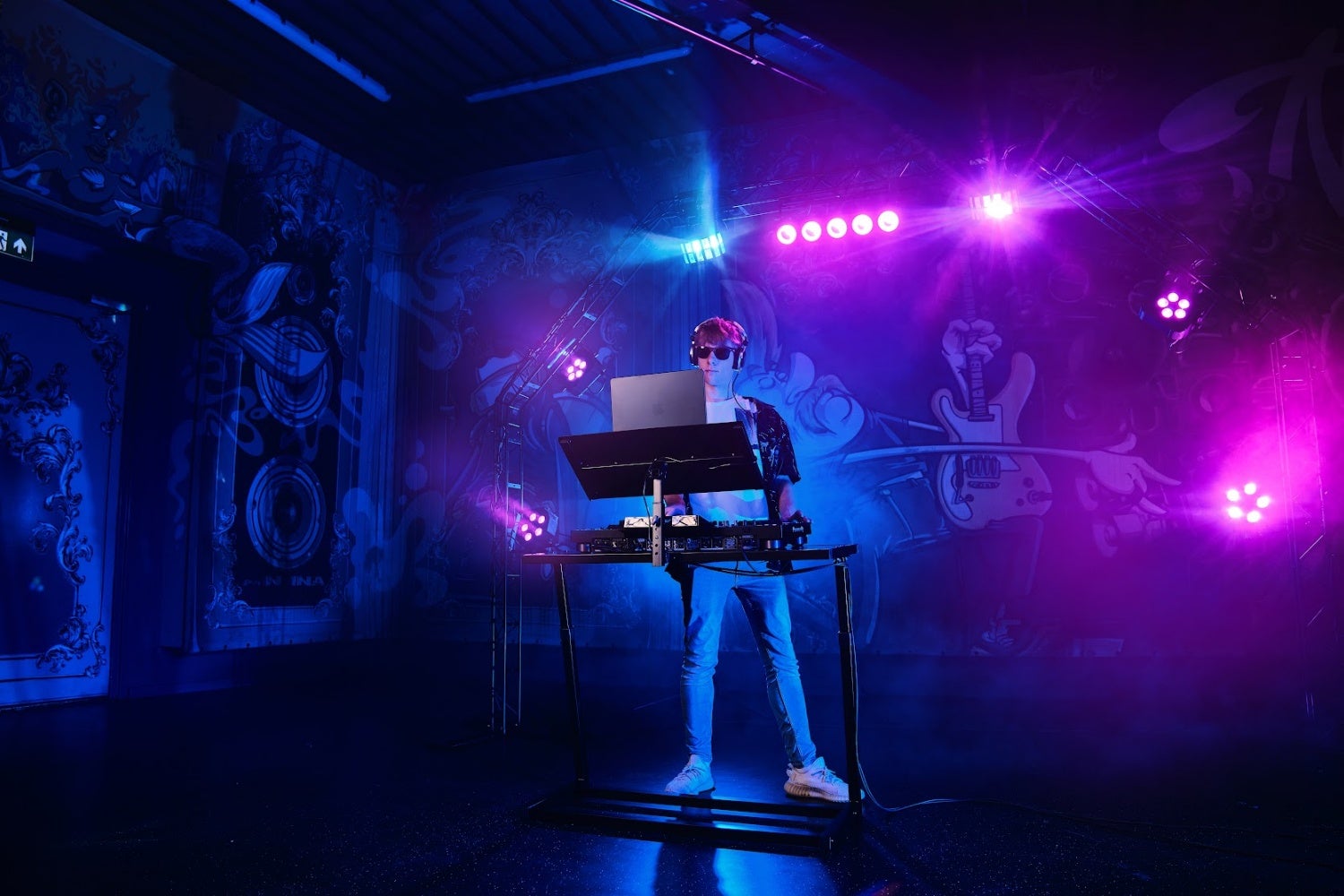
A minimalist booth isn’t just convenient; it can still look sleek, as long as you set up your equipment neatly and route the cables tidily
Foldable booths for the mobile DJ
If you’re playing somewhere different every week, a booth that takes three people to unload isn’t much use. That’s why there are foldable booths: flat-pack models that fit flat into a carry bag, and booths that travel in their own flight case and fold up out of it in just a few steps. Ideally with as few loose parts and tools as possible.
When choosing, pay attention to the working height and the depth of the top: your controller, mixer and laptop need to fit without the laptop hanging over the edge. Also check whether the front lets light through, or whether there’s room for a Lycra cover and a light. A sleek booth that you can’t fit any lighting into puts you right back at square one.
Finally: set up your entire rig, including the cover, lights and cables, a few times at home, so you’re not fumbling around on the day itself.
 Want to turn LPs into MP3s? Here’s How to Digitise Your Vinyl
 How to Breathe: For Vocalists & Musicians
 Everything You Need to Know About Making a Podcast
 Playing Keys in a Band: What You Need to Know
 How to Tune Up & Play a Guitarlele
 Setting Up the Band with a PA System? Here’s What You Need to Know
No comments yet...