
Buddy Rich – Why He’s a Drum Legend
Published on Thursday 14 May 2026
Buddy Rich (1917-1987) is regarded by many as the greatest drummer of all time. Either way, he’s a true drum legend and is often seen as one of the key pioneers of technical drumming. Buddy’s roots are in jazz, but his drum techniques have made their way into every genre.
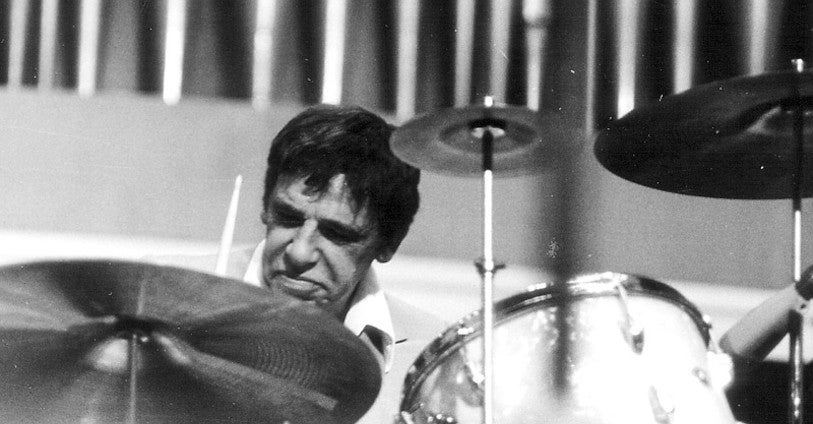
Bernard
Buddy (whose real name was Bernard) was born in 1917 in Brooklyn, New York. It quickly became clear he had a gift for rhythm. By the time he was one year old, he could already play a steady beat with spoons. As a toddler he was performing as a drummer, earning him the nickname ‘Traps the Drum Wonder’. By the age of eleven, he was leading a band. At the height of his child-star career, he was the second-highest-paid child in show business (after actor Jackie Coogan). Let’s focus on Buddy Rich’s musical qualities and the influence he’s had on countless drummers who looked up to him then and still do today. Buddy is praised for his virtuoso technique, power, groove and speed. As well as being a drummer, Buddy led his own big band—while also playing drums in it. With this big band he delivered some outstanding music-making, but his fame mainly comes down to the way he played the drums.
Cheque from Sinatra
Before we dive into Buddy Rich’s drumming, here’s a quick overview of his life. The story goes that Buddy never had drum lessons. He did study with Henry Adler, but Adler only taught him how to read music notation. He never rehearsed—not even with his own big band. For that, he’d hire other drummers. Around the age of twenty, Buddy moved into jazz, where he soon began performing with big names. One of those was singer Frank Sinatra, who also became a friend. In 1944, Buddy told Sinatra he wanted to start his own band. Sinatra immediately wrote him a cheque for 40,000 dollars and said, ‘Good luck—you should be able to make it work with this.’ And he did. Buddy formed a big band that made a big impact, also outside the United States. The thirties and forties were the golden era of big bands, but Buddy managed to keep his big band successful in the decades that followed. Legendary is The West Side Story medley.
Buddy Rich also knew exactly how to operate in the world of American television and entertainment. He regularly appeared on all sorts of TV shows, where he could win the audience over with ease. Perhaps his best-known appearance is on The Muppet Show, where he takes on Animal, the show’s resident drummer (played by Ronnie Verrel), in a drum battle. Animal loses and takes revenge by throwing a tom at Buddy’s head.
A precise drummer
Enough entertainment—now for the music. What made Buddy Rich so special as a drummer? We’ve already mentioned his virtuoso technique, power, groove and speed. “He was also an incredibly precise drummer,” says Pierre Courbois, one of the Netherlands’ best-known jazz drummers. “That’s essential when you’re playing in a big band. The larger the band, the tighter the drummer has to be. Beat one has to land exactly in the right place. In big bands especially, that kind of precision is crucial. Some drummers naturally play a bit more ‘on top’ of the beat, while others have a looser, more laid-back feel—which can be great in jazz, especially in smaller ensembles.”
A starring role for the snare drum
Another hallmark of Buddy Rich’s playing is the starring role he gives the snare drum. “Technically speaking, he’s undeniably the best in the world on the snare drum,” says Pierre Courbois. “He took snare-drum technique to a higher level. You can train that technique with, among other things, so-called paradiddles. These are basic exercises on the snare drum (or multiple drums) in which you alternate left and right in a set order, using single strokes and double strokes (single and double hits).” The incredible speed Buddy Rich could develop was legendary. “But speed isn’t the same thing as technique,” Pierre Courbois notes. “Speed can be trained. It looks very technical, but technically speaking, playing slowly is much harder. The slower you play, the more exact it has to be. The same goes for volume: playing softly is harder than playing loud. Buddy Rich mastered all of this to perfection: fast, slow, loud and soft. He was also fantastic with brushes.”
Right to the end
Buddy Rich remained active as a drummer until the very end of his life. He died in 1987 from heart failure after surgery for a brain tumour. The story goes that when he was admitted to hospital, a nurse asked if he was allergic to anything. Buddy replied: “Yes—country & western music.” Curious about this drummer? There’s an unbelievable amount online about him. In book form, there’s a biography titled Traps, The Drum Wonder: The Life of Buddy Rich, written by Mel Tormé.
The ‘scream tapes’
Buddy Rich was known as an outspoken personality who wasn’t always the most diplomatic. On the one hand, he could be helpful and friendly, but he was also notorious for his short fuse. Band members often took the brunt of it. He frequently threatened to fire people, though it usually didn’t go beyond threats. Some of his band members made recordings of his outbursts during rehearsals and while on tour on the bus. These recordings (known as the ‘scream tapes’) started circulating and only reinforced Buddy’s image as a hot-headed musician. John La Barbera, former trumpeter in Buddy Rich’s big band, has put those tapes into perspective somewhat. After Buddy once made a drum mistake during a performance, John ended up having a deep conversation with him. “Buddy told me that as a musician he always gave more than a hundred percent. And that he never wanted to compromise at the expense of musical quality. That’s why he could get incredibly angry when he felt a musician wasn’t giving it their all.”
Book and DVDs
It’s always great when legendary musicians want to pass on their knowledge and skills to others. Buddy Rich did too. In 1942, he wrote a book together with drum teacher Henry Adler about snare-drum techniques, titled Modern Interpretation of Snare Drum Rudiments. It’s still a standard work for drummers. Not too long ago, an updated version of the book was released, adding exercises that hadn’t been written out at the time. It’s also available with two DVDs, on which drummer Ted MacKenzie demonstrates the exercises. It’s available via various (online) shops. Google the title and you’ll find it straight away.




No comments yet...