
Drummer
-

Sometimes, you come across instruments that have a pretty special origin-story, a unique design or even a weird sound. Companies that develop and produce percussion instruments often bring out some weird and wonderful sound-making tools designed to create a specific sound effect. In this blog, we take a closer look at some of the more remarkable percussive instruments out there and see how they can be deployed to mimic the sounds of nature, so you can build your own organic soundscapes.
-

Acoustic drum kits are often configured to match a specific style, which is why rock-based drummers usually opt for a rock-configured kit, while jazz drummers are more likely to go for a little bebop kit. That said, there’s no reason why you can’t lay down jazz patterns with a rock kit or vice versa. Besides, a good drummer will always make sure that the sound of their kit matches the style of music, no matter how the kit is configured. Want to pull a more jazzy sound out of your kit? Read on for a few tips and tricks.
-

The venerable experts of Bax Music could offer up a thousand-and-one fascinating facts about the drum kit, but since no one has time for that, we’ve hand-picked just five!
-

If you want to be a successful band, you can’t overlook the groove. It’s what every musician should always be after and, although the groove can be elusive and mythical, there are various tips, tricks and tools that can help you catch it. So in the famous words of Sam Cooke: get in the groove and let the good times roll.
Comments Off on The Groove: What It Is And How It’s Formed | in: Bassist, Drummer, Guitarist, Keyboardist, Musician -

Guestblogger Wietse Hendriks lays down the ins and outs of the drum solo. Where does the drum solo come from? Are there different kinds of solos? And, how can you build a great solo that delivers maximum impact? Here, Wietse puts the drummer in the spotlight and explains how to get the most out of every second of your solos.
-

Scientists are discovering more and more about how the human brain works, and if you’re a musician that ever-increasing knowledge can be put to good use. Using vocalists for our little case study, in this blog, we’ll focus on ways musicians can use the power of repetition to reach the next level in their development.
-

Most drummers and percussionists will have come across them: ‘low-volume’ cymbals – also-known-as ‘mute’ cymbals. The big names as well as smaller names have released their own take on the low-volume cymbal, but what exactly are they and what can and can’t you do with them? Why would you even need a set of low-volume cymbals? In this blog, we lay it all out for you. What Are Low-Volume Cymbals? Here’s a short and sweet summary: low-volume cymbals often have a perforated design which, in some cases, reduces the volume by up to 80% when compared to normal cymbals. Low-volume cymbals are usually made of some kind of special alloy to keep the structure strong while offering the same rebound and playing feel as normal cymbals and, just like normal cymbals, low-volume cymbals come in a range of different colours, so you can finish off your kit with your own […]
-

Ever made it to a drum fill only to find out that your hands and wrists have tightened up and refuse to move any faster? Whether you’re new to drumming or more experienced, you probably know what I’m talking about. In this blog, I’m going to show you how you can make it through fast-paced parts without slowing down, getting sloppy or having to simplify your parts.
-

Any drummer will be all-too-familiar with that feeling of mounting horror as they helplessly watch their bass drum slowly shift further and further away from them during the gig. It’s maybe the most annoying thing that can happen on stage, or even in the studio or practise space, but that doesn’t mean that it can’t be solved. Here, we take a look at what you can do to help stop your kick drum from wandering off into the far distance.
-

Guest-blogger and multi-instrumentalist Nigel Hubée reveals how he bumped the foot percussion of the acoustic duo he’s one half of (The Tickets) up to the next level with a mix of self-contrived drums, a fresh take on an old-school hi-hat, and modern digital technology. Read on and learn!
Comments Off on Foot Percussion: DIY Solutions for Hands-Free Drumming | in: Drummer, Guest Blogs, Guitarist, Musician -
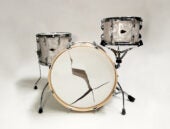
One moment you’re happily pounding out beats, the next you’re looking at a hole in your drumhead. While this is something that will eventually happen to every drummer, it’s usually a bit of a scare for beginners. In this article, we’ll take a look at some quick-fixes that can get you up and drumming again in no time.
-

In this blog, we’ll answer the question: “What are drum triggers?”, hopefully expel the myth that sticking a bunch of triggers on an acoustic drum kit is reserved for metal drummers, and tackle the almost criminal assumption that using triggers is cheating!?