
Drummer
-

It’s time to delete Angry Birds and those diet tracker apps you never use and install what you really need: five essential apps that can ease your life as a drummer and help you prepare for any situation that involves drums.
-
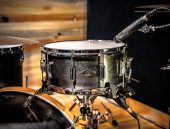
Out of all the instruments that exist, the drum kit is arguably the most difficult to record. Then again, a drum kit actually isn’t a single instrument; it’s a collection of loud percussion instruments that cover the entire audible frequency spectrum. As such, it’s not uncommon to record a drum kit using multiple microphones. In this blog, you can find out which microphones are the best for the job and how you should set them up.
-
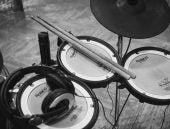
Some drummers swear by it, while others can’t stand it: the click-track. For any musician, a click-track is essentially a metronome that you can hear over a set of headphones or speakers. Play in time with the click or risk the recording or performance sounding loose and shambolic. This method certainly offers a lot of advantages but also comes with a few pitfalls. So, when should you toe the line and use a click track and when should you just let it go?
-

To end up as a drummer for a big band, you can’t escape beginning with a couple of basic rhythms. While the ones you’ll want to play are likely to depend on your stylistic preference, there are a few simple beginner drum rhythms that can be used in any style. In this blog, I’ll discuss four quintessential rhythms that offer endless experimentation and variation.
-

Fellow drummers, we all know how important we are, but sometimes we need to remind our friends, band members and fans of this slightly boastful fact. We’re more than a glorified metronome and fortunately, there are and have been various drummers prepared to prove that to the world with some beautifully recognisable, iconic drum parts. In honour of them, Bax Music presents: 5 legendary drum parts!
-

An electronic drum kit is the ideal tool for almost every drummer: no more heated arguments with the neighbours about the noise; practically all the sounds you could wish for and you can practice whenever you want. But let me remind you that you can do much more than simply hone your drumming here, as digital drums are also a great recording tool. As a matter of fact, ease of recording is one of the biggest advantages compared to an acoustic kit. In this blog, I’ll show you how it works and offer you three easy ways to record an electronic drum kit.
-

The drum kit as we know it today has undergone centuries of evolution. In all likelihood, it originates from the first instrument played by humans, as archeological evidence suggests that for thousands of years, people having been pounding and hammering on anything they could get their hands on.
-

Unfortunately, we don’t get to see them as much as we’d like, but that’s already changing fast. Thanks to pioneers like Karen Carpenter, Sheila E., Meg White, Helen Hallsworth, and YouTube stars like Meytal Cohen, more and more girls are picking up a set of sticks and pounding the skins. In this blog, we tell you about 5 of the best known and most interesting female drummers out there.
-
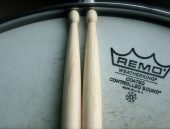
In this blog, I’ll be taking a look at the four most important drum rudiments you need to raise your drumming game. Rudiments are short drum pattern made up of a small number of strokes. Drill these rudiments every day, and you’ll not only watch yourself grow as a drummer, but you’re likely to find that playing your drum kit becomes much easier. This is simply because the most complex of rhythms is actually made up of rudiments. In this blog, we’ll talk about the four most common patterns, and since they’re the most-used, they’ll stay with you for the rest of your drumming life.
-

If you’ve just set up your electronic drum kit and you’re just missing a set of sticks, then you’ve probably noticed that there’s an overwhelming amount to choose from. Different lengths, diameters, tapers, tips, material … If you’re just starting your epic drumming journey, it can be tough to pick through what’s out there. And, while some or all of these questions can be answered by our other blog: How Do I Choose the Right Drum Sticks?, we’ve put together this blog to help explain the kind of sticks you’ll need to play an electronic kit.
-

Practice may make perfect but when it comes to drumming, practice also makes a lot of noise. As such, not every neighbour, house mate or family member is going to be equally appreciative and understanding. To meet those that are slightly annoyed with your new hobby in the middle, we’ll give you 5 tips you can use to turn down the volume a little.
-

Singing while playing guitar or piano, or any other combination of vocals and an instrument for that matter, all comes down to high-level multitasking. While for some the thought alone can cause nightmares, anyone can learn to do it. Start by asking yourself two questions: 1) Can I sing? and 2) Can I play an instrument? If your answer to both questions is “yes”, then you can also do both at the same time. It’s a really just a matter of practice, practice and mostly, practicing both individually.