
How to play harmonica and guitar at the same time: choosing and setting up a harmonica holder
Published on Tuesday 3 November 2026

Playing guitar and blowing harmonica at the same time: Bob Dylan did it, Neil Young still does, and I’ve been doing it myself for years with varying degrees of success. The secret isn’t a third arm, but a sturdy, well-adjusted harmonica holder plus a harmonica in the right key. The rest is practice (and the odd bum note, but that’s all part of it).
How does a harmonica holder actually work?
A harmonica holder, also known as a neck rack or harmonica rack, is basically a metal frame that hangs around your neck. At the top there’s a spring clamp that you slide the harmonica into, and the hinge points have wing nuts or small adjustment screws to lock the height and angle in place. That’s all there is to it. Oh, and… it does look a bit odd, as if you’re wearing a brace on the outside of your teeth. You’ll get used to that.
The idea is simple: your hands stay free for the guitar while your head takes care of the blowing. In practice, though, that means you need to be able to play your guitar part on autopilot, because your brain is already busy enough with blowing, drawing and finding the right hole without being able to look at it.
» View all harmonicas
» View all harmonica accessories

What to look for when buying one
Don’t buy the cheapest one. That sounds like a sales pitch, but I’m speaking from bitter experience. A flimsy holder made of thin wire with weak wing nuts will slowly sag after three songs, leaving you chasing the harp with your chin halfway through your solo. So look for sturdy wire, a strong spring clamp and nuts that stay put once you’ve tightened them.
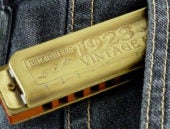
Then there’s the harmonica itself. For this job you’ll want a ten-hole diatonic harmonica, the standard type you hear on just about every folk or blues recording. Every diatonic harp is in a single key, and that letter is simply printed on it. Ideally, choose one with a plastic comb. In a holder you’ll sometimes play for minutes on end without tapping it out, and a wooden comb absorbs that moisture and swells. Plastic couldn’t care less.
» Try the Interactive Harmonica Buying Guide
Setting it up: the mirror is your friend
Stand in front of a mirror with your guitar on and start adjusting. The right position is a compromise: the harp needs to be close enough to your mouth to get a good seal on it (otherwise it sounds like there’s a punctured tyre next to you), but far enough away that you can still sing without knocking into the metal on every line. There isn’t a great deal of leeway between the two, so take your time.
If no position in between works, feel free to bend the wire a little. The metal is strong enough for that, and every neck is different after all. Then tighten everything up properly. You can’t just leave the nuts alone for good, because the holder has to be folded flat again to go in your gig bag, so they’ll come loose anyway. So remember what the position looks like, or put a small mark on the hinge. Nothing is more annoying than a holder you have to reinvent at every gig. Mine is back exactly where I want it within a minute of unfolding it.
» Singing and playing at the same time – You can learn it too!

Combining guitar and harmonica like Dylan and Young
The most important thing is that the key of the harmonica matches your guitar part. The easiest way is first position: if you’re playing a song in C, grab a C harp. All the blow notes together form a C chord, so wherever you blow, it fits. That’s also how you get that classic Dylan sound: mostly blow notes, the occasional draw, and above all, don’t overcomplicate it. For folk, pop and country, this is the position you’re after.
If you want something bluesier, turn it around: second position, also known as cross harp. On that same C harp you then play in G. Drawing on the first three holes gives you a G chord, blowing gives you C, and with a bit of bending (pulling the note down with your mouth, which is easiest on a draw on hole four) you get that wailing blues sound. It sounds complicated, but it boils down to this: for a song in G, you simply pick up a C harmonica.
In practical terms, then, you’ll need a different blues harp for each key, which means swapping between songs. So group songs in the same key together on your setlist. Playing in minor keys is possible to some extent on a standard harmonica, but you’ll soon run into missing notes. My advice: start with a single C harp, play everything in C or G, and only buy more once you’ve got the bug.




No comments yet...