
Technique and gear: Jimi Hendrix
Published on Monday 18 May 2026
In this blog, we’ll be taking a look at the playing style and the gear of Jimi Hendrix. Over the years, his brilliant playing has inspired countless guitarists, and it still does to this day. His influence can be heard across the widest range of musical styles. Because of his early death, his own discography remained limited to just three studio albums: Axis: Bold as Love, Are You Experienced and Electric Ladyland. After his death, a stream of official and unofficial albums was released, of highly variable quality. What is it about a guitarist who died too young, with only three albums to his name, that still inspires guitarists and music lovers?

Technique:
What made Jimi Hendrix unique was his complete mastery of his instrument, scales, keys, and so on, and so on. Unfortunately, it would go too far to cover every ins and outs of his technique in this blog. Don’t think it all came easily to Jimi. From a young age, little Jimi was already obsessed with music. At thirteen, Jimi bought his first electric guitar: a Supro Ozark 1560. Rumour has it that Jimi was so obsessed with the instrument that he even took it to bed with him. I wasn’t there, so I can neither confirm nor deny that rumour, but the rumour alone speaks volumes about his dedication. After Jimi was discharged from the army, he worked as a backing guitarist for, among others, B.B. King, Bo Diddley, The Isley Brothers and Little Richard, as well as various soul and blues groups. That’s where Jimi learned the ropes. The competition was brutal. As a guitarist, you had to stand out from the crowd not only with your playing, but also as a performer. There were ten others ready to take your place, and no gig meant no money. As a professional musician, Hendrix therefore practised an average of six to eight hours a day. He kept up this habit right up until his death. So yes, you know what you need to do. Practise, practise – that’s basically the only advice I can give you.

To be of some use to you, here are a few tips: As an enthusiastic hobbyist, what really helped me was the Guitar World DVD ‘How to play all of Jimi Hendrix’s ‘Electric Ladyland’. Click the following link for a short teaser video (Crosstown Traffic intro). The title really says it all: Jimi Hendrix’s entire third album is covered in an understandable and authentic way by Andy Aledort. At first glance he doesn’t look particularly sharp and he talks a bit slowly, but the different techniques are explained very clearly without leaving things out. He also teaches you how to apply the methods used to your own guitar playing. The DVD comes with a booklet containing all the tabs.
On YouTube, I find the videos by Pappa Stash very instructive. This moustachioed guitarist can talk the hind leg off a donkey, but when it comes to the lessons he’s serious and easy to follow. Just like Stevie Ray Vaughan, who I covered in my previous blog, Jimi’s guitar was generally tuned down a semitone. On a guitar with a tremolo, this can be quite an annoying job, especially if it’s a Floyd Rose. So if you don’t feel like tuning back up, always look for tutorials with ‘in E’ or ‘standard tuning’ in the title. The link below takes you to a tutorial for crosstown traffic in e. This is the full version; as usual, the different sections can be found in the suggested links on the left.
Of course, there’s plenty of Hendrix tablature to be found online. However, there’s also a lot of rubbish mixed in with the good stuff. It often happens that the tab is written out by lesser guitar gods. Of course you don’t have to copy Hendrix exactly (if you can even manage it). But it is important that your core learning material is solid. A tab program like Guitar Pro-six is ideal for learning, because it lets you slow the music down without changing the pitch. There are also plenty of Hendrix presets online for VST programs. If you want to get as close as possible to the tone, there’s the Jimi Hendrix Anniversary Collection add-on for Amplitube 3.

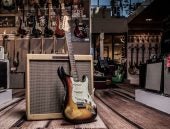
Although the last album by The Jimi Hendrix Experience in particular was packed with (psychedelic) effects, Hendrix only had a few effects available live. Compared to today’s generation of guitarists, he had a modest setup. The best known is the rig he used around the time of Woodstock. He played a right-handed Fender Stratocaster that was strung left-handed. For effects, he used a VOX wah pedal (think Voodoo Child), a fuzz face, a Univox Uni-Vibe vibrato effect and a foot pedal that let him control the Uni-Vibe settings. Amplification was handled by two Marshall Super Lead amp heads (100 W) and four 4x 12 speaker cabinets.
The Flying V is another guitar that reached iconic status thanks to Jimi Hendrix. The symmetrical body shape made it easy for him to convert the guitar into a ‘lefty’ without too much effort. Later in his career, he switched to an SG model. These models, fitted with humbuckers, he mainly used to make bluesy songs sound fatter. Thanks to the pickup configuration, with an SG-style guitar for example, it’s possible to create Jimi’s famous helicopter/machine gun effect. To do this, turn the volume knob of one pickup all the way down and preferably play with high gain. By quickly switching between pickups with the selector switch, you can achieve the ‘stuttering’ effect.

Besides his phenomenal guitar work, Hendrix was also known for his whirlwind performances. A heavy jam session regularly ended in a climax where he set his guitar on fire using lighter fluid. This definitely doesn’t do the quality of the instrument any good! As a Bax blogger, I therefore feel obliged to point out that if you set your own guitar on fire, the Bax warranty will be completely void! That said, I realise that this short blog does Hendrix’s phenomenal technique a serious disservice. Still, I hope that the videos and suggestions provided have helped you along the way.





No comments yet...