
Open-back or closed-back headphones: which should you choose for home, gaming, the office and the studio?
Published on Monday 23 November 2026
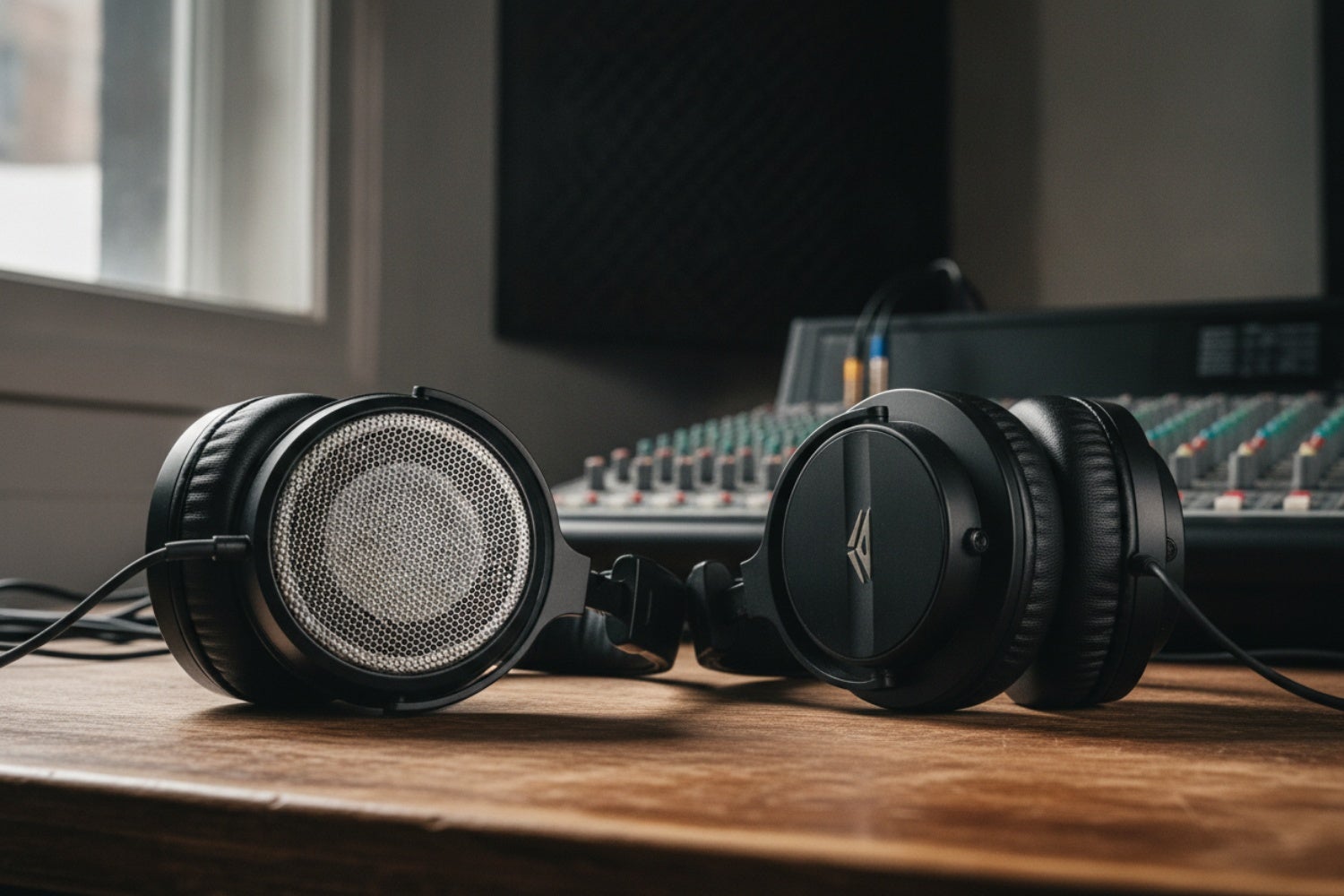
Open-back or closed-back headphones: it’s the first question I ask when someone comes to me for advice. The answer doesn’t depend on your budget or your taste in music, but on where you’ll be wearing them and who’s nearby. An open-back model sounds more spacious; a closed-back model keeps sound out, and in. That difference shapes virtually everything else.
First, your wallet: open-back usually costs more
Before you fall in love with the spacious sound of open-back headphones, take a look at the price tag. Open-back models generally sit in a higher price bracket than closed-back ones. The entry-level segment consists almost entirely of closed-back headphones, and if you’re set on open-back, you’ll be starting quite a bit further up the ladder. I see it all the time: someone hears the difference in the shop, decides they want open-back, and then gets a shock at the price that comes with it.
There’s a logic to it, though. Open-back headphones have traditionally been built for critical listening and mixing, a smaller market where manufacturers use better components. Closed-back models sell in large numbers for use on the go, gaming and the office, so prices naturally come down. One exception: within a single manufacturer’s range, the open-back and closed-back versions sometimes cost exactly the same.
My advice: set your budget first, and only then see which type fits within it. A good pair of closed-back headphones beats a mediocre open-back pair, especially if you’ll mainly be using them for gaming or at the office.

The renowned DT770: a pair of closed-back headphones
What the housing does to your sound
A headphone driver is a tiny loudspeaker that radiates in two directions: towards your ear and backwards into the earcup. In a closed earcup, that rearward sound has nowhere to go. It bounces around and collides with the sound that is heading the right way. With an open earcup, it escapes outwards through the grille.
And you can hear it. Open-back headphones sound more natural and, above all, more spacious: the music seems to be in the room rather than between your ears. A closed-back model delivers more bass and punch, because the earcup seals better around your ear. Some manufacturers put exactly the same driver in an open and a closed housing, with identical specs on paper. Yet the two sound noticeably different. So the housing is anything but a minor detail.
What’s more, the bass on closed-back models is something of a lottery. Press the earcups more firmly against your head with your hands and the bass audibly increases. How well the ear pads seal therefore partly determines what you hear, and that varies from head to head and with every pair of glasses. An open design is less affected by this. Just don’t expect miracles: even the best open-back headphones can’t match the stereo image of a pair of speakers.
» View all open-back headphones
» View all closed-back headphones
Isolation and leakage: who hears what?
Closed-back headphones are like a car with the windows up: the outside world is muffled and can barely hear you, and your own voice suddenly sounds odd. Open-back headphones are that same car with the windows down. Ambient noise comes through almost unhindered, and whatever you hear, the people around you hear too.
I learnt this first-hand in an open-plan office. After a week, my colleague two desks away knew my entire playlist, and I knew all about her phone calls. So the leakage works both ways. It gets more troublesome with a microphone nearby: sound leaking from open-back headphones during recording ends up on your recording in no time, and a sensitive desktop microphone will pick up your game audio during voice chat.
It works the other way round too. With an open-back model, the sound of the dishwasher, your PC fan or the street mixes with your music, and the quiet details are the first to disappear. Open-back headphones call for a quiet room.

The DT990 is a well-known sibling of the DT770, with an open-back design
At home, gaming and in the office
At home on the sofa, in a quiet room, the choice is simple: open-back. Isolation does nothing for you there, and you get a more spacious soundstage with no downsides. As soon as there’s a noisy PC next to you or the neighbours start renovating, the advantage shifts to closed-back.
For gaming, it depends on how much you talk. With open-back headphones you hear your own voice and the room naturally, so you speak at a normal volume and can still hear the doorbell. With a closed-back model, your voice sounds muffled and you automatically start talking louder, like people making calls with earplugs in. If there’s a sensitive microphone on your desk, though, closed-back is still the sensible choice. If you talk a lot, go open-back; if your surroundings are noisy or your mic is sensitive, go closed-back.
For a shared office, the train, the coffee shop or the gym, there’s no debate as far as I’m concerned: closed-back. Not because they sound better, but because otherwise the whole room listens in with you, and you’ll catch every conversation around you.

In the studio: closed-back for recording, open-back for mixing
During recording, the musician wears closed-back headphones, and I won’t budge on that. The cue mix with the click track stays inside the headphones, the microphone signal stays clean and the singer mainly hears the mix rather than the room. Professional studios have been doing it this way for decades, and for good reason.
For mixing, I reach for an open-back model. Because of the seal, closed-back headphones can create a slightly pressurised feeling, as if there’s already a compressor on your mix, and that steers your decisions on dynamics and balance in the wrong direction. So my advice for a home studio isn’t either/or: one pair of closed-back headphones for recording and one open-back pair for mixing.
Also keep an eye on impedance. For both types it ranges from around 8 ohms to several hundred ohms, and most headphone amplifiers handle that without any trouble. If you want to split one output to two pairs of headphones, choose models with the same impedance. Otherwise one pair will sound louder than the other, and you’ll end up with arguments in the recording room.
» View all studio headphones
» View all closed-back headphones
» View all open-back headphones
 Want to turn LPs into MP3s? Here’s How to Digitise Your Vinyl
 Which headphones suit your digital piano? Open-back, closed-back, impedance and more
 How to Breathe: For Vocalists & Musicians
 Setting Up the Band with a PA System? Here’s What You Need to Know
 How to Tune Up & Play a Guitarlele
 Everything You Need to Know About Making a Podcast
No comments yet...