
Melodica: a unique crossover between a wind instrument and a keyboard instrument
Published on Friday 8 May 2026

A melodica looks like a mini piano, but you have to blow into it to get any sound. It’s easy to take with you, simple to learn, yet versatile enough to earn a place in all sorts of styles — from reggae to jazz. Let’s take a closer look at this unusual instrument, where it came from, and how it’s used today.
What makes the melodica so special?
The melodica is a combination of a wind instrument and a keyboard instrument. Thanks to its low purchase price — available from under £20 for a basic instrument — and the chance to experience both a keyboard and a wind instrument in one, the melodica is an excellent choice for children and beginners who want to learn their first instrument. You play it by blowing air into the instrument via a mouthpiece or a tube, while pressing the keys with your fingers at the same time. Compared to the piano, the melodica is easier to play, because you usually play with just one hand and the keyboard is considerably smaller. Unlike other wind instruments, you also don’t have to learn which holes to cover to get the right note, which makes the learning process much simpler.
Melodi-what?
Because of the way it produces sound, a melodica is sometimes called a ‘blow piano’. Manufacturers often use their own names too. Suzuki, for example, calls it the Melodion and Yamaha uses the name Pianica. Other common names include Melodika, Melodia, Melodihorn, Diamonica and Clavietta.
What does a melodica sound like?
The sound of a melodica is like a mix between an accordion and a harmonica. The tone can be bright and clear, but by blowing harder or softer you can create different tonal colours. This makes the instrument suitable for both solo passages and accompaniment in various music styles. For solo performances, you’ll want a clear, powerful sound so the melodica is easy to hear and stands out from other instruments. For accompaniment, you’ll usually play with a softer, more restrained tone.
The different types of melodica
Melodicas are often grouped into soprano, alto, tenor and bass. Some manufacturers use different terms or combine more than one range in a single instrument. Generally speaking:
- Higher melodicas (soprano and alto) have a bright, sharp sound and are suitable for melody lines that need to cut through. Their range is usually between F4 and F6, depending on the model.
- Mid-range melodicas (tenor) have a warmer tone and are often used for both solo playing and accompaniment. Their range typically varies from C3 to C5.
- Low melodicas (bass) produce a deep, resonant tone and are mainly used for supportive bass lines in ensembles. These melodicas often cover the range from F2 to F4.
Because the tone is strongly influenced by the design and materials of the melodica, different models can sound different, even within the same category.
How does a melodica work?
A melodica consists of a compact body with a keyboard and an air chamber. When you blow into the mouthpiece and press a key, a valve opens, allowing air to flow past a metal reed — a thin strip of metal. This reed starts to vibrate, producing the note. This mechanism is similar to that of an accordion or a harmonica, where the pitch is determined by the length and thickness of the metal reeds.
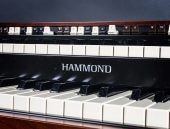
Most melodicas have 25 to 44 keys, and some advanced models, such as the Hammond 44, even offer a built-in microphone system for amplification. There are also two ways to play the instrument: directly via a mouthpiece or with a flexible tube, which leaves both hands free to play.
Where did it all begin?
One of the earliest predecessors of the melodica was the Symplexophon, an instrument invented around 1870 by Ch. Weiss, a German harmonica manufacturer. It was later followed by the Hohnerette, patented by Hohner in 1908. These early models laid the foundation for the design and sound of the melodica as we know it today. However, there are some clear differences between these instruments and today’s melodicas:
Symplexophon
Where modern melodicas typically have a piano-style keyboard, the Symplexophon had metal buttons. The Symplexophon also differed from the modern melodica because the pitch changed depending on whether you breathed in or out, similar to a traditional harmonica. Another interesting aspect of this instrument is that it had different registers. These are buttons that let you change the instrument’s tone colour and pitch.
Hohnerette
The Hohnerette was a further development of the Symplexophon and resembled a kind of small accordion. Like the Symplexophon, it had metal buttons rather than a piano-style keyboard like modern melodicas. The instrument was introduced by Hohner around 1908. You played it by blowing into the mouthpiece, with the buttons producing different notes.
Modern melodicas
The first modern melodica was presented by Hohner in 1958. In that same year, André Borel in Italy developed the Clavietta. Hohner’s model, the Student 32, had a simple design with a plastic body and buttons instead of a piano-style keyboard. The modern version does have a keyboard. You played the instrument by blowing air through a mouthpiece while pressing the keys with your fingers. By contrast, Borel’s instrument was closer to a modern melodica, since it had a keyboard rather than buttons.
Compared to their predecessors, modern melodicas have a more even tone, which is less influenced by the direction of the airflow. Another key difference from earlier versions is that on modern melodicas you can play multiple notes at once — so you can make chords sound.
In the ’70s, Augustus Pablo, a well-known reggae artist, gave the melodica a permanent place in the reggae and dub scene. Composers such as Steve Reich also began experimenting with the instrument in minimalist music, which helped the melodica find a much wider range of uses.
Buying a melodica: what should you look out for?
When choosing the right melodica, there are several factors to consider. First of all, you’ll want to decide which range suits you best. Models with 32 keys are more compact, but have a more limited range. Still, these models are suitable for jazz, reggae, pop and rock. For classical music — or if you often play music that requires a wider range — it’s better to choose a model with 34 or 44 keys.
Reed quality
Another important point is the quality of the reeds, since they play a crucial role in the sound and durability of the instrument. Higher-quality reeds provide a richer tone and a longer lifespan. In general, a higher price often goes hand in hand with better reed quality. It can therefore be useful to ask the retailer for advice on this.
Music style
Finally, the kind of music you play matters too. Do you mainly play jazz? Then choose an instrument with a warm, expressive tone. If reggae and dub are more your thing, it’s better to choose a melodica with a bright, penetrating tone. The same goes for pop and rock music. Are you more focused on classical music? Then a melodica with a wide range and a pure tone is a good choice.
Where can you buy melodicas?
» Take a look at the Bax Music melodica range
Nice to know
- In Japan, the melodica is a standard instrument in primary schools, where children learn to play music from an early age.
- Although it’s not the first thing you’d associate with classical music, there are plenty of examples of classical pieces arranged for melodica, such as this excerpt from Mussorgsky’s Pictures at an Exhibition.
- The bass melodica, with its short range from F2 to E4, has a kind of built-in delay — it takes a moment after you press a key before the note sounds.
- The band The Hooters got their name from a sound engineer who wasn’t familiar with the melodica and called the instrument a “hooter”.
- Until not too long ago, the word melodica was a registered trademark of Hohner. That’s why other manufacturers often use different names.
Where do you hear the melodica?
You can find the melodica in various music genres:
Reggae & dub
Augustus Pablo made the instrument famous and gave reggae a melancholic, dreamlike vibe, for example in his track Melodica rise.
Jazz
Jazz musicians such as Jon Batiste and Jack DeJohnette integrate the melodica into their playing as a solo instrument. Or have a listen to Donald Fagen, who we know from Steely Dan:
Pop & rock
Depeche Mode used a melodica in Everything Counts, and Gorillaz in Clint Eastwood. The Hooters use melodica as part of their signature sound, for example in And We Danced.
Is the melodica hard to learn?
Compared to many other instruments, the melodica is very accessible for beginners. The only new element for pianists is learning to blow while playing. Beginners can quickly play songs on it, while more advanced musicians can use complex improvisations, dynamic expression and harmonic combinations across different music styles.
How do you play the melodica?
Playing the melodica is simple: you blow into the mouthpiece or use a tube. You play the keys just like on a piano. By varying how hard you blow, you can play louder or quieter.
Five tips to improve your playing technique
- Breath control – With an even airflow, you get a stable tone. You do this by paying attention to your breathing and breathing from your diaphragm.
- Finger technique – Use a relaxed but precise touch to improve speed and control. Practise scales and arpeggios for smoother transitions.
- Phrasing and articulation – Try different articulations like legato (smooth notes) and staccato (short, detached notes) to add variation and expression to your playing, just like with other wind instruments.
- Hand position – Keep your hand relaxed and use your wrist for natural movement, especially during fast passages or complex chord progressions.
- Using vibrato – Try creating a vibrato effect by subtly varying your breath pressure to add extra expression to your playing.
- Soprano and alto melodicas are often played with two hands, with one hand handling the white keys and the other the black keys.
- Tenor melodicas, on the other hand, can be held with one hand, but can also be placed on a table to play.
In tune or not?
Bending notes on a melodica is an advanced technique that experienced players use to add expression and variety to their playing. While the melodica isn’t naturally designed for pitch bends like a harmonica, it is possible to achieve a similar effect. A commonly used method is to partially press a key while increasing breath pressure; this can lead to a slight lowering of the pitch, especially effective on lower notes.
It’s important to emphasise that if you’re not careful, this technique can damage the instrument’s reeds. However, well-known musicians such as Jon Batiste and Augustus Pablo have successfully used this technique to add a unique tone colour to their playing.
Maintenance and tuning
Like other acoustic instruments, melodicas can go out of tune over time. You can have your melodica tuned, or if you have the necessary experience and skill, you can do it yourself by carefully filing material off the reeds. With regular maintenance, you’ll extend the lifespan of your instrument.




No comments yet...