
Buying an ocarina: which type and how many holes should you choose?
Published on Tuesday 3 November 2026

Buying an ocarina seems simple: a little flute with holes, job done. Yet plenty can go wrong, from unplayable souvenirs to a fingering system you’ll later have to unlearn. My advice in one sentence: start with a 12-hole plastic ocarina in C, and only look at ceramic once you’re hooked. The rest of this article explains why.
What kind of flute is an ocarina, exactly?
An ocarina is a vessel flute: a flute with a closed sound chamber rather than an open tube. On a recorder or tin whistle, the air travels down a tube and out the end; on an ocarina, it’s trapped inside a hollow chamber and can only escape through the holes. Physicists call this a Helmholtz resonator. I call it the reason an ocarina sounds so round and hollow, like blowing across an empty bottle, but with notes.
That closed chamber also explains why ocarinas come in all sorts of shapes. The pitch depends only on the volume of the chamber and the total area of open holes, not on which holes are open. That’s why the holes on a good ocarina are different sizes. The modern Western ocarina was invented in Italy in the mid-19th century by Giuseppe Donati, although the Chinese and Mesoamericans were playing similar flutes long before that. The transverse shape is nicknamed the ‘sweet potato’; hold one and you’ll see why.

6, 10 or 12 holes: what’s the difference?
The more holes, the wider the range. The standard transverse ocarina has 10 or 12 holes: a row of finger holes on top and two thumb holes underneath. A 12-hole in C covers 21 notes, from A4 to F6, including all the sharps and flats. In other words, it’s fully chromatic: you’re not stuck in a single scale.
The 10-hole uses the same basic fingering but lacks the two small holes that let you go below the tonic. You won’t need them for most melodies; I barely touched them in my first six months. Even so, I’d go for them. It’s like a calculator with a square root button: you won’t use it for the first few months, but you’ll be glad it’s there when that one song calls for it.
The 6-hole is a different story. You’ll mostly come across it as a pendant on a cord, and these pendants use their own fingering system with four holes on top. You learn that system separately, and it doesn’t carry over to a 10- or 12-hole. Nice around your neck, and you can genuinely make music on one, but if you want to learn to play properly, it’s a detour.
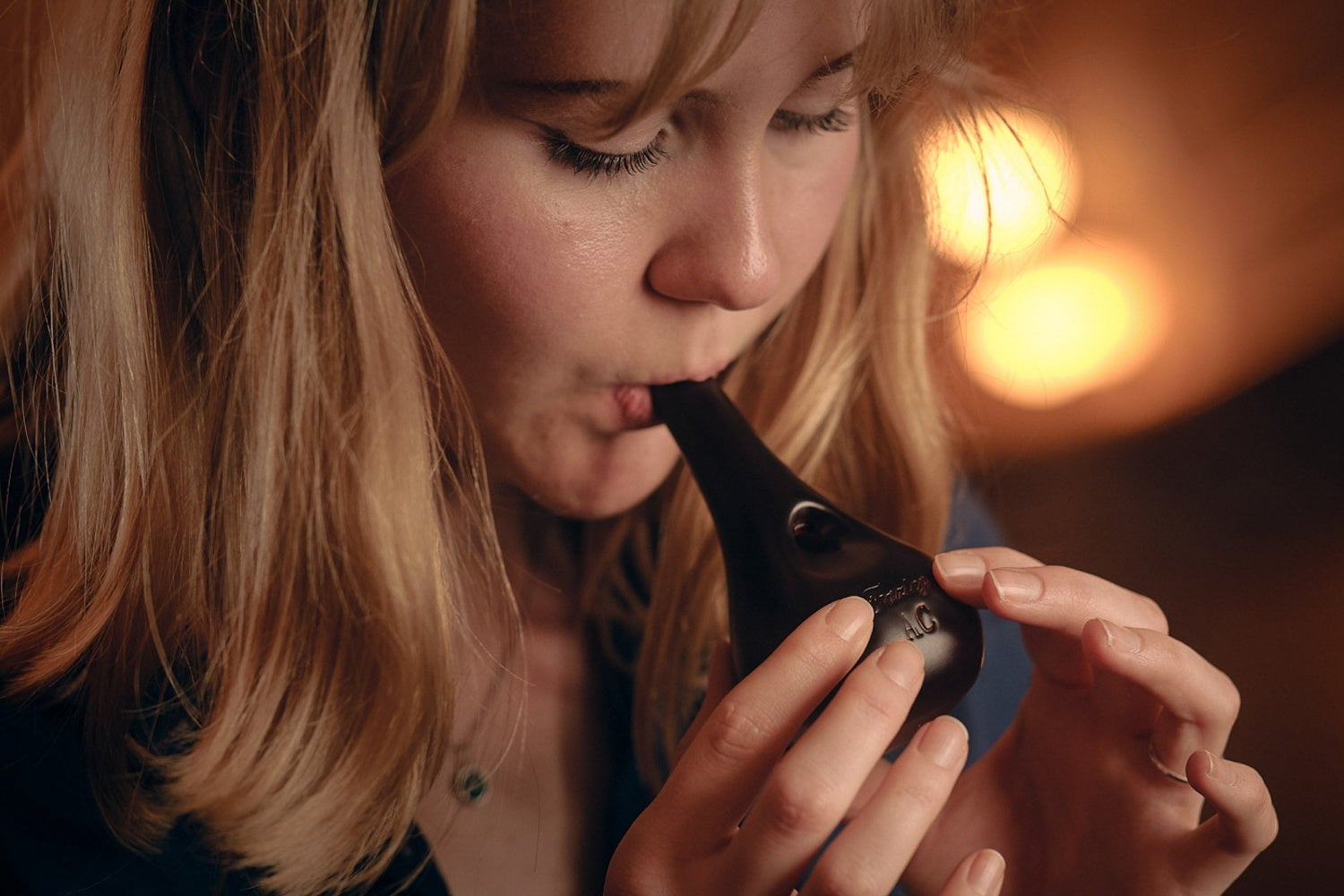
Ceramic or plastic?
Ceramic is tradition, plastic is common sense. Clay and earthenware are the original materials and feel lovely in the hand. But if one falls off the table just once, the party’s over. Plastic is lighter, survives your rucksack, is easy to clean and comes from a factory with better quality control. Quality has improved massively over the past ten years, and a good one will only set you back a few tenners. Wood, glass and metal are for when you already know what you want.
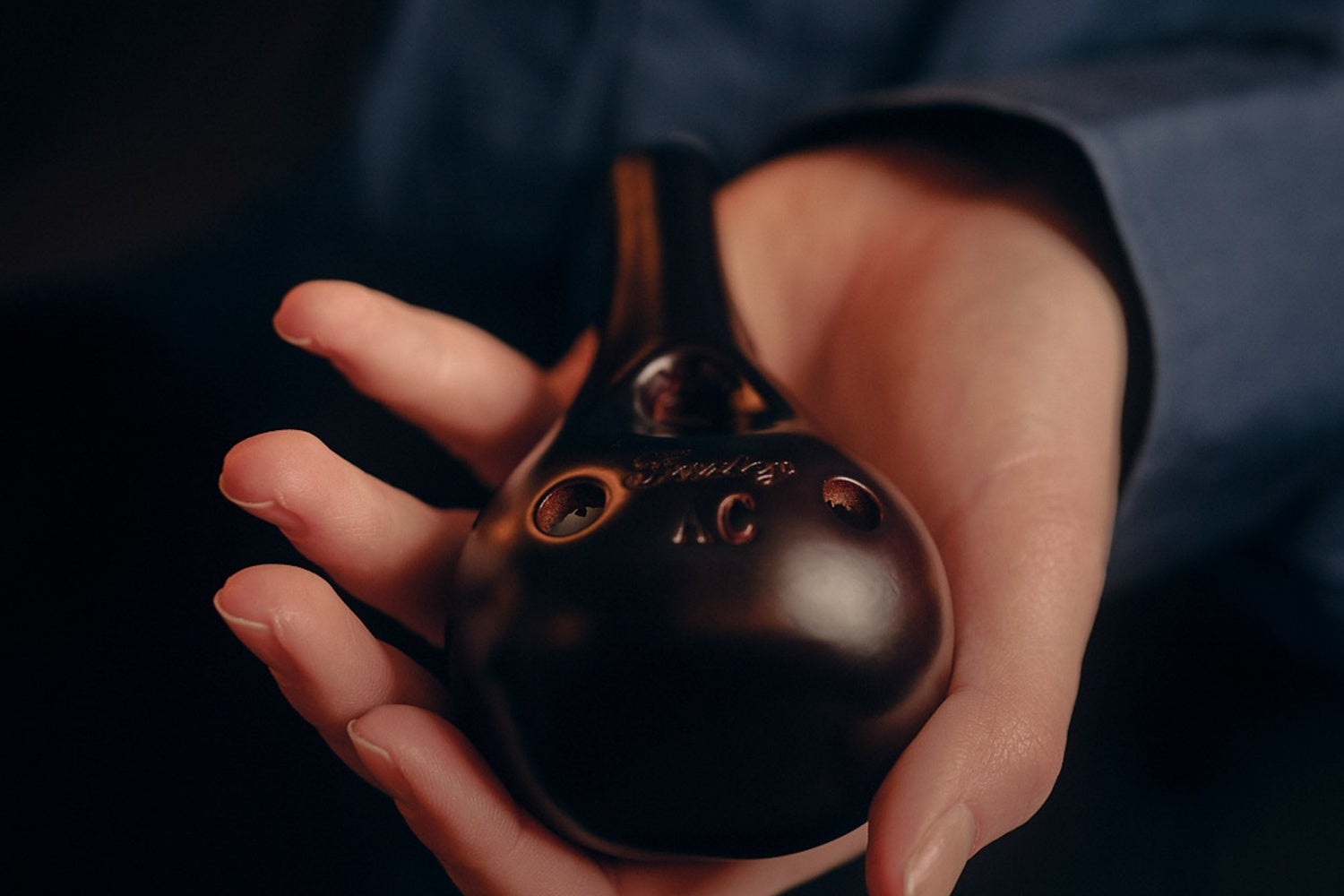
Be wary of cheap ceramic ocarinas sold as souvenirs or as replicas from a well-known video game. Many of them simply aren’t playable. The quickest check: if all the holes on top are the same size, it’s an ornament. A real instrument has holes of different sizes, because of that total hole area. Listen to sound samples or read reviews before you buy, as the tuning varies from brand to brand and sometimes from one instrument to the next.
Key: start in C, and how quickly can you play something?
For your first ocarina, choose an alto C. Not because C is a nicer letter, and not because of the fingering either: that works the same on every transverse ocarina, whether it’s in C, G or F. You cover the main holes for the tonic (on a 12-hole you leave the two small sub-holes open) and with every hole you open, you climb up the scale. The real reason is simpler: almost all tutorial material and sheet music assumes a C, so you don’t have to transpose anything.
How quickly can you play something? Faster than on almost any other instrument I’ve picked up. You blow, cover the holes, and out comes a note. Within an hour you’ll be playing a simple tune. The tricky part is your breath. An ocarina responds to air pressure: blow too hard and the note goes sharp; too softly and it goes flat. That way you naturally learn to listen to your own tuning, something many a guitarist could learn from (myself included).
Compare it to the harmonica: there too, nearly everyone starts in C, and you’ll naturally buy a second one in another key later on when a song calls for it. So don’t start with a G or F just because it sounds so wonderfully deep. Learn to walk first, then dance.




No comments yet...