
Captain Beefheart and his Magic Band – The story of a living legend
Published on Monday 11 May 2026
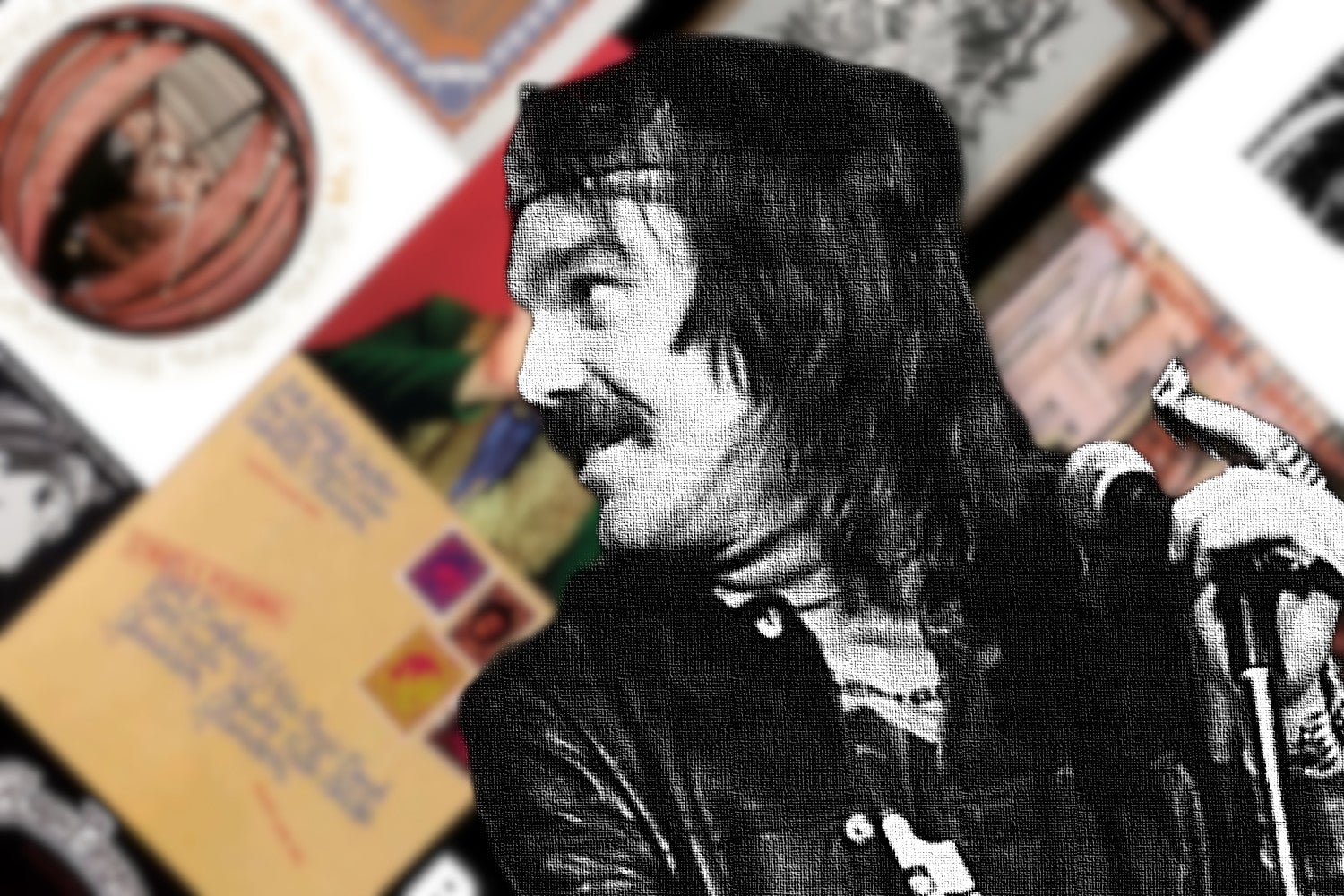
Don Vliet — does that ring a bell for anyone? Don Ván Vliet, perhaps? Captain Beefheart sounds a lot more familiar — and a good deal more magical. This singer, multi-instrumentalist, songwriter and painter was, with his Magic Band behind him, a legend throughout his entire career.
Photo (edited): Captain Beefheart in Toronto, by Jean-Luc Ourlin, licence CC BY SA 2.0
A life as a phenomenon
Born Don Vliet — later his official name became Don Van Vliet — on 15 January 1941 in Glendale, California. Died on 17 December 2010. After his death, pop media and newspapers exhausted themselves with retrospectives. They invariably lay it on thick about the experimental side of ‘the Captain’. Yet with his expressive, raspy, driving voice, he is also one of the best white blues singers, related to and building on Howlin’ Wolf. But there’s more: the Rolling Stone Rock & Roll Encyclopedia puts it like this (all the special quirks are poured over you in two sentences; this is also Beefheart the experimentalist): “The loose-tight rhythms, the rasping harmonies and earthy surreal lyrics of Captain Beefheart’s songs, and the blues-infected vocals ranging from 6 ½ octaves, or depending on who you believe, 3 octaves (…) suggest an improvised kind of Delta blues, avant-garde jazz, 20th-century classical music and rock’n’roll bordering on chaos. But in fact it is a form of modern chamber music, because he determines every note in advance and demonstrates each band member’s part. Because he breaks many rock conventions at once, Beefheart’s music has always been more influential than popular.”
Child prodigy
As a child, Don was seen as a prodigy in painting and sculpture. He was eligible for a grant to do an internship in Europe. His parents were fiercely against it, and he decided not to apply for the grant after all. Don Vliet and Frank Zappa, of the Mothers of Invention, were childhood friends, based in the Mojave Desert town of Lancaster in Southern California. It was there that Don found his singing style in an R&B band called the Omens. Frank bought a recording studio in Cucamonga in 1963. They also worked on a film titled Captain Beefheart Meets the Grunt People. That’s where Don got his stage name. There is no clarity about the origin of ‘beefheart’.
A minor cult figure
In 1964, the Captain quickly became a minor cult figure in the LA scene thanks to his live shows. The band got a contract with A&M, but they dropped him because the demo for their first LP was deemed too negative. They were then able to sign with the Buddah label and their first LP, Safe As Milk, came into being. The producers were one George Perry and Bob Krasnow. The Magic Band at that time consisted of Alex Snouffer, nicknamed St. Clair (guitar), Jeff Cotton, nicknamed Antennae Jimmy Semens, John French (‘Drumbo’) (drums) and Jerry Handley (bass). Perry had the brilliant idea of bringing in Ry Cooder (guitar) as well. He was poached from the group The Rising Sons with, among others, Taj Mahal — who were also very popular in LA clubs at the time. On the record you can also hear Russ Titelman on guitar, later a well-known session musician and producer, and brother-in-law of Ry Cooder. Taj Mahal is also said to be audible in percussion passages.
Safe As Milk
Personally, I think this first LP Safe as Milk (recorded in 1966, released April1967) is the finest of all his work. Safe As Milk is an ironic reference to the safety of mother’s milk; he fears that soon it won’t be so safe anymore. I want to play one side of Safe As Milk and a few tracks from the LP The Spotlight Kid.
Yellow Brick Road
Alongside Van Vliet, the name Bermann appears in the credits of quite a few songs on this record. Herb Bermann is a poet who saw Beefheart perform and gave him permission to work texts and poems into songs.
I have a special memory of Captain Beefheart: his performance at the Rome pop festival in May 1968, which I attended. The first LP wasn’t out yet. For the time, the band members’ outfits were extremely strange — and the Captain himself wore big glasses and a top hat. The music was loud. At one point the vocal microphone cut out, but even without it the Captain could still be heard above everything. Later, a standard anecdote was his sheer vocal volume: he supposedly once sang a studio microphone to pieces. A constant mumbled catchphrase was “Webcor, webcor”, after a brand of microphones. Even so, the whole LP has quite a ‘small’ sound. For me, that makes it even more intriguing. I read that this was an unintended consequence of switching from an 8-track to a 4-track recorder during the recording process. The backing group is the first of what is effectively three line-ups. Ry Cooder contributed to the record as a very young lad. I can hear this in various signals that don’t crop up on later LPs — for example, the heavily syncopated rhythm passages. Before the Monterey Pop festival in June 1967, Cooder left the group, which is why they didn’t play there. From August that year, Jeff Cotton, aka Antennae Jimmy Semens, was the band’s guitarist.
Abba Zaba
The Captain was a genius at coming up with song titles, and, as mentioned, he wrote surreal lyrics. They include many made-up words. It’s essentially expressionistic language: back to child babble. In Abba Zaba I always only caught the word ‘baboon’. I pulled the full lyrics from the web. The image is a love scene and a family in prehistory.
Plastic Factory
One of the sharpest blues tracks ever written. Lyrically, you could also call it a protest song. Here, the Captain shows that cutting vocal sound, drawn from Howlin’ Wolf’s blues.
Where There’s Woman
The rhythm is loose — a few rolls, relaxed, not tight. This becomes more noticeable on later LPs. It’s almost never a straight rock-’n’-roll rhythm again. The Captain does that deliberately: he hates the ‘mama-heartbeat rhythm’.
Grown So Ugly
A song from 1960 by blues singer Robert Pete Williams. This track is pure Ry Cooder, brought in and arranged by him.
Sure ‘Nuff ’n Yes I Do
An irresistible Captain blues number. Especially the voice in two keys. And the beautifully syncopated guitar backing.
From a botched second LP to Frank Zappa’s label
Captain Beefheart’s last LP recordings date from 1982. His output is small overall. The Captain is completely unbusinesslike, and sometimes also the victim of dishonest businessmen and weirdos. For example, his second LP Strictly Personal (sleeve like porn in brown wrapping paper) was, in a solo action by producer Bob Krasnow, given an electronic noise effect (phasing) across every track — which ruins the entire record. After the first European tour, Krasnow also makes off with all the takings. Beefheart is dropped by his record company and ends up on Frank Zappa’s Bizarre label. Zappa allows him complete freedom for an entire album. This becomes the double LP Trout Mask Replica from 1969.
Trout Mask Replica
It is highly valued as avant-garde art and sold reasonably well. All kinds of tall tales circulate about this record: the band locked up for 8 weeks, 70 to 80-hour working weeks, every second determined in advance during rehearsals. The Captain also appears on a few of Zappa’s own LPs (Hot Rats and Bongo Fury). Then a temporary rift opens up between the two. I read that he was quite bothered by Zappa’s sexist attitude towards women. It’s also written that he took issue with how Zappa presented his work: as a kind of social documentary, and with cut-price recordings in a recording trailer. I’ve never listened to Trout Mask Replica in full, so I can’t judge it. Reviews in Dutch newspapers are ecstatic — wildly enthusiastic without saying anything about the music. I always think that’s a bad sign. In the Dutch daily De Volkskrant there’s a small piece, probably by Peter Schröder: “The result is a sort of Beep Beep Oink music in which there isn’t much of a line to be found, and which, without the driven singing of Beefheart, would be unlistenable. Whether, in this case, it is listenable depends entirely on whether Beefheart’s intense shouting/mumbling/singing has something to tell you. Aside from that, listening to those four sides is a laborious occupation.” Then come the records released in 1972, discussed below.
Once again exploited by swindlers
In 1973 and 1974, a few records came out with fairly ordinary music that the critics considered mediocre (Unconditionally Guaranteed and Blue Jeans And Moonbeams). The Captain regarded them as worthless — not his own work. Without his knowledge, many changes were made. Because of contractual tricks, he could do nothing to stop them being released against his wishes.
Later work, released when he was already a legend
Then there’s one fairly good record (Shiny Beast, from 1978), one that resembles Trout Mask Replica in terms of experimental drive (Doc At The Radar Station, from 1980) and a final statement in 1982 (Ice Cream For Crow). The Captain then performs with a third Magic Band made up of a younger generation; the members of the second band have collectively broken off their relationship with the dictatorial Captain. Two of them — Bill Harkleroad and Mark Boston — plus later drummer Artie Tripp (aka Ed Marimba), ex-Mothers of Invention, form the group Mallard, who make a few excellent records.
A memorable TV moment
In interviews you always read about the Captain’s unique personality — for instance, that he spoke in riddles and images just like in his lyrics. Interviewers sometimes left in total confusion. In photos, that magic naturally comes across less. In Europe, his TV appearances are often remembered as cult moments. He seemed completely at ease amid staged chaos — collapsing bookcases and sudden monologues. In older age he always reminds me of painters like Francis Bacon and Lucian Freud.
Original top work in the early seventies
In 1972 he makes two LPs on which he delivers accessible and original music: The Spotlight Kid and Clear Spot — hugely impressive. From The Spotlight Kid I choose:
The Spotlight Kid
Click Clack
Grow Fins
This last track is, for me, the ultimate in impressive blues. “I’m gonna grow fins, live with a mermaid.” This period is that of the second Magic Band. The band members have spectacular invented names like Winged Eel Fingerling (Elliot Ingber), Rockette Morton (Mark Boston), Zoot Horn Rollo (Bill Harkleroad) and Orejon (Roy Estrada). The names were invented by the Captain. He holds the copyright on them so that, after leaving, they are no longer allowed to use those names.
Also a fine painter
The Captain paints expressionistic portraits of the members of the second group on the cover of The Spotlight Kid. At the end of his life he only painted, and no longer made music. Multiple sclerosis made it impossible for him to sing. But his paintings and sculptures are his primary — substantial — source of income. One of the mythical stories doing the rounds is that he claimed to be a descendant of someone called Peter van Vliet, a painter who was a contemporary and acquaintance of Rembrandt. He dies after nearly thirty years of being a living legend.

No comments yet...