
Cello vs Double Bass – Big instruments, big differences
Published on Tuesday 12 May 2026
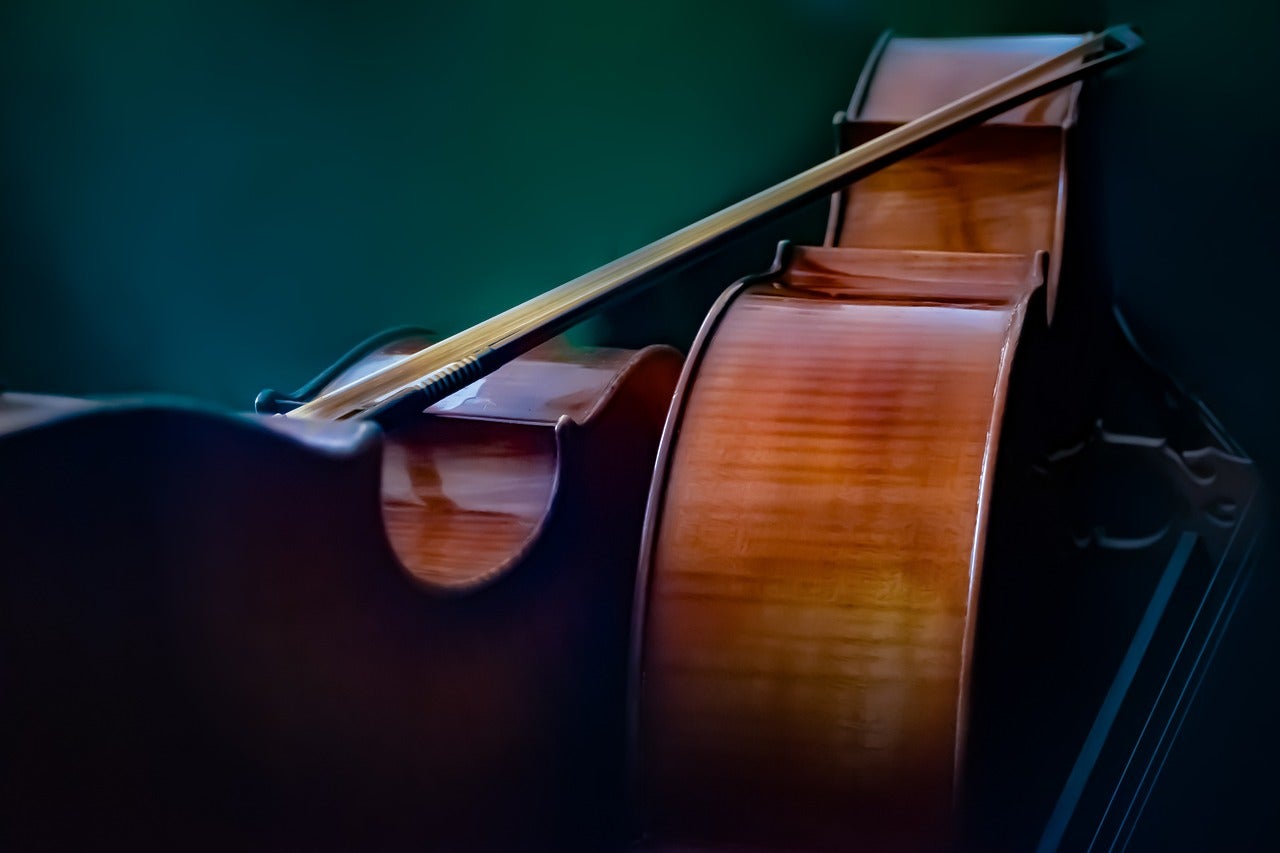
You’ve decided to learn a big, low-sounding bowed string instrument and you’re torn between the cello and the double bass. Both instruments are so large that you need to place them on the floor to play. And with both, you can feel those deep notes resonating through your body. But… they’re used differently. Read on and listen.
Double bass vs. cello – In brief
- At around 120 cm in length, the cello is much bigger than the violin/viola, but smaller than the double bass (182 cm).
- It also sounds lower than the violin/viola, but not as low as the double bass.
- The double bass is usually played standing / half-standing, and the cello is played sitting down.
- You’ll mainly hear the cello in classical music. You’ll often come across the double bass in both classical and jazz.
- The double bass is mainly used for accompaniment, whereas the cello is also often used as a solo instrument.
The cello
Above, listen to a melodic solo cello part from John Williams’ soundtrack for the film Seven Years in Tibet
The cello is a popular and elegant bowed string instrument. In orchestral sheet music, it’s abbreviated to Vc., which stands for violoncello. That’s the instrument’s official name, but in everyday speech we simply shorten it to cello. It’s played by a cellist. Like the viola and the violin, it has four strings. In this case, they’re tuned to C-G-D’-A’, which is an octave lower than the viola.
Why buy a cello?
The cello is an instrument you can take in pretty much any direction—literally and figuratively. It can go fairly low: two octaves below middle C on the piano. But that doesn’t mean the cello is condemned to monotonous bass parts. On the contrary, this bowed string instrument is excellent for solo lines. Not as high as a violin, of course, but with a solid range from low to high—so much so that an untrained ear might sometimes mistake it for a violin. One thing cellos do really well is take over a (violin) melody in the middle register: the same melody, but lower. The sound you get is strikingly rich and full. Cellos are also great for warm countermelodies. By the way, although a cello isn’t as handy as a violin or viola (given its 120 cm length), it’s still fairly transportable, even if you’re a bit younger. At around 3 kg, it’s also less heavy than it looks.
Listen to how the cello in the Superman (1978) soundtrack takes over the earlier violin line from 1:01:
How deep does the cello sound?
A cello will never sound as deep as a double bass, even though the difference compared to a double bass is only a minor sixth. As part of a jazz combo, a cello wouldn’t be able to carry the ensemble in the same way a double bass can. It is, however, a great bass instrument in a string quartet (two violins, a viola and a cello). But that kind of music will also sound a bit less bass-heavy. In a symphony orchestra, that’s why cellos aren’t positioned right at the back with the lowest-sounding instruments. As a cellist in a symphony orchestra, you sit close to the conductor—pretty much at the front of the orchestra’s semicircle—while the double basses stand behind the cellos. Since the focus is often on the conductor, as a cellist you’ll naturally be more in the spotlight. And because of the cello’s melodic role, there’s often more attention on the cello section too—so you’ll get more attention from the audience. Whether you see that as a plus is up to you.
Also read: A Closer Look At The Cello
The double bass
Above you can hear Adam Ben Ezra’s plucking skills
The double bass is the lowest normal bowed string instrument (we’ll leave the monstrously large octobass out of it). The ‘full’ size is 4/4, but the slightly smaller 3/4 version is more commonly used. You’ll see two main applications of the double bass: in the orchestra (usually played with a bow) and as part of a jazz ensemble (usually plucked). In orchestral scores, the double bass is abbreviated to DB, which stands for its English name: the double bass (also called the upright bass). Most double basses have four strings, tuned to E-A-D’-G’, which is the same as a standard acoustic or electric bass guitar you’d see in pop music. The five-string double bass is less common, but it’s more popular than it used to be. With that kind of model, you also get an extra low B string, which is sometimes tuned to C.
In Beethoven’s Fifth Symphony, simple and intricate double bass parts alternate:
Why buy a double bass?
First of all: you love low sounds and laying down a solid foundation for the other instruments. There’s a big difference between playing in a symphony orchestra (or string orchestra) and being the bassist in a jazz combo. In a symphony orchestra, you’re like a cog in the machine and you don’t play too flamboyantly. The orchestra as a whole is the main instrument, and the players know their contributions are useful—but usually not in-your-face. In a large orchestra, you’re one of around sixty string players. That can be exactly why people want to play in an orchestra: if you love making music, but don’t need to be in the spotlight. A jazz combo is almost the opposite: with only around three to six players, as a double bassist you’re essential and very noticeable—especially when you play complex walking bass patterns and you strongly shape how the music comes across to the audience. By comparison, bass parts in classical orchestral music are often a bit simpler, because a walking bass in a large concert hall isn’t practical: the reverberation turns all those fast notes into an acoustic soup.
Listen below to the Christian McBride Trio. You can tell the double bass is indispensable.
The double bass isn’t really a melody instrument
Above all, the double bass is a bass instrument, while the cello is more melodically interesting—both solo and in an ensemble. In terms of repertoire, as a double bassist you’ll almost always be limited to bass parts, and as soon as you want to hear complete music, you’ll need to be part of a group. It’s also good to know that the double bass is a hefty beast. At 182 cm (around 6 ft), a 3/4 bass is roughly the height of many adult players. So if you’re young or small, you’re faced with a huge instrument to play. But an even bigger issue is transport. The double bass gets even bigger once it’s in its case. Even when an adult is carrying one of those cases, it looks pretty imposing. Beautiful instrument? Practical? We’ll leave those judgements to you.
Also read: Get to Know the Double Bass



No comments yet...