
Musician
-

Ever made it to a drum fill only to find out that your hands and wrists have tightened up and refuse to move any faster? Whether you’re new to drumming or more experienced, you probably know what I’m talking about. In this blog, I’m going to show you how you can make it through fast-paced parts without slowing down, getting sloppy or having to simplify your parts.
-
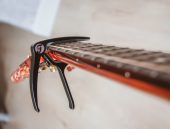
You’ve no doubt seen one clamped on the neck of a guitar before: a capo. Also known as a capodastro, this handy little tool typically features a metal, plastic or rubber-coated bar that, as soon as the device is clamped on, holds down all six strings at the preferred fret to change the pitch, essentially changing the key the guitar is in. Never used a capo before? Then read on to learn all about it.
-

Nothing is more boring and unappealing than a song that doesn’t go anywhere, which is why any successful song needs to build tension and make sure that the listener is kept curious about what will happen next. So what can you do to keep a song fresh and surprising? How do you make a song instantly recognizable but a pleasure to listen to? Songwriting teacher, Peter van Vleuten offers some handy tips and tricks.
Comments Off on How to Build a Song with a Hit-Worthy Tension Arc | in: Guest Blogs, Musician, Songwriting & Composing -

You might not know it, but the concept of a headless electric guitar or headless bass is actually pretty old. In 1979, Steinberger released a headless model with a distinctively minimal design, and soon after, Hohner released their own ‘licensed by Steinberger’ models. During the last few years, a headless trend has been brewing and these less-than-standard models have experienced a comeback, so in this blog we dive into the benefits and the pitfalls of owning your own headless guitar or bass.
-

While the guitar industry is fairly conservative when it comes to innovation, some recent developments are worth checking out. So, if you’ve never heard of multiscale guitars before (aka models fitted with so-called fanned frets), simply read on and be amazed.
-

Suffering from Gear Acquisition Syndrome? Here’s the cure: instead of buying a new guitar, upgrade your current guitar! In this article, we lay out five ways you can upgrade your stringed sidekick and refresh its sound, look and feel. Ready for a make-over?
-

It is possible to play your electric or acoustic guitar sitting down or standing up. We recommend starting out by playing seated. In the beginning, this is better for maintaining a healthy posture. We explain how to hold the guitar both when playing seated and when playing standing up, and what the best posture is.
-

You happily tune up your guitar, your bass, your ukulele or another string instrument and a few minutes later it’s already fallen horribly out of tune. In desperation, you look to the sky and cry out to the universe: “Why won’t it stay in tune?!!” It’s a simple question but it has at least ten possible answers. So, depending on the answer, you might be able to solve the problem in the blink of an eye. Or you might be working with an instrument that’s in dire need of a good tune-up. No matter the problem, you’ll be able to find the solution in this list of the usual suspects when it comes to wonky tuning stability.
-

Working from home surrounded by restless kids? Then it can sometimes feel like you’re not just the breadwinner and caretaker, but the teacher. Besides cartoons and YouTube videos, one of the sure-fire ways to keep children entertained and out of trouble is music, but coming up with fun music-related games and activities at home can be a tall order, especially if you should be working at the same time. Not to worry! Here, we’ve stacked up seven tips and musical games that you can try out and see what sticks… or comes to a sticky end.
Comments Off on 7 Musical Games & Tips for You and Your Kids | in: Musician -

If you’re looking for your first digital piano and want to make sure you’re not only well informed, but know exactly what you’re looking for before you start wading through the sea of models that are out there, then this blog has been written for you. Here, you’ll find out the ten most essential things to know about when it comes to picking out the right digital piano.
-

In this guitar-focussed article, guest-blogger Marc serves up a step-by-step guide on how to swap out the standard strap buttons of your acoustic guitar, electric guitar or bass with strap locks. Rest assured, it’s easier than you think and all it takes is a screwdriver and a little bit of your time. Let’s get started.
Comments Off on How To Replace Guitar Strap Buttons With Strap Locks | in: Bassist, Guest Blogs, Guitarist, Musician -

Since he once struggled to grasp music theory himself, guest-blogger Lode Habex knows exactly how to help out beginners. In this article, Lode breaks down the circle of fifths and explains why it’s one of the most practical tools that musicians can use to match scales, find notes, create chord progressions, and more.
Comments Off on The Circle of Fifths: Every Musician’s Best Friend | in: Guest Blogs, Music Theory, Musician