
Saxophone: history, types and playing techniques
Published on Monday 18 May 2026
In our articles about musical instruments, the saxophone simply can’t be left out. It’s remarkable to see how this relatively young instrument – invented in 1840 – continues to hold its own in pop music and jazz. The saxophone is a popular instrument and features on countless classic tracks. We’ll cover the history of this ingenious wind instrument, along with the different types of sax, playing styles and techniques.

Photos: Gerard Burgers

Saxophonist Allard Buwalda (photo: Fred de Groot)
The human voice
“Of all instruments, the saxophone probably comes closest to the human voice,” says saxophonist Allard Buwalda. “The saxophone has an enormous range of tone colours. From beautiful and sweet to loud and gritty, and everything in between. That means you can put any emotion you can think of into a saxophone.” Allard Buwalda is a sought-after session and studio saxophonist. He plays in various ensembles and has performed with internationally renowned artists. He’s also part of the well-known horn section The Jayhorns. Allard has released two solo CDs, and his latest project with The Phonebox Quintet was nominated in 2009 for the Edison Jazz Award. When he was eight years old, he was captivated by the sound of the saxophone. “I saw a clown at a travelling circus playing the sax. I instantly fell in love with the sound.”
The saxophone is originally a classical instrument. It was invented by the Belgian Adolphe Sax, who we’ll come back to in a moment. The saxophone never truly became established in the classical orchestra. It doesn’t have a fixed place among woodwinds like the flute, clarinet and oboe, or among the brass instruments. There are, however, various classical works in which the saxophone plays a role (such as Ravel’s Boléro), along with solo pieces by composers including Ibert and Glazunov. In classical music, the saxophone found a more natural home in chamber music, with the saxophone quartet as the clearest example.
In jazz and pop, we’re still very grateful for Adolphe Sax’s invention. The saxophone entered jazz via the big bands of the 1920s. In that style, the saxophone really made its mark. When pop and rock emerged later on, the saxophone also found its place there. “That’s remarkable, because it’s an acoustic instrument,” Allard notes. “I think it’s partly down to the saxophone’s versatility and its flexibility in sound. The clarinet and the flute have that much less, although I’m a huge fan of the flute myself. People often find sax solos beautiful too.”

Inventor of the saxophone Adolphe Sax
Adolphe Sax
The saxophone was invented in 1840 by the Belgian Adolphe Sax (1814-1894). Sax came from a family of instrument makers. He wasn’t only the inventor of the saxophone; he also introduced important improvements to many other wind instruments. With the saxophone, Sax wanted to create an instrument that had the suppleness of strings, the dynamic possibilities of brass, and the tonal options of woodwinds. In short, he wanted an instrument that combined the best qualities of the classical orchestral instruments. And he succeeded. But as mentioned, that still didn’t earn the saxophone a fixed place in the classical orchestra. Incidentally, the first saxophone Sax built was a bass saxophone, because the proportions make it easier to build. In the years that followed, he built the rest of the family.
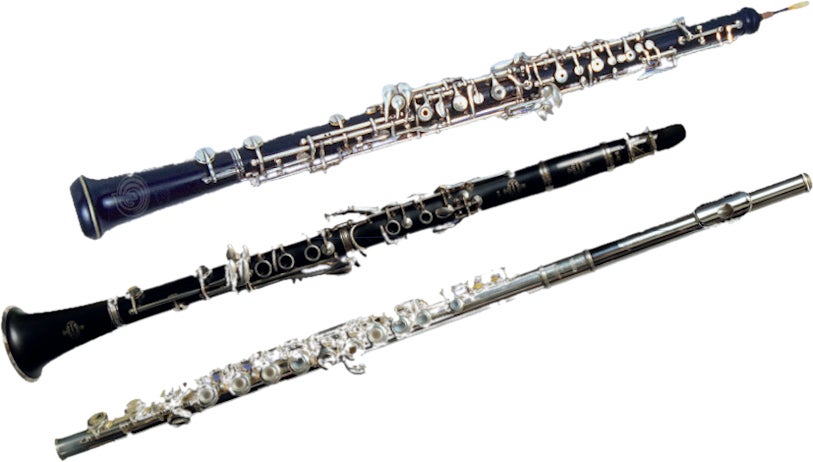
Like the oboe, clarinet and flute (top to bottom), the saxophone is classed as a woodwind instrument, even though it’s usually made of brass. Below, we explain why.
To Paris
Adolphe Sax’s life was far from easy. Multiple times, he narrowly escaped death through illness and accidents. Most of his brothers and sisters died young. He himself lost seven children. Business-wise, things didn’t always go his way either. In his home country Belgium, he didn’t receive the recognition he expected as the inventor of the saxophone. Luckily, a French nobleman saw Adolphe Sax as the right person to equip French military bands with better instruments. At this man’s request, Sax moved to Paris in 1842, where he opened his first instrument factory, called Adolphe Sax & Cie. As a regular supplier to the French army, his business flourished. But when a so-called decree was withdrawn, he lost that position and his company went bankrupt in 1852. Under Napoleon III, the decree came back into force and Sax was able to supply again. During the Franco-Prussian War, his business collapsed once more. His personal collection was even sold. His only income came from his role as musical director of the Paris Opera. Adolphe Sax created a wonderful invention and received recognition for it, but he never truly became wealthy. After his death at the age of 79, he left behind a mountain of debt. The company was continued by his son. In 1928, the rights were purchased by the French instrument maker Henri Selmer. To this day, the company is a renowned producer of saxophones and other wind instruments. Allard has an endorsement deal with Selmer.

The mouthpiece is usually made of ebonite and the reed of Arundo donax (a type of bamboo).
Reeds and keys
Before we dive into the musical side of the saxophone, here’s a bit of tech. The saxophone is a wind instrument whose mouthpiece uses a single reed, just like the clarinet. A saxophone reed is made from a type of bamboo called Arundo Donax. When you blow, the reed vibrates, which produces sound vibrations. These are amplified and coloured by the saxophone itself, which acts as the resonating body. Allard personally uses La Voz reeds by Rico.
Most saxophones are made from brass, an alloy of copper and zinc. Even so, the saxophone is classed as a woodwind instrument, like the clarinet and the oboe. That’s because, thanks to the reed and the keys, the saxophone is closer to the clarinet than to brass instruments, which use a mouthpiece and valves. Incidentally, the flute is also classed as a woodwind instrument, because it was originally made of wood.
The saxophone is a conical (flaring) tube with keys. The longer the tube, the lower the sound. Most keys are closed by default, while a few are open. By opening (or closing) certain keys, you change the airflow and produce a different pitch. The saxophone is an octave-registering instrument. With a certain key combination you can play a note, and with that same combination also play the note an octave higher. You reach that higher octave by so-called overblowing. To make overblowing easier, there’s an octave key by the thumb, which operates the octave vents. “That octave register is a big difference compared to the clarinet,” Allard notes. “If you overblow on a clarinet, it doesn’t go up an octave but an octave plus a fifth. They call that a twelfth. That difference makes it tricky to switch from saxophone to clarinet.” Allard also plays clarinet and flute.

By opening (or closing) certain keys, you change the airflow and create a different pitch.
The saxophone family
The longer the tube (and therefore the larger the saxophone), the lower the sound. Those different tube lengths have resulted in a fairly extensive saxophone family. But out of all those “family members”, five are the most common. These are (from high to low): the soprano saxophone, alto saxophone, tenor saxophone, baritone saxophone and (more rarely) the bass saxophone. You’ll see the alto most often in pop music and jazz, followed by the tenor. “The alto has a very manageable size, especially for children,” Allard notes. “That’s one of the reasons why the alto is the most commonly used saxophone.”
The soprano, tenor and bass are pitched in Bb. The alto and baritone in Eb. When a tenor plays a written C, you hear a Bb (just like with a Bb trumpet). That’s why sax parts need to be written in transposition. A lot of music with horns is in F, Bb or Eb, so that players don’t end up with too many sharps and flats in their parts. So why aren’t these instruments simply pitched in C? “In principle they can be, but a C saxophone doesn’t sound as good,” Allard explains. “That’s probably down to the proportions. The soprano, tenor and bass sound best in Bb. The alto and baritone sound better in Eb.”
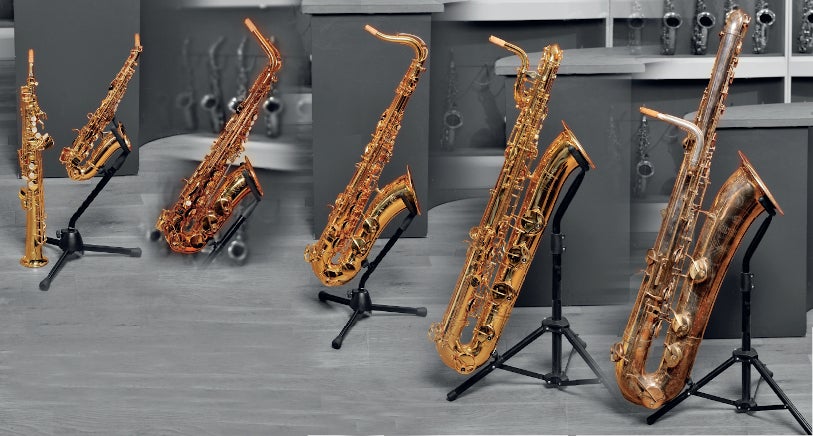
The main members of the saxophone family (left to right): soprano (straight and curved), alto, tenor, baritone and bass
An ever larger bore
Originally, the saxophone is a very mellow instrument, with a gentle tone. When the saxophone entered big bands in the 1920s, the volume had to be increased to compete with the power of the brass section. To achieve that, saxophones were made increasingly conical (more flared). This is called a larger bore. That development continued as the saxophone moved into pop and rock. Even today, saxophones are being developed with an even larger bore. Allard isn’t happy about that. “A large bore sounds very impressive the first time you play it. But after two months, it starts to get boring. As far as I’m concerned, the limit has been reached.”
Allard does understand the search for an ever louder saxophone. “Saxophones are often used alongside brass, for example in a big band or a horn section. On average, trumpet players have become better and better. The level is much higher than in the days when trumpeter Louis Armstrong came onto the scene. With that higher level, the volume of trumpet players has also gone up. On top of that, trumpet players don’t hear themselves well because they’re blowing away from their own ears. The sound of a saxophone spreads much more.”
That’s why Allard enjoys playing in a big band less these days. “The trumpet players behind you play far too loud. But I experience that in other settings too. Really, the person in musical charge should guide this. I think the Wynton Marsalis big band is a good example of the right volume balance. It also depends on how a piece is written, by the way. If it’s written ‘open’, this problem is less of an issue.”
Over the years, the tone character of the saxophone has also changed, mainly because of how it’s played. That’s largely due to its use in pop and rock, where a saxophone needs to sound bright to cut through the mix. “Adolphe Sax wouldn’t be pleased, because that’s not what he intended,” Allard remarks.
Saxophone in a band
Allard sometimes notices that brass players can be a bit envious of saxophonists because the saxophone is a less difficult instrument. “Brass players have to invest a lot of time in their technique and keep doing so. Saxophonists need to do that less, and as a result they sort of have time left over to develop other musical skills. For example, playing other instruments. You also see many saxophonists going deeper into harmony and theory, like keyboard players and guitarists often do too.”
And if you compare saxophonists to the musicians in the rhythm section – drummer, bassist, guitarist and keyboardist? “That’s a completely different world. Mainly because of background. Rhythm-section players often started individually on their instrument and then ended up in the band scene. Horn players, including myself, often come from wind bands and brass bands. And they bring that atmosphere with them. A really nice atmosphere, by the way. I still enjoy appearing as a guest soloist with a local music society. I immediately recognise the vibe from when I was younger.”
The way of playing is also very different from that of the rhythm section. “In the rhythm section, everyone does their own thing. Of course, together they need to play the right groove. The horn section, on the other hand, forms a musical block that plays together in detail. As a horn section you play lines and stabs. Those need to be spot on and tightly timed.” (See also our article about this.)
A great instrument to start on
Is playing saxophone difficult? “No, not really,” Allard answers. “Trumpet and trombone are much harder to learn. If you practise seriously on saxophone, you can play a song after a month. You really won’t manage that on trumpet or trombone. In the end, of course, all instruments are roughly equally difficult if you want to master the finer points as an advanced player. But as an entry point, saxophone is a great instrument, because you can play reasonably well quite quickly.”
Still, the saxophone has its own challenges, Allard explains. “The saxophone is an instrument that naturally plays out of tune. If you play a scale upwards, the sax wants to go ‘sharper’ than it should. As a player you have to hold that back. You do that by ‘thinking the notes down’ when you’re playing an ascending line. The same goes the other way: if you play a line downwards, the sax wants to go too far down. In that case you need to ‘think the notes up’. Playing in tune might well be the hardest part of playing saxophone.”
Are there common mistakes saxophonists make? “Something you see sometimes is using the tongue too much. The back of the tongue then gets too involved with the reed’s vibration. That doesn’t help the tone. You also see saxophonists producing too much sound with the upper part of the throat. That also goes at the expense of the tone. As a saxophonist, you should actually do as little as possible yourself and leave as much as possible to the saxophone. It’s a brilliantly designed instrument, so it can do the work.”
An affordable instrument
“The big secret to playing saxophone well is breath support,” says Allard. “That was a huge eye-opener for me. With good breath support you have much more control, and you can even compensate for keys that don’t seal perfectly.” You create breath support with your flanks.
“The great thing about the saxophone is that it’s not actually that expensive an instrument,” says Allard. “For a little over four thousand pounds, you’ve got a top instrument. There are plenty of other instruments with much higher prices. Take the flute. A professional flute that you can play in a classical orchestra costs between sixty and eighty thousand pounds. Those are very different figures.”
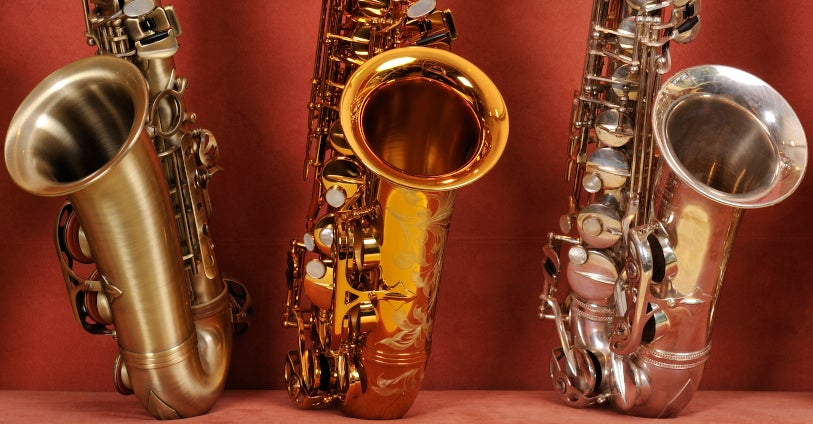
Different saxophone finishes (left to right): matte, gold lacquer and silver-plated
Good to know
Lacquered or matte?
Saxophones come in various finishes, such as ‘vintage’ matte, silver-plated and gold lacquer (see photo above). With the latter two, the saxophone is covered with a layer of silver or gold. Allard has developed a preference for gold lacquer because of the sound. “I have the impression that a saxophone with a gold lacquer layer vibrates more freely. That benefits the sound. It’s probably because a gold lacquer layer is very thin. A silver layer is thicker.”
Saxophone and singer
Are you accompanying a singer with your saxophone? Then Allard advises choosing a tenor saxophone rather than an alto saxophone. “The alto sax sits in the same pitch range as a singer. From experience, I know singers can quickly feel uncomfortable when they’re accompanied by an alto sax. With the tenor sax you sit a bit lower and therefore less in the singer’s tonal range. It’s also important to apply the golden studio rule: don’t play through the vocal.”
Play injury-free
With any musical instrument, you can pick up injuries, for example through overuse. The same goes for the saxophone. “If you feel anything, stop immediately,” advises Allard, based on what he learned during his conservatoire training. This advice obviously applies to any instrument.
Reading music or not?
If you want to make a profession out of making music, you need to be able to read music well, Allard believes. “Thanks to their wind band or brass band background, most horn players can do that. With guitarists, for example, it’s different. But I also know guitarists who can read music well, and they’re the ones who get called for studio and session work. Reading music isn’t difficult. Anyone can learn it and it has nothing to do with musical talent. It’s simply a matter of practice. Play from sheet music for half an hour every day and keep increasing the metronome speed. It’ll come naturally.”
Influential saxophonists
The list of famous saxophonists is fairly long. Here, we’ll limit ourselves to jazz and pop saxophonists who have had a major influence on those who came after them.
Rudy Wiedoeft (1893-1940) was an American saxophonist of German descent. He played the C Melody saxophone and made it very popular in salon music. He invented many effects that are still used by saxophonists today.
Johnny Hodges (1906-1970) was an alto saxophonist with a velvety tone and smooth glissandos. He played, among others, in Duke Ellington’s big band.
Coleman Hawkins (1904-1969) was the first to use the tenor saxophone in jazz. His style is characterised by lots of air and fat, dark tones.
Lester Young (1909-1959), tenor saxophonist, was a contemporary of Coleman Hawkins, but had a lighter and more lyrical sound. He played, among others, in Count Basie’s big band.
Charlie Parker (1920-1955) was a saxophonist and composer. He is seen as one of the most influential jazz musicians and was the man of bebop.
Julian ‘Cannonball’ Adderley (1928-1975) was an alto saxophonist who, through his soulful, swinging and bebop-style playing, built a bridge between Charlie Parker’s bebop and pop music.
Phil Woods (1931-2015) followed in Charlie Parker’s footsteps as a bebop saxophonist. Also known for the famous sax solo in the pop song Just the way you are by Billy Joel.
Gerry Mulligan (1927-1996) was a well-known baritone saxophonist, particularly in cool jazz.
John Coltrane (1926-1967) was the defining tenor saxophonist of the 1960s. He played hard bop and free jazz. Michael Brecker (see below) was inspired by him.
Lee Konitz (1927) is an alto saxophonist with a typical melodic West Coast sound, who inspired many saxophonists.
David Sanborn (1945) on alto saxophone is the pop saxophonist of the twentieth century. He shaped the pop sound. He was inspired by Julian ‘Cannonball’ Adderley.
Michael Brecker (1949-2007), like David Sanborn, set the tone for the saxophone in pop music, but on tenor saxophone and with a harmonically ‘heavier’ approach. He also played jazz.
Branford Marsalis (1960) plays jazz, classical and pop. Because of his mellow sound, he can be seen as the ‘softer’ counterpart to Michael Brecker. He played, among others, with Sting.
Playing amplified
Amplifying a saxophone via a microphone can be done in two ways: with a clip-on microphone on the bell, or by playing into a microphone on a stand. “A clip-on mic gives you more freedom to move,” says Allard. “And the distance between the microphone and the bell is always the same. That’s very helpful for the sound engineers. I use an AMT clip-on mic myself.”
Feel where the note sits
The article mentions that playing in tune may well be the hardest part of playing saxophone. There are different ways to train that. For instance, you’ll play more in tune if you develop the sense of where notes “sit”. You can train that by hearing a note (for example by singing it) and then trying to find that note on the saxophone in one go. This develops your tone–fingering association, which in turn helps with intonation.





No comments yet...