
Connecting a subwoofer: how do you do it?
Published on Thursday 7 May 2026

You play live shows or mix music in a studio. And your big wish is for your speakers to sound deeper: more bass! So now you reckon it’s time for a subwoofer (or two). Not a bad idea. Only… how do you connect one? We’ll explain.
What kind of subwoofers is this article about?
Here, we’re focusing on speakers for the stage, i.e. PA speakers, but you can also apply the advice to studio monitors. Got questions about subwoofers for home use? Then ask a hi-fi specialist for advice.
What terms like 2.1 and tops mean
The first number is the number of tops you use (your regular speakers) and the second number is the number of subwoofers. A 2.1 configuration therefore has two regular speakers (left and right) plus a subwoofer. If you have a 5.1 system, that’s probably a surround setup, with five regular speakers and one sub.
How to tell whether a speaker is active or passive
It’s very easy to check:
- An active top or subwoofer needs to be plugged into the mains.
- With a passive top or subwoofer, you can’t do that. You’ll need a separate amplifier.
- It’s possible to have a combination of an active subwoofer with passive tops.
What’s better: an active or passive subwoofer?
What are the pros and cons of active subwoofers on the one hand, and passive subs on the other?
Active
➕ It’s a ready-to-go speaker that’s easy to connect, because you don’t need an external amplifier.
➕ The built-in amplifier is already perfectly matched to the woofer.
➖ An active subwoofer needs power, so you’ll need an extra cable to it.
➖ An active subwoofer is heavier.
Passive
➕ Passive subwoofers are lighter than active subwoofers because there’s no amplifier inside.
➕ With passive speakers, you can build your setup exactly the way you want.
➖ Integrating a passive subwoofer into a sound system is more complicated.
➖ You need more equipment.
» Active PA subwoofers
» Passive PA subwoofers
» Studio subwoofers
Option 1: active subwoofer + active tops
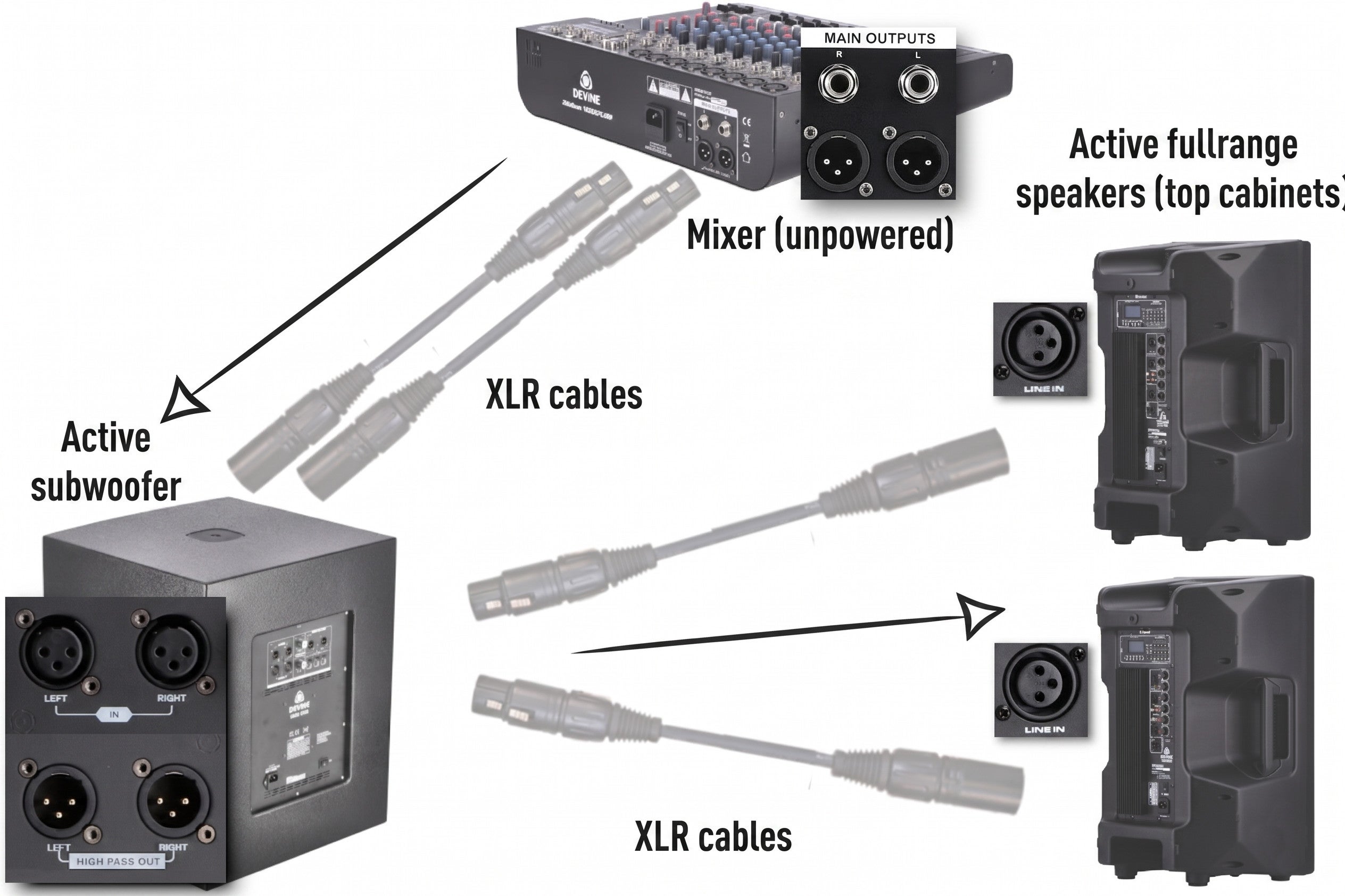
An active subwoofer has a built-in amplifier, just like a standard active speaker. That’s why you connect an active subwoofer to the line out of a mixer or audio interface, and NOT to a speaker output of an amplifier.
In total, you’ll need four audio cables. Run two cables from your mixer to the subwoofer: one cable for left (L) and one for right (R). With the other two cables, go from the subwoofer to the tops: one for left, one for right. Note: use the ‘high pass’ output, or something similar, and not ‘link’ or ‘output’, because it’s important that the tops don’t receive the full signal, but only the higher frequencies, for the best sound.
Internally, the subwoofer automatically splits the signal between the lows and the mid/highs. The low frequencies from the left and right channels are summed and played by the subwoofer. The mids and highs go to the outputs where you can connect your tops. So this is the same signal that comes from your mixer, but without the low frequencies.
What about two subwoofers?
No problem. Instead of running two cables from the mixer to one subwoofer, you now run one cable to the left sub and the other to the right. Alternative: if it’s more convenient cable-wise, you can also run two cables to the first sub, and then run one cable from a ‘link’ output to the right subwoofer.
» Active PA subwoofers
» Active PA tops
» XLR cables
Option 2: active subwoofer + passive tops
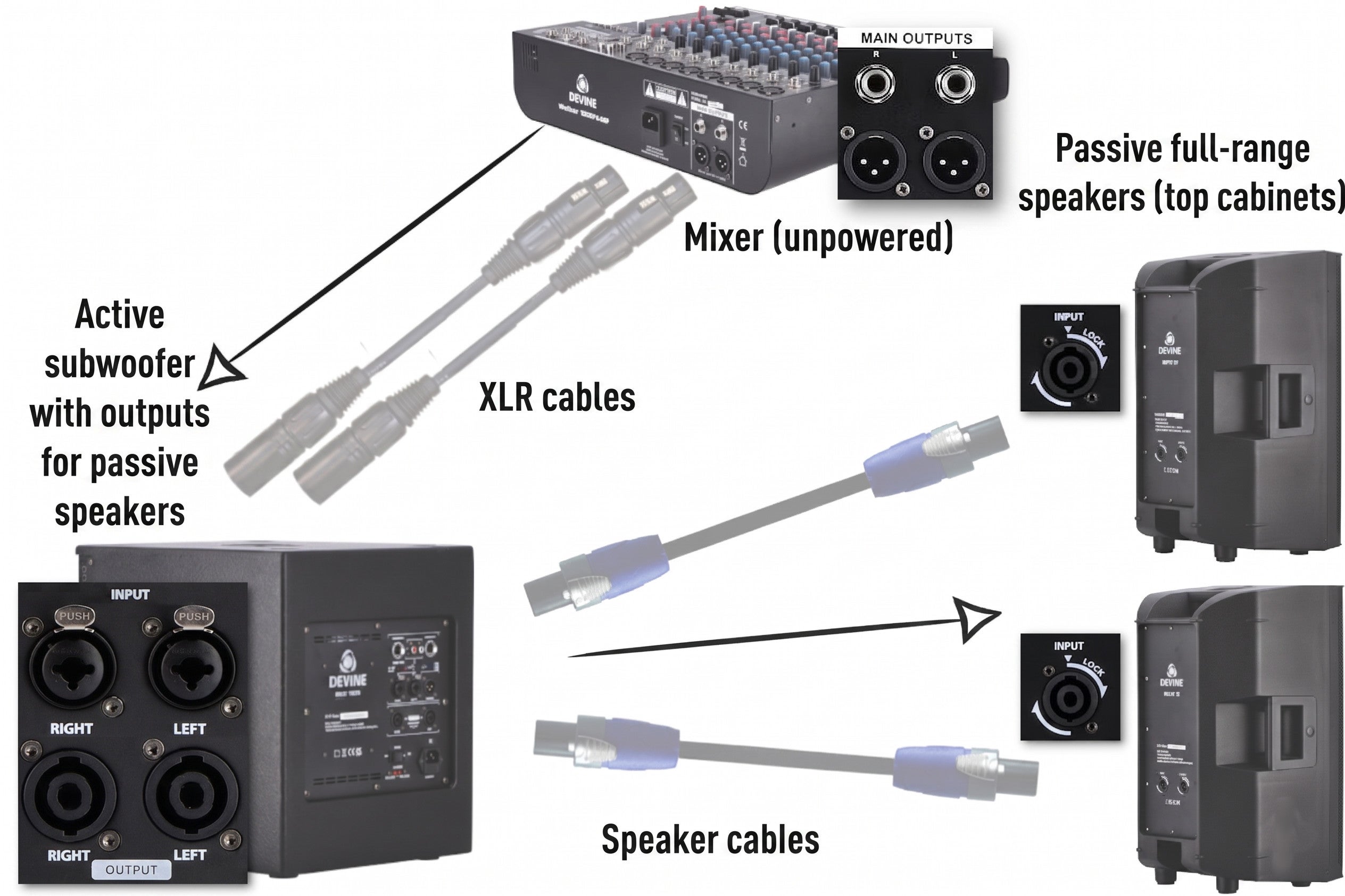
Some subwoofers give you the choice between two types of outputs:
- XLR line out, for 2 active tops and
- locking speaker outputs, for 2 passive tops
An active subwoofer with locking outputs has not only an amplifier inside to power itself, but also a stereo amplifier to power two external speakers. Just make sure that the total output power (in Watts) that the subwoofer delivers to the tops is 1.5 to 2 times higher than the combined power handling of those tops.
So you can now choose whether you want to use active or passive tops. The advantage of passive speakers is that they’re lighter and you don’t need to run separate mains cables. In that case, power is delivered via the speaker cables coming from the subwoofer.
What about two subwoofers?
That’s also perfectly doable. If you have two subwoofers, simply run one cable from the mixer to the left sub and one cable to the right.
» Active PA subwoofers
» Passive PA tops
» XLR cables
» Speaker cables
Option 3: passive subwoofer + passive tops
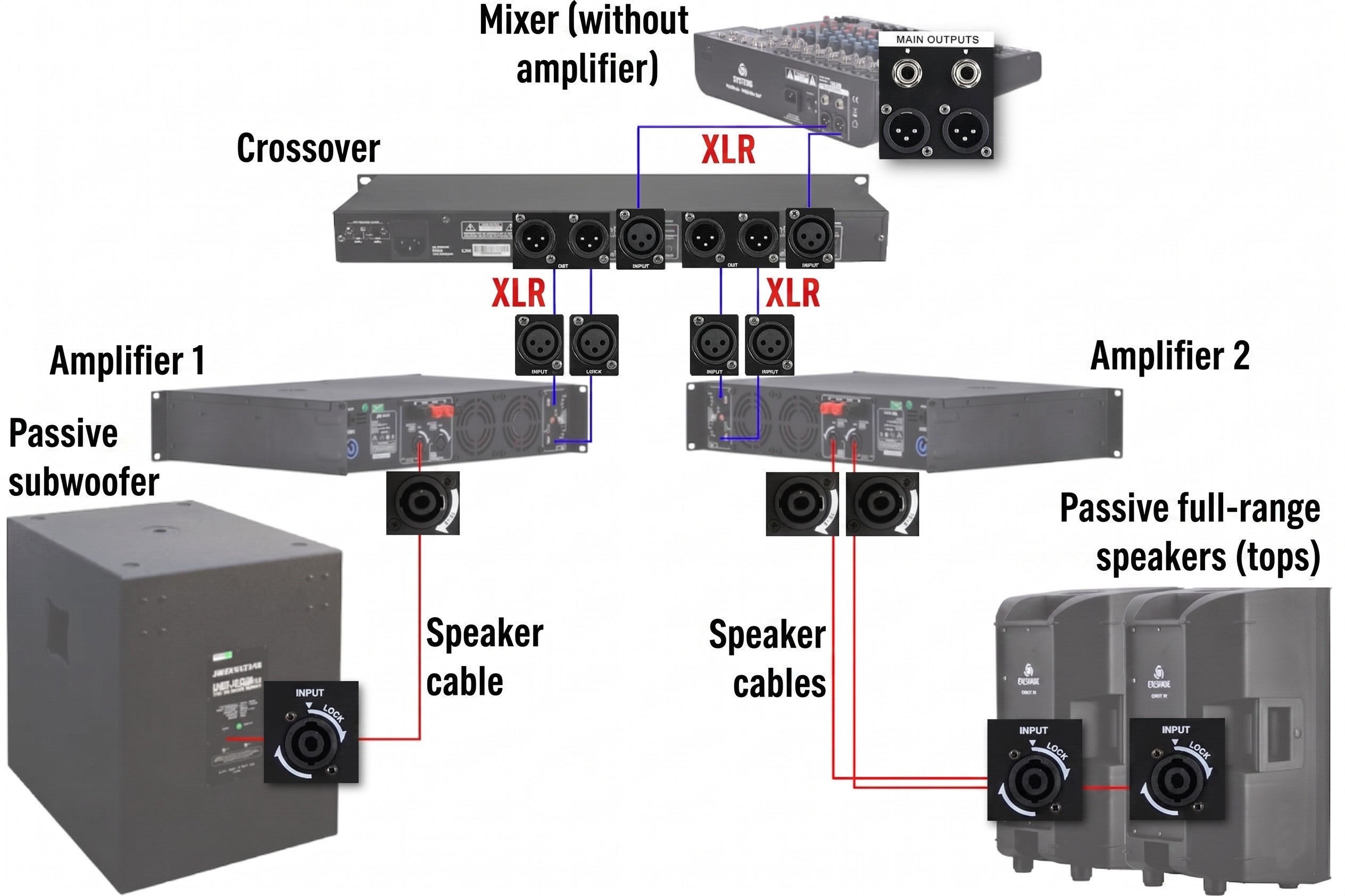
Amplifier for the sub
Passive subwoofers don’t have a built-in amplifier. So you’ll need an external amplifier. It is not possible to use the line out of your mixer. A line output does carry a signal, but it’s far too weak to drive a speaker. In short, the line-level signal from the mixer needs to be amplified with an amplifier. Is that all? No!
A top amplifier + crossover
You’ll also need a second amplifier to drive your tops. And to split the signal between high and low frequencies, you’ll need a separate, active stereo crossover. Connect the gear as shown in the image above. So:
- Connect the left and right outputs of your mixer to the left and right inputs of your crossover.
- Connect the ‘Low’ outputs of your crossover to the subwoofer amplifier and connect the amplifier output to the speaker input of your subwoofer.
- Connect the ‘High/Mid’ outputs of the crossover to the top amplifier and connect the amplifier outputs to the speaker inputs of the tops.
What about two subwoofers?
Absolutely possible. We’re assuming you have a stereo amplifier for the subwoofer (almost all amplifiers are stereo). Connect one sub to the first speaker output of the amplifier and the other to the second speaker output.
» Passive PA subwoofers
» Passive PA tops
» Crossovers
» Amplifiers
» XLR cables
» Speaker cables
Crossover: what is it?
A subwoofer takes care of the low frequencies in your sound system. So when you integrate a subwoofer into your system, it’s important to redistribute the tasks within your system. After all, you don’t want your tops and your subwoofer both playing low frequencies. This overlap can cause big peaks and dips in your system’s frequency response. To create this new split, you use a crossover. A crossover receives the full signal from your mixer and splits it into a low band and a mid/high band. The lows are sent to your subwoofer and the mids and highs are sent to your tops.
Other important products
» PA speaker stands or speaker poles (to place a top above a sub)
» Mixers
 The Difference Between Active and Passive Speakers
 Want to turn LPs into MP3s? Here’s How to Digitise Your Vinyl
 Setting Up the Band with a PA System? Here’s What You Need to Know
 How to Breathe: For Vocalists & Musicians
 How To Connect Your Speakers To Your Audio Equipment
 How to Tune Up & Play a Guitarlele
No comments yet...