
-

Whether you’re getting a shop-fresh model or a more played-in hand-me-down, no bass guitar ever comes perfectly set up specifically for you. We’ve all got a unique style and preferences to match, and there’s nothing wrong with that. In this blog, guest-blogger and bassist Cor Vos presents a basic guide to setting up a bass guitar. It’s completely beginner-friendly too, meaning we’re not covering more in-depth tweaks like pickup swaps and nut-filing. Depending on your bass, all you’re going to need is a good ol’ hex-key and a phillips head screwdriver. Let’s get started!
-

Throwing in solid drum fills can be pretty difficult for beginners. Some go too fast while others over-complicate things – two habits that are hard to kick without the help of a drum teacher. In addition, not being able to time your fills right can be extremely frustrating, whether you’re rehearsing or just jamming, and not just for you, but for any musicians you’re playing with as well as anyone listening. So, in this blog, I’m going to teach you various simple drum fills and show you some very useful tips!
-
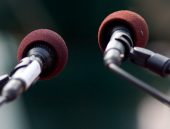
Say you’ve finished recording all of the instruments and vocals and you want to mix everything down. The individual tracks sound great, but once you start playing with the faders, it sounds like all parts of the recording are working against each other. The mix is all but up to snuff, and a phase issue is most likely to blame. In this blog, I’m going to explain what phase is, what it causes and how you can get rid of it, so you can prevent or fix any phase issues as they pop up while you’re working on your studio projects.
Comments Off on How to Prevent or Fix Phase Issues in the Studio | in: Microphones, Studio & Recording -

In this blog, we dive deeper into how harmony works by looking at the chords commonly used in jazz and pop: the ninths, elevenths, and thirteenths, and all of their variations. Each of these magic chords can be built by simply stacking more thirds onto a seventh.
-

These days, any musician or producer is offered the tools they need to make good audio mixes. Audio interfaces sound more impressive than ever, recording software has never been so extensive, and a solid set of studio monitors has never cost less. But there might be one last thing missing: a great sounding listening and mixing room. Here, I’ll let you in on a few little secrets when it comes to acoustic treatment and where and why you should place any absorption panels and diffusion panels to improve the acoustics and perfectly neutralise the sweet spot. I’ll also explain the part that calibration software can play in setting you up with the perfect listening room.
Comments Off on Get the Best Out of Your Studio Monitors with Absorbers & Diffusers | in: Studio & Recording -

If you want your acoustic or electric guitar or bass to sound and feel as good as it possibly can, you can’t overlook the importance of proper maintenance. In this article, guest-blogger Dean explains how to nourish your instrument, how to keep the humidity in check and why the right room temperature is crucial.
Comments Off on Guitar Maintenance: Wood Conditioning, Temperature and Humidity | in: Bassist, Guest Blogs, Guitarist, Musician -

Everyone who’s privileged enough to have access to broadband internet and a fairly fast computer can launch a podcast or even an internet radio station of their own for a relatively small amount of money these days. However, the microphone built into your laptop isn’t going to cut it, and the acoustics of your soon-to-be studio space could probably do with a little treatment too – so read on to find out how you can get pro-grade podcast audio quality on a budget!
Comments Off on How To Make a Pro-Grade Podcast on a Budget | in: Studio & Recording -

If you’ve already made it this far, then you’re probably already the proud owner of your very own cajon. You’ve seen or heard a cajon afficionado spitting beats and thought, “I can do that!” But now that you’re sitting astride your brand new percussion box, it’s already looking a little more complication than you first thought. Not to worry! Everyone starts somewhere, and since you’re here, this is where you’re going to start! In this friendly little blog, we’ll guide you through three awesome cajon beats that you can use as a foundation to expand your cajon-based skills. No theoretical knoweldge or the ability to read music required!
-

A full choir can be seen as an enormous, singular audio source, that sometimes spreads out its sound over tens of metres, making for a pretty unique job when it comes to recording. How do you make sure that every choir member is captured while the choir sounds like a cohesive whole? In this blog, I’ll explain how just two or three cleverly positioned microphones can result in a balanced and clear stereo-recording.
-

While recording an acoustic guitar might sound like a straightforward job, getting a clear and natural-sounding recording can depend on a number of factors. The kind of microphone you use, the way the microphone is positioned, as well as the way the recording space reacts to the vibration of the strings, all play an important role in the final recording.
Comments Off on Recording the Acoustic Guitar: The Basic Rules | in: Guitarist, Microphones, Studio & Recording -

In theory, it’s definitely possible, but in practice it can be a little bit cumbersome. The advantage of using a USB microphone is that you have a great all-in-one setup without needing to use an audio interface. But if you want to use more than one USB mic, things get pretty complicated for your computer. Also, hooking two USB microphones up to a computer kind’ve defeats the purpose of using a USB microphone. But, can it actually be done?
Comments Off on Plug Two USB Microphones to One Computer? Is That Possible? | in: Microphones, Studio & Recording -

In this blog, we’re going to talk about playing the blues, show you which ingredients are needed to play typical blues-flavoured sounds on a piano or guitar, and take an in-depth look at blue notes, blues scales, blues-style chord progressions (including that well-known 12-bar blues), straight-versus-swing blues and various other important topics.
Comments Off on Want to Play the Blues? Use These Chords, Notes and Tips! | in: Guitarist, Keyboardist, Musician
About Bax Music
Bax Music is your go-to online music store in the UK with more than 48,000 bits of gear and accessories in stock. More than 1,000 brands and a 26,000m2 warehouse packed with musical instruments, DJ and studio gear, headphones, speakers and lighting. Ordered before 10 PM? Receive delivery in 2 - 4 business days.
Subjects
Sign up for the Bax Music Blog Update!
Just fill in your email address and we'll drop a fresh instalment of blogs in your mailbox every month so you never have to miss out again.