
Lyrics first or music first? How to start writing a song
Published on Friday 23 October 2026

Lyrics first or music first? Every beginner songwriter asks an experienced colleague that question at some point. The answer is usually a let-down: it doesn’t matter where you start, as long as you start, because a song only gets finished in the back-and-forth between words and notes. Still, every starting point has its own pitfalls.
Lyrics first: the hard part first
I still have a notebook at home from my student days, full of lyrics that never got a melody. Beautiful lines, or so I thought at the time. Only they were poems, not songs. That’s the risk of writing lyrics first: nothing holds you back, so you write too much. Lines of fourteen syllables, verses of six lines, and then you still need a melody that can carry all of it.
Yet there are big names who work this way. Willie Nelson reportedly starts with words and only then picks up his guitar; he calls it doing the hard part first. Elton John and Bernie Taupin have worked like this throughout their careers: Taupin writes the lyrics, John sets them to music. The advantage: you know exactly what you want to say before a single chord rings out, and the music serves the story.
But pay attention to what really happens. Writing a complete lyric and only then looking for music is rare in practice. Far more often there’s a bit of lyric, then a bit of melody, and then you cut and tweak until it fits. Lyrics first rarely means lyrics finished.

Music first: a foundation to build on
Sit down with a guitar or piano on your lap and within a minute you’ll have a chord progression, and within five minutes a vocal melody sung to la-la-la. That feels great and is a genuine foundation: the tempo, mood and phrase lengths are locked in. Many writers work this way, and in the pop world it’s a craft in its own right: the producer makes the beat and the chords, and the topliner adds the melody and lyrics.
The pitfall lies in that la-la-la. A melody that came first has already decided how many syllables fit in a line and where the stress falls. You end up looking for words that fit rather than words that say something, and before you know it “heart” rhymes with “apart” yet again. The music then dictates the content. So decide in advance, even if it’s on the back of a beer mat, what the song is about; if you get stuck, that’s your way back.
The title as a starting point
There’s a third route that’s often overlooked: start with a title. A phrase you overhear on the train, or a friend’s remark that sticks with you. A title like that isn’t lyrics and isn’t music, but it already has a rhythm and a mood. Say it out loud a few times and you’ll often hear where the chorus needs to go.
The big advantage is direction. A title forces you to know what the song is about, which is exactly where lyricists get lost and music writers never get round to. The downside: a good title isn’t a good song yet. I’ve got dozens that never got further than that one line, because the rest just wasn’t in them.
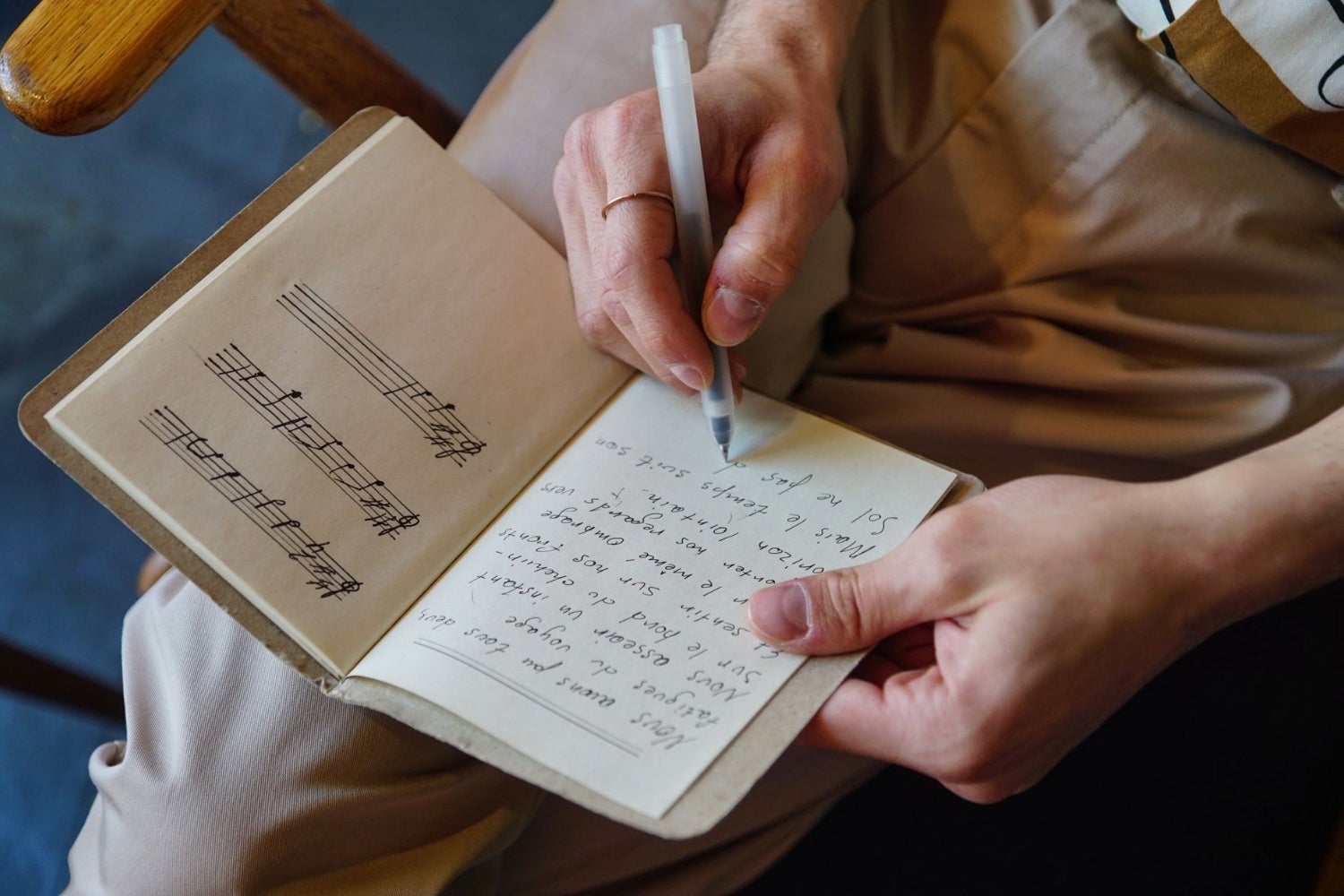
What all starting points have in common: the idea vanishes faster than it came. A melody you hear in bed at night is gone by morning. That’s why one writer walks around with a notebook in their breast pocket while another records everything on their phone. How you do it doesn’t matter, as long as it happens within ten seconds.
Still, I’d like to challenge you with a quote from Stephen King: “A writer’s notebook is the best way in the world to immortalize bad ideas. My idea about a good idea is one that sticks around and sticks around and sticks around.” In other words, trust that the good ideas will resurface in your mind when you need them; a notebook only gets in the way of that process. Agree? I’d love to hear your thoughts… 🙂
Fitting lyrics to an existing melody
Sooner or later you’ll have words and a melody that simply don’t get on. That’s when songwriting becomes tailoring: taking in, letting out, and sometimes a sleeve has to come off. Pat Pattison, who has taught at Berklee since the 1970s and dissected lyrics by Joni Mitchell, Paul Simon and Leonard Cohen there, calls the guiding principle prosody: everything in a song, from line length to rhyme scheme and harmonic rhythm, should point in the same direction as the message.
Take “stable” versus “unstable”, for example. A verse with an even number of lines of equal length, a neat rhyme scheme like ABAB and phrases that start on the first beat: that’s stable. It becomes unstable with an odd number of lines, a deviating final line, a lopsided rhyme like ABBA and phrases that come in after the first beat. If your lyric is about “coming home”, for instance, go for stable. If it’s about “doubt”, make it unstable. Form and content should tell the same story.
In practice: sing the melody to la-la-la and listen for where the long notes and strong beats fall. That’s where the words that matter most belong, with their stress in the right place (if a weak syllable lands on a strong beat, you hear it straight away, like someone mispronouncing your name). Keep shifting things around until it works. And a lovely line that really doesn’t fit? Just save it for the next song. My notebook is full of them.

Handy songwriting tools: from a cheap guitar to a groovebox
The best writing instrument is the one within arm’s reach. A cheap classical guitar on the sofa or a compact keyboard on the kitchen table beats the expensive piano. No cables, no start-up time, no excuses. An idea that pops into your head while you’re cooking can be tried out straight away, before it evaporates again.
A looper and groovebox are also well worth a try. With a looper you record a chord progression that plays on endlessly, leaving your hands free to hum a melody or sing along with a lyric. A groovebox does the same with beats and basslines. Experience shows that it works like instant inspiration: a rhythm that keeps going forces you to respond to it, and that’s exactly when the lines come that you’d never think up sitting at a silent table.
My own turning point was a second-hand MIDI keyboard with a row of drum pads and the stripped-down free DAW that came with it. DAW software like this is often bundled with a controller, and for songwriting a lite version like that is really all you need. You tap in a beat on the pads, lay a few chords underneath, set it to loop and sing over it. What doesn’t work, you bin. What does work is already recorded. Plenty of MIDI keyboards are compact enough to slip into your rucksack along with your laptop.
» View all grooveboxes
» View all loopers
» View all MIDI keyboards
» View all classical guitars






No comments yet...