
What are romplers and samplers?
Published on Friday 15 May 2026
Guest blogger Freek Roffel from Freaky Studio takes you through his second blog about sound synthesis. Or the lack of it. To understand what a rompler is, we’ll take a deep dive into the history and discover that old techniques still shape today’s music. And what exactly is the difference between romplers and samplers?

Hitting the nail on the head
In a recent BBC Radio 2 broadcast, I spotted something beautiful on stage—something white. A Mellotron! The band had a modern version of something that dates back to the early sixties. If I mention Strawberry Fields by The Beatles, you can probably already hear the flutes, and the strings on Bowie’s Space Oddity will ring a few… bells too. The list of Mellotron users is endless.
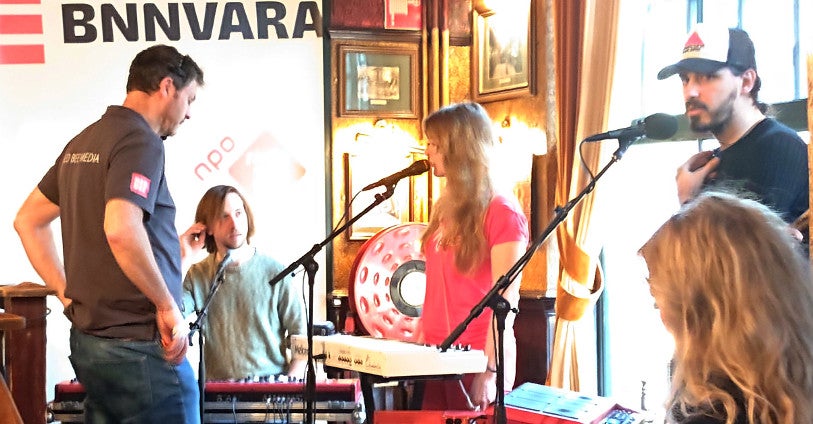
Dutch singer Sandra van Nieuwland during soundcheck with her Mellotron (photo: Freek Roffel)
Mellotron: bowing down to a box of violins
There was a big demand for ‘real’ instruments in the studio, right at the moment when multitrack recording techniques were becoming possible. But hiring a full string orchestra for two bars of music was a hassle, so they came up with a trick. Or rather, a list of 37 recording tapes. When you press a key on a Mellotron, a tape—like a cassette—plays back and stops after eight seconds. Hit a chord and multiple tapes start running, and you hear a whole orchestra pit playing. The downside was that you had to buy new sounds from the factory every time, because recording your own wasn’t possible.
Put your sound in the bank
Fairlight and E-mu started developing samplers in the late seventies that actually let you record and play back your own sounds. Akai became the market leader alongside E-mu, and it quickly turned out that floppies and CD-ROMs were flying off the shelves. But sampling yourself took a lot of patience and time—and often wasn’t exactly straightforward. That’s why every music shop ended up with a rack of discs full of ready-made ‘sound banks’.

AKAI S1000PB (playback), the first rompler ever?
Sounds off the production line
With the introduction of the Roland D-50, samples were combined with digital synthesis, and you could hear ‘natural instruments’ such as pianos. Korg developed the workstation—the M1—which was packed with samples. With these instruments, you can’t sample yourself, but you play back part of the memory: the rompler was born. Just like with the Mellotron’s tapes. Memory was also expensive in the 80s, and the sound wasn’t exactly super-luxurious yet. These days, romplers come with gigabytes of working memory and samples, and the approach to reality can be called eerily convincing. Examples include the Roland FA(ntom), Korg Kronos and Yamaha Montage. There are also plenty of romplers in plug-in form, such as those from Native Instruments, MOTU, Steinberg and Apple.

Where does the term ‘rompler’ come from?
A rompler is a ROM player: a way to play back something that’s written into read-only memory. (The word ‘rompler’ may be a combination of ‘ROM’ and ‘sampler’.) So: you can read, but you can’t write (sample). Is a rompler a synthesiser? Yes and no. You generate sound with the instrument, and most romplers have a whole arsenal of filters and other things you also need for synthesis. Conversely, some synthesisers—such as the PPG Wave and Waldorf Blofeld—use so-called wavetables. These are short samples used as a basic waveform, but they’re not recognisable as the sound of, say, a piano or snare drum. Devices like that are therefore not samplers or romplers. Only the attack—the first part of a sound—is used, and extra synthesis options are used to finish the sound. So you can use the character of a source, but do completely different things with it. Purists will argue that a synthesiser should generate the sound source—the oscillator—itself, but you can debate that for years, and we’re not going to, because we need to make music!
Question for the readers: is a Mellotron sample the same as the sound of the Mellotron itself? And why (not)?



No comments yet...