
Guitar footstool: why and how should you use one?
Published on Wednesday 28 October 2026
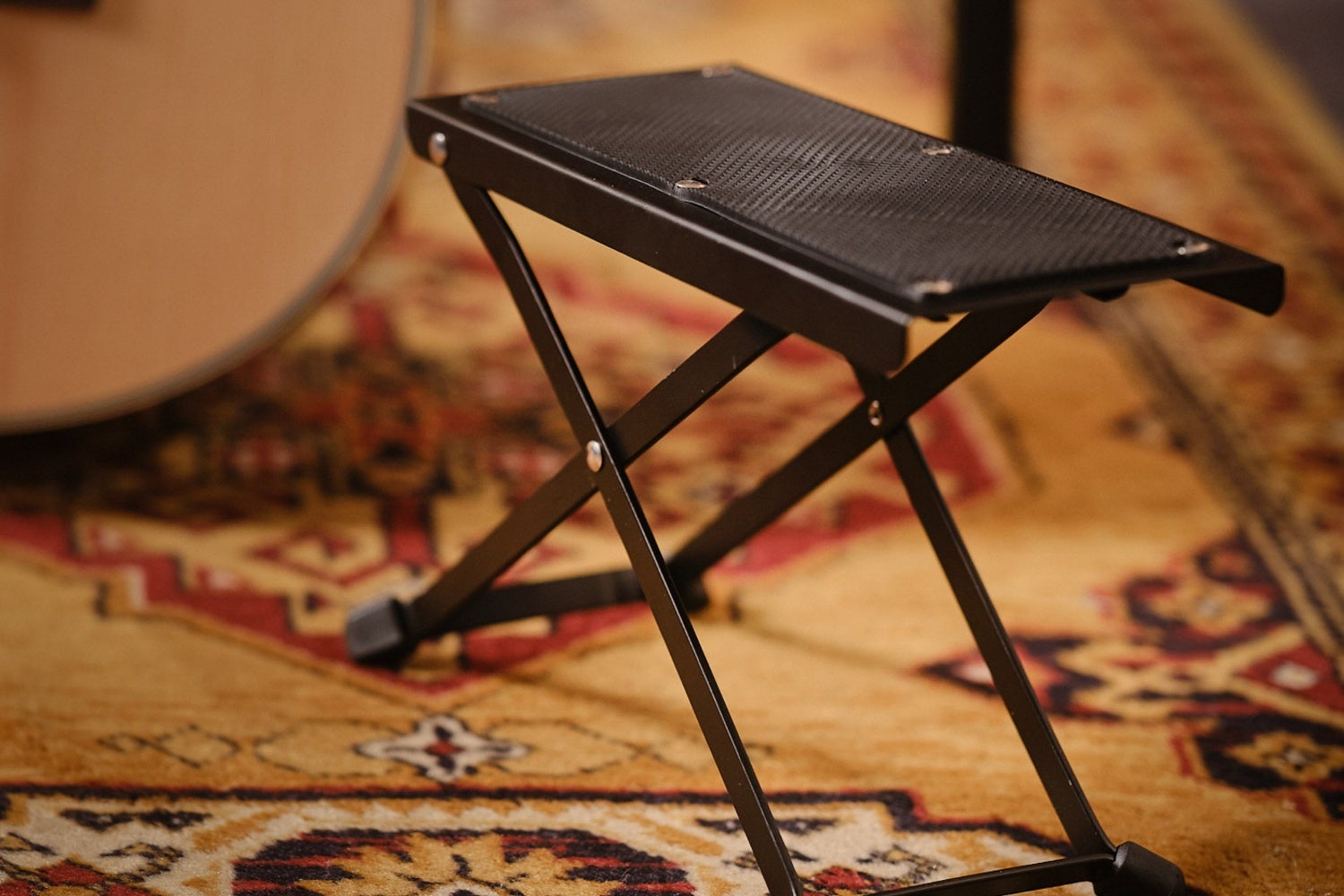
A guitar footstool is a small, height-adjustable stool that you place under your left foot. Classical guitarists in particular swear by it, and not without reason. By raising your left leg slightly, the guitar rests on your left thigh and the neck naturally sits higher, without you having to sit at an angle or let one shoulder drop.
Why a footstool gives your left hand room to move
Try it for yourself first. Rest your guitar on your right leg, as you often would with a steel-string acoustic or electric guitar, and play a scale from the first fret all the way up the neck. Chances are you’ll notice yourself leaning forward to reach the first positions. A wide stretch with your left hand suddenly feels a lot harder, too.
That’s because in this position the neck sits too low and sticks out too far forward. Your left hand has less freedom of movement and your body starts to compensate. If, on the other hand, you rest the guitar on your left leg with nothing underneath, you simply swap one problem for another: now it’s your right shoulder that starts to drop.
The footstool solves both. With your left foot slightly raised, your thigh comes up, and the guitar comes with it. This way you get the neck up without your posture going crooked. Your left hand can move freely across the fingerboard and your shoulders stay nicely level. In other words, you don’t bend your body towards the guitar; the footstool brings the guitar to you.
No wonder the footstool has long been the standard in the classical guitar world. Around 1900, virtually every classical guitarist used one, and Andrés Segovia made it the definitive norm. Today you’ll still see it with almost every established classical player.
» View all classical guitars
» Which acoustic guitar: steel-string or classical?
How to sit properly with a footstool
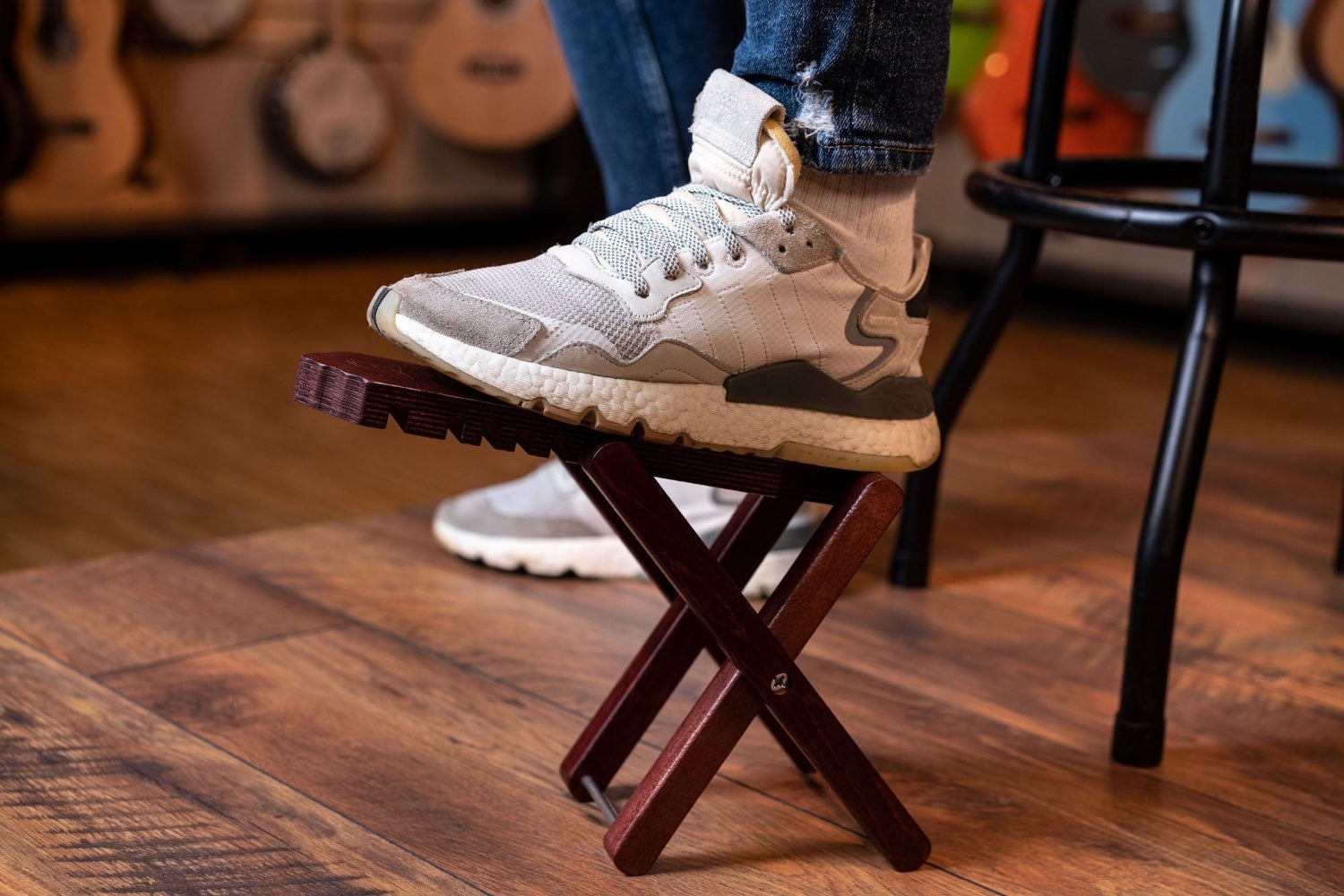
The footstool goes under your left foot, and the guitar rests on your left thigh. Simple enough so far. What really matters is getting your chair and footstool to work together, because the two go hand in hand. Think of it like setting up a road bike: raise the saddle and you often need to adjust the handlebars too, otherwise your whole position is off.
So start with your chair. Choose a seat height at which your legs aren’t bent too sharply and your right foot sits flat on the floor. An ordinary dining chair or piano stool, on which your thighs are roughly horizontal, is exactly the right height for most people. Only then do you adjust the footstool, in relation to how high you’re sitting. A higher chair usually calls for a slightly higher footstool, otherwise your left knee will sink down again.
Once everything is set up correctly, the guitar rests against your body at several points and sits securely, so you don’t need your hands to hold it in place. A quick check: look in the mirror to see whether your shoulders are level. If one is lower, raise or lower the footstool a notch until it’s right.
» How to hold a guitar – Posture for playing standing up or sitting down
What to look for in a footstool
The most important thing about a footstool is a height you can adjust quickly and easily. There isn’t much else to adjust on one, but that single setting is exactly what makes the difference. What feels perfect on your own chair at home might suddenly be too low or too high on a different chair in a lesson room or at a student recital.
That’s why it’s worth taking a critical look at what you’re sitting on, too. A sofa or deep armchair pulls you backwards and makes it hard to find the right height. A sturdy chair or guitar stool without armrests, with a seat height that suits your height, makes setting up a lot easier. Once that foundation is in place, the footstool only needs to take care of the last few centimetres.
» View all footstools
» View all guitar stools

Footstool or guitar support?
The footstool isn’t entirely without controversy. Because your left leg is higher than your right, you’re sitting asymmetrically. Opinions differ on what that does to you if you play for hours every day over many years. It’s a bit like always carrying your bag on the same shoulder: there’s no doubt that it works. The debate is about what your body thinks of it in the long run.
If you’d rather sit symmetrically, you can opt for a guitar support instead. It sits between the guitar and your left leg, raising the neck while both feet stay flat on the floor. There are various types, from foldable A-frame models to supports that attach to the guitar with suction cups, magnets or clamps. Ergoplay is one of the best-known brands of guitar supports.
So which of the two is better? There’s no clear-cut answer. Both share the same goal: positioning the guitar so that your left hand has room to move and your body doesn’t have to compensate. Try them both, ideally with your guitar teacher, and choose whatever feels most comfortable for your body and playing style.






No comments yet...