
Small-diaphragm or large-diaphragm condenser microphone: what’s the difference?
Published on Wednesday 7 October 2026

Large diaphragm or small diaphragm: it’s the first choice you face when you’re looking for a condenser microphone. The chunky ‘side-address mic’ and the ‘slim pencil’ work in the same way, but the size of the diaphragm determines what they’re good at. The large diaphragm captures quiet sources better and sounds a little fuller in the low end; the small one is better for sound arriving from the side and for stereo. That said, the difference is smaller than you might think.
Which one should you buy?
If you mainly record vocals, a large-diaphragm mic is the obvious choice. It’s no coincidence that it’s the go-to studio vocal microphone: the high sensitivity and full low end suit a voice positioned directly in front of the mic, so the off-axis drawbacks barely come into play. The same goes for a guitar cab.
If you record acoustic instruments, or want to work in stereo, go for a small-diaphragm mic, ideally a matched pair right from the start.
Can’t decide? Then one large-diaphragm plus a pair of small-diaphragm mics is the classic starting point for a home studio. Those three will get you surprisingly far.
» Try the Interactive Studio Microphone Selection Guide
» View all studio condenser microphones
» Recording drums: a specialised skill

Chunky and side-on, or slim and straight ahead
A large-diaphragm condenser microphone is a hefty cylinder that hangs upright in a shock mount and that you sing into from the side: side-address.
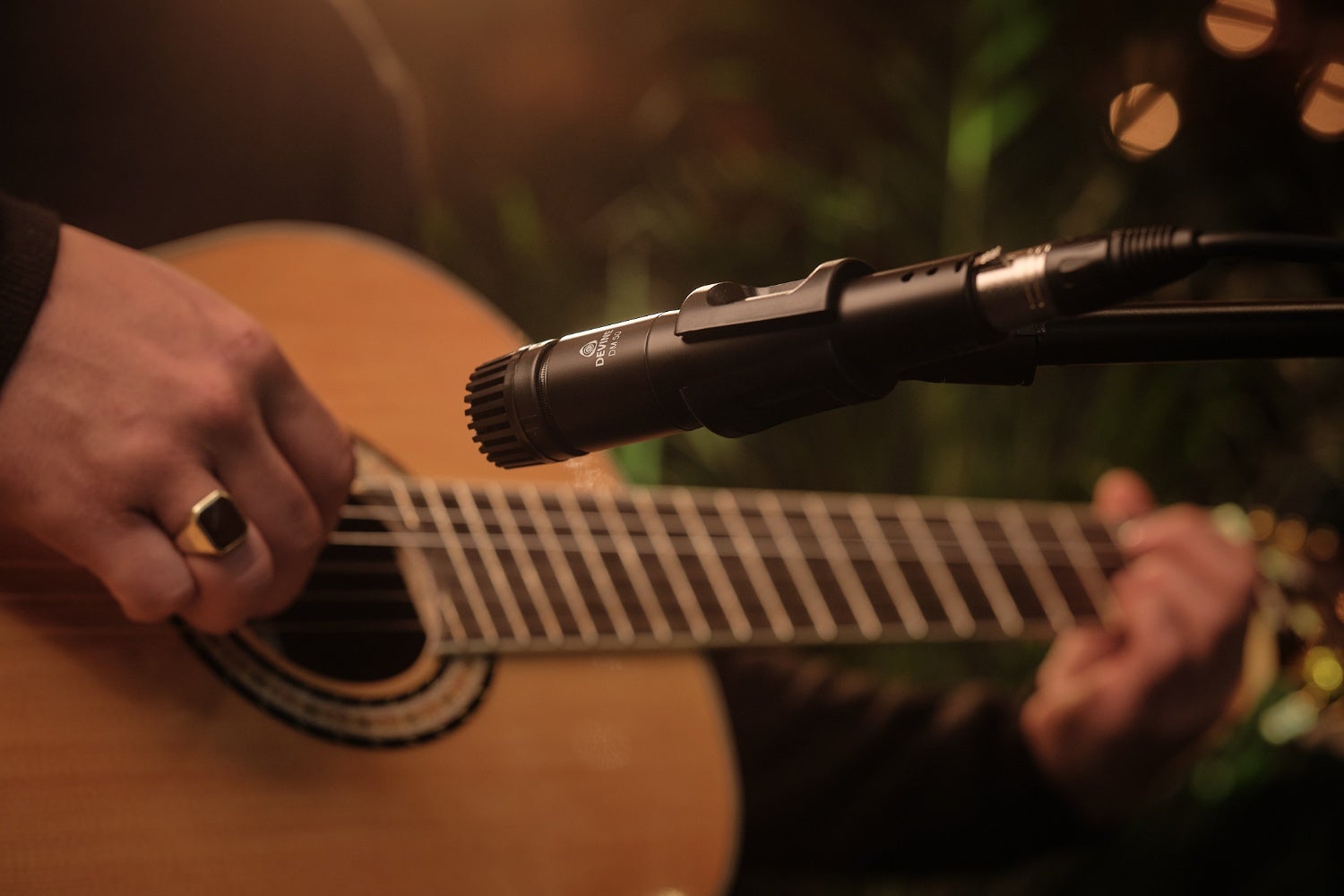
A small-diaphragm mic is a pencil that you point straight at the source, with the diaphragm at the end of the tube: end-address. Hence the nickname pencil mic.
‘Large’ in large-diaphragm means a diaphragm of around one inch, roughly 2.5 cm, or more. That diaphragm is a sheet of film just a few thousandths of a millimetre thick: Mylar with a wafer-thin layer of gold. It’s stretched as tight as a drumhead and, just like a drum, has its own resonant tone. The designer damps this out, but where it sits depends on the size. And that’s exactly where the differences in sound begin.
» The difference between dynamic and condenser microphones
» View all large-diaphragm microphones
» View all small-diaphragm microphones
Sensitivity and low end: where the large diaphragm scores
A larger diaphragm captures more air and delivers more signal at the same sound pressure, just as a bigger solar panel generates more power from the same sunlight. As a result, a large-diaphragm mic has higher sensitivity and a better signal-to-noise ratio. You can record a whispering singer or a choir at the back of a church without cranking the gain all the way up. In those situations, a small-diaphragm mic’s self-noise becomes audible a little sooner.
Then there’s the low end. A large diaphragm has a lower resonant frequency than a small one, so a (directional) large-diaphragm mic generally reproduces deeper, fuller bass . In practice, you’ll notice this because you need to place a small-diaphragm mic slightly closer to get the same ‘bottom end’. Bear in mind, though: with microphones, diaphragm size is far less decisive than with loudspeakers. This isn’t a woofer versus a tweeter.
Incidentally, all of the above only applies to directional capsules, such as a cardioid pattern. An omnidirectional microphone registers small pressure differences and, in principle, does so equally well with a large or a small diaphragm. There, the low-frequency limit is set by a tiny vent hole that protects the diaphragm from changes in air pressure, not by its size. So an omni pencil mic gives away nothing compared to an omni large-diaphragm mic.
» Microphones: distance and the proximity effect – how it works
Off-axis and stereo: where the pencil wins
Sound rarely comes from straight ahead alone. A guitarist moves, a choir spreads out wide, the room reflects sound back. How a microphone sounds for sound arriving at an angle is therefore at least as important as its sound straight on, and this is where the small diaphragm has the edge.
A high-frequency tone arriving from the side doesn’t reach every part of a large diaphragm at the same time: it hits one edge before the other. These phase differences partly cancel out high frequencies in a large-diaphragm microphone. A small diaphragm is simply too small to be much affected by this. That’s why off-axis sound is more natural with a small-diaphragm mic and less dull, and its cardioid pattern stays more consistent across the entire frequency range.
Then there’s the housing. The capsule of a large-diaphragm mic sits inside a sturdy grille to protect it from dust and knocks, but all that metal reflects sound, colouring both the tone and the polar pattern. Manufacturers go to great lengths to minimise this effect, but it remains a necessary evil. With a pencil mic, the capsule simply sits exposed at the end of the tube. That gives the sound less to bounce off and therefore results in less colouration.
For stereo, this counts double. An X/Y or ORTF pair stands or falls on predictable off-axis behaviour, and two pencils are much easier to set up in such a configuration than two chunky cylinders on a stereo bar. That’s why recording an orchestra or classical guitar in stereo is usually a job for small-diaphragm mics. (It’s true that the lighter diaphragm theoretically responds faster to transients, but the difference is so small that you shouldn’t base your choice on it.)
» Microphone set-ups for stereo recordings
» Recording drums
» Recording singer-songwriters
» Recording a choir





No comments yet...