
Test, test! Can you hear me? – The basics of a microphone
Published on Tuesday 19 May 2026
Bax Music has a wide range of microphones in its catalogue. On the microphone product pages in the webshop you’ll find a list of specifications, which we’re going to take a closer look at. To understand what these specs actually mean, we need to start with the basics.
How does a microphone work?
A microphone converts acoustic energy (sound waves) into electrical energy (an audio signal). Different microphones use different methods to convert that energy. They all have one thing in common, though: the diaphragm (or membrane). This is a thin piece of material such as paper, plastic or aluminium, which is set into motion by sound waves. These vibrations are then converted by other components in the microphone into an electrical charge that results in an audio signal.

Microphone types
Microphones can broadly be divided using two criteria: conversion technology and intended use. The most commonly used conversion methods are dynamic and condenser.
Dynamic microphones use a diaphragm, a coil and a magnet and are very robust and able to withstand rough handling. They’re ideal for live vocals and can cope well with high volumes from, for example, guitar amplifiers and certain wind or percussion instruments. A classic example of a dynamic microphone is the Shure SM58 (pictured).
Condenser microphones need a bias voltage (phantom power) to register the diaphragm’s movement. They’re more sensitive than dynamic microphones, making them better suited to capturing subtle nuances in sound. Brilliant for recording vocals and acoustic instruments in the studio. They are, however, less suitable for very loud sound sources. An AKG C 414 XLII is a recognisable condenser microphone you’ll find in many studios.
Polar pattern
Whether a microphone is more or less suitable for a specific application is partly determined by these characteristics. A microphone’s polar pattern describes how sensitive it is to sound coming from different directions. There are broadly three categories:
- omnidirectional; sound from all directions
- unidirectional; sound from one direction (cardioid and hypercardioid)
- bidirectional; sound from two opposite directions
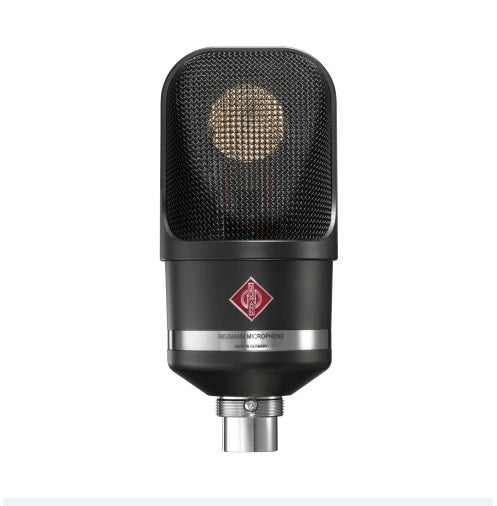
In microphone manuals, you’ll usually find a graphic representation of the microphone’s polar pattern. This is called a polar pattern. There are also microphones with switchable polar patterns. The brand-new Neumann TLM 107 (pictured) is an excellent example.
Frequency range and frequency response
A microphone’s frequency range only indicates which frequencies it can register, for example a range of 20 Hz to 20 kHz. It doesn’t say anything about how successfully the microphone reproduces those individual frequencies.
Frequency response does tell you how a microphone reacts to different frequencies. This response is shown in a graph where the frequencies in Hertz (Hz) are plotted against the level in decibels (dB). In this frequency response curve, a higher value means that frequency is emphasised, and a lower value means that frequency is reduced. A completely flat response means the microphone is equally sensitive to all frequencies. This results in a more accurate representation of the original sound, which is why we say a flat frequency response produces the most faithful audio. A good example is the Shure SM 81. A completely flat response isn’t always desirable, though. A frequency response tailored to the intended use is often more practical.
For example, if you use a microphone with a frequency response tuned for the human voice, it will be better able to pick up that voice in an environment with a lot of low-frequency background noise. It’s also wise to avoid response curves that emphasise the wrong frequencies. For instance, don’t use a vocal microphone to reinforce a kick drum.
Sensitivity
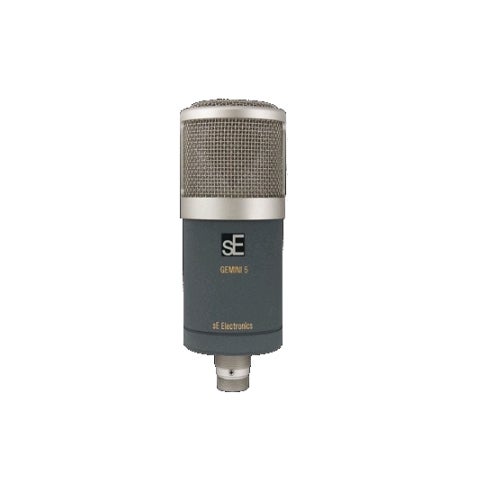
Microphone sensitivity describes the voltage (output) a microphone produces at a given sound pressure level. It’s usually stated in mV at 1 Pascal of sound pressure (=94 dB SPL). At bax-shop.co.uk, we use dBV/Pa, which is a conversion of the number of mV at 1 Pascal. This results in negative dB values because every microphone produces a voltage lower than 1 Volt = 0 dB at the reference value of 1 Pascal. For example: 2.0 mV/Pa = -54 dBV/Pa. The closer this value is to zero, the more sensitive the microphone. An example of a microphone with a sensitivity of -30 dB is the sE Electronics Gemini 5.
Maximum sound pressure level
A microphone’s maximum sound pressure level is particularly important when close-miking loud sources, such as drums and loudspeaker cabinets from (bass) guitars. The value is usually expressed as the number of dB at which distortion (THD, Total Harmonic Distortion) is 1%. This value typically lies between 110 and 150 dB. The Sennheiser E 965 can withstand an SPL between 140 and 149 dB.
Impedance
Impedance is an electrical engineering term and refers to resistance: how much a device resists an electrical voltage such as an audio signal. Generally speaking, the main drawback of high-impedance microphones is that they don’t perform well with long cables. The signal quality suffers and high frequencies are lost. Microphones with a low impedance (< 600 ohms) are generally the better choice.
 Recording the Acoustic Guitar: The Basic Rules
 Setting Up the Band with a PA System? Here’s What You Need to Know
 Vocal Effects: Play with Reverb, Compression and More!
 So, Can You Connect a Microphone to Your Computer?
 The Mixer: Functions & Connections Explained
 The Right Microphone for Recording Dialogue
No comments yet...