
Saxophone or clarinet: which suits you best?
Published on Thursday 30 July 2026

Saxophone or clarinet: both instruments use a reed and belong to the woodwind family, but they sound different, feel different and suit different musical styles. If you’re not sure which way to go, it helps to set out the main differences side by side. That way you can make a choice that suits you.

Two instruments, one ancestor
The clarinet and the saxophone are closely related, but they come from very different eras. The clarinet has been around since the early eighteenth century — around 1700, the German instrument maker Johann Christoph Denner developed an instrument based on the chalumeau, a simple single-reed wind instrument. The saxophone is considerably younger: the Belgian instrument maker Adolphe Sax patented it in 1846.
Adolphe Sax knew the clarinet well — he had studied it himself and worked as an instrument maker improving existing wind instruments. The saxophone was therefore deliberately designed as a cross between the tone of a woodwind instrument and the projection power of a brass instrument, intended to strengthen the orchestra in places where neither family worked particularly well. He borrowed the conical metal tube of the sax from brass instruments; the reed mouthpiece he took from the clarinet.
That shared mouthpiece principle is also why the two instruments are so often mentioned in the same breath. Both use a reed and a mouthpiece, and the fingerings share enough similarities to make switching between them technically achievable. Yet the acoustics work differently: the clarinet has a cylindrical bore and therefore overblows a twelfth higher — a jump of an octave and a fifth — while the sax, with its conical bore, jumps up an octave, just like a flute or oboe.
That acoustic property makes the clarinet somewhat trickier for beginners, as you’ll read further on in this article. Historically speaking, then, these are related but deliberately different instruments, with Sax using the clarinet as a starting point to create something new — not a copy, but a deliberate evolution.
» What are the best clarinet or saxophone reeds for me?

They look so different — and that has consequences
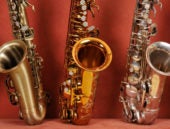
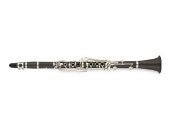
A saxophone and a clarinet are both single-reed woodwind instruments, but beyond that they look like two completely different instruments. The saxophone is made of brass and has that recognisable curved shape (except for most soprano saxophones) with a wide bell at the bottom. The clarinet is a straight, slender tube, traditionally made from grenadilla wood, with a cylindrical bore that has virtually the same diameter from top to bottom.
That bore is exactly what makes the difference in sound. A clarinet has a cylindrical bore and therefore produces mainly odd harmonics: a warm, focused tone with plenty of character in the lower registers. A saxophone has a conical bore, which widens towards the bottom, giving it a fuller, louder and brighter sound. The saxophone projects its sound outwards into the room; the clarinet sings more inwardly.
» View all clarinets
» View all saxophones
Does the saxophone sound richer?
Saxophonists are known for their enormous tonal palette: from a warm, breathy tone to growling multiphonics and piercing high notes. You hear this constantly in jazz, funk and soul. With the clarinet, that range seems narrower at first hearing — but that’s not quite right. The clarinet has just as much tonal colour to offer, it’s just largely hidden away in genres you might not seek out as quickly.
In classical music and concert bands, the clarinet usually plays a clear, well-controlled tone — that’s a stylistic choice, not a limitation of the instrument. In klezmer you hear a completely different beast: sobbing effects, sliding tones (glissandi), an almost shrieking upper register and expressive vibrato. In traditional jazz from the 1920s and 30s, the clarinet did exactly what the saxophone does now: scraping, wailing, singing.

Which is harder to learn: sax or clarinet?
On the sax, you don’t need to work as precisely with your lips: the mouth position, also known as embouchure, is a little more forgiving. On the clarinet, the embouchure is more like cookie dough that you need to roll out just right — too little pressure doesn’t work, and neither does too much. That doesn’t mean the saxophone is easier, just that the barrier to getting started is lower.
There are a few other things that make the clarinet slightly harder at the start. For instance, the clarinet has a register break halfway through the instrument — a jump of an octave and a fifth where you use an extra key (the thumb key) — which costs beginners some effort. Properly sealing the tone holes also takes practice, unlike the keys of the sax.
For a beginner who wants quick results, the saxophone is somewhat more accessible in the first few months. Those who want to play classical music from the start, or join a concert band, more often choose the clarinet. Both instruments ultimately require years of practice to truly master — that doesn’t differ.

Do you have to learn clarinet first before playing sax?
This is one of the most persistent myths in the wind instrument world. Switching from sax to clarinet (or vice versa) is actually harder than it seems, precisely because as an advanced player you’re used to specific habits that work against you on the other instrument. A saxophonist picking up the clarinet for the first time will find that the embouchure needs to be rebuilt from scratch: what works on the sax produces a shrill or squeaky sound on the clarinet.

So which instrument should you choose?
Choose the instrument that speaks to your musical heart. Do you love the warm, classical sound and want to join an orchestra or concert band? Then go for the clarinet. Does the bright, powerful sound of jazz, pop or soul appeal to you, and do you want to hear results quickly? Then the saxophone is a better fit for your start. Budget also plays a small role. A beginner’s clarinet is, on average, cheaper than a beginner’s alto saxophone.



No comments yet...