
Musician
-

Digital sheet music. YouTube lessons. Guitar tab sites. Today, it’s easier than ever to learn to play a new song you’ve just discovered. This is incredibly convenient of course, especially for beginner musicians. But it also has a downside. Having access to all those great resources has made it easier than ever to neglect an important skill: figuring out music by ear. StringKick founder Just Rijna explains how learning music by ear will help you to grow as a musician.
Comments Off on How to Become a Better Musician by Figuring Out Music by Ear | in: Guest Blogs, Music Theory, Musician -
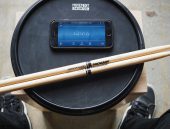
In this blog, guest-blogger and drummer Wietse Hendriks shares some of knowledge on drumming in irregular timings, like 5/4 and 7/8. Wietse explains how to count along and, most importantly, how to master the skill as a drummer – examples, explanations and drum exercises included below!
-

Have you ever wondered what pop music would’ve sounded like if the electric guitar had never been invented? Used in practically every other pop tune, this massively popular instrument has allowed many musicians to reach a legendary status. If you’re wondering who some of those famed and influential guitarists are and what it takes to become one of them, then simply dig into this humble article and read up on the history, sounds and various playing techniques of the electric guitar.
-

In this blog, we’re going to focus on two scales that provide an endless supply of transition tools. These magic scales are the octatonic and altered scales, and while you won’t come across them in much popular music, these scales are compulsory reading for any jazz, blues, or progressive pop and rock musicians looking for a fresh approach.
-

The Minimoog, or to be more precise: the Minimoog Model D is essentially the archetype of the synthesizer. So if you think of a synth, you’re likely to be thinking of the Model D. First released in 1970; given a short re-release by Moog back in 2016; and recently honoured by the Behringer Model D copy, the unmistakable sound of the Minimoog has helped create countless records and slapped grins on countless faces. But what exactly is the magic that lies behind what’s considered the ever enchanting analogue-hearted mother of all synthesizers?
-

The fact is, there’s no right or wrong way to wear a guitar strap. But, if the length of your strap doesn’t match up with the way you play, it can have a pretty negative effect. In this wee blog, we take a look at the advantages and disadvantages of a super-long, super-short, or somewhere-in-the-middle guitar or bass strap.
-
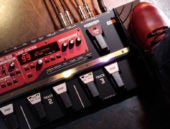
A ‘loop’ is what happens when you take a short (or long) snippet of music and repeat it again and again – on a loop. So, you can take a drum or guitar part and loop it. You can even sing a line and loop it. In fact, using a looper; as long as you can record it in, you can loop it. And, you can not only loop snippets of music, but record and stack endless ‘overdubs’ over the top. In this blog, we’ll take a look at the history of the loop pedal and find out exactly what you can (and can’t) do with these magic boxes.
-
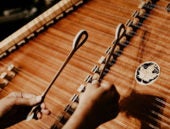
In this article, guest author Aleah Fitzwater will walk you through the ins and outs of how to play, and purchase the hammer (or ‘hammered’) dulcimer.
-

In this blog, you’ll get a full explainer on how to transpose musical score. Transposing basically means shifting the notes of a piece of music up or down by a semitone or more so it can be played in a different pitch. Of course, there’s plenty of software you can use to transpose sheet music, but you learn way more when you do it yourself. And, since you can pull it off in three steps, why wouldn’t you? Is it easy? Well, not at first, but if you take your time and follow these instructions, then you’ll definitely be able to do it. We’ll take a look at transposing with software; with nothing more than pen and paper; and even transposing on the spot while you’re playing. We’ll also look at how to pitch-shift audio files.
-

A well-tuned violin forms the base of good intonation! If just one of the strings is even slightly too sharp or flat, then every note you play will sound slightly out of tune and the balance of your sound will be off, meaning you won’t be able to hit the right notes or play a melody that you can immediately recognise. Ultimately, it’ll make playing your violin a miserable experience. Being able to tune up is an essential skill for any violinist, so here, Guestblogger and professional violinist, Nicolas Penel offers a clear guide to bring your violin up to perfect pitch.
-

While many people associate the flute with classical pieces, such as the Bach Partita in A Minor, or the Mozart flute duets, you’d be surprised how often this woodwind instrument has infiltrated the world of rock. In this article, guest blogger Aleah Fitzwater will lead you through how the flute made its way into jazz, and then rock and roll, as well as some of the instrument’s biggest moments in rock history.
-

K-pop lovers were invited to fully indulge themselves during KPOP.FLEX; Europe’s first-ever K-pop mega festival. The event took place on Saturday the 14th & Sunday the 15th of May at Deutsche Bank Park in Frankfurt, Germany and featured some of K-pop’s most stratospheric artists, including Monsta X, Kai, NCT Dream, ENHYPEN, (G)I-DLE, IVE, Dreamcatcher and Mamamoo.
Comments Off on KPOP.FLEX: Europe’s First-Ever K-Pop Mega-Festival! | in: Musician