
What is sampling?
Published on Friday 15 May 2026
This is, in a nutshell, what people generally mean by sampling (or samplen in Dutch): re-using a fragment of someone else’s music in your own. That fragment could be a beat, a vocal line or an instrumental hook. In this blog, guest blogger and musician Jemy Gijsman from music school Let it Rock takes you through the history of sampling. And what about sampling and copyright?

Tape looping
Sampling is essentially a more flexible evolution of the tape loops from the 60s and 70s. So it’s no surprise you still come across the term ‘loop’ on just about all hardware and software samplers. Although people were already experimenting with it in the 40s, the wider public only really got acquainted with tape looping in 1966. That was the year The Beatles released the album Revolver, with ‘Tomorrow Never Knows’ as the last track on side B. With the approval of producer George Martin and under the watchful eye of engineer Geoff Emerick, the Fab Four used various loops that alternated and overlapped. It became a revolutionary little masterpiece that, even now—more than half a century later—still sounds massive!
How did sampling start?
With the arrival of the Mellotron, tape looping—generally quite a labour-intensive technique—was housed in a compact unit for the first time (at least, for that era). Once again, The Beatles were the undisputed pioneers: on both ‘Strawberry Fields’ and ‘Lucy in the Sky’, the Mellotron plays a prominent role with its flute and harpsichord samples. But in my opinion, the instrument was used most tastefully in ‘Nights in White Satin’ by The Moody Blues. The choir sample gives the chorus so much punch that it must have sounded almost otherworldly back then.
Samples instead of tape
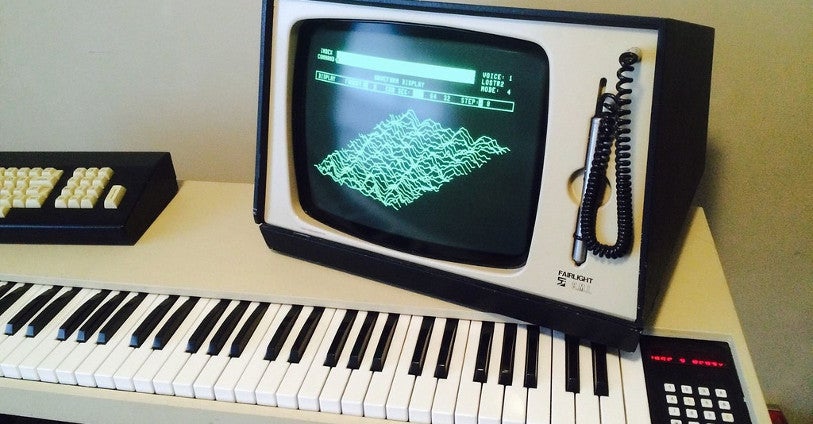
All well and good, of course, that prehistoric messing about—but unfortunately you couldn’t get much further than the samples supplied by the factory. On top of that, every key had its own mechanism with a playback head and a piece of analogue tape, which not only made the whole thing ingenious (fair play) but also pretty heavy and maintenance-hungry. With the arrival of the Fairlight CMI in 1979, all of that was a thing of the past. This machine—which in a sense consisted of multiple components tied together—could record random sounds in real time and then play them back at different pitches. Jean Michel Jarre, my childhood hero, made extensive use of the CMI for his seventh—and perhaps most forward-thinking—album Zoolook. The 8-bit* samples had, depending on the chosen 24 or 12 kHz sample rate**, a maximum length of only half a second to a full second, and the unit also came with a price tag of around £25,000 (equivalent to well over £88,000 today). Still: it was a start!
* Bit depth is comparable to the number of pixels that make up a single frame/image. A higher value basically means more detail. ** You can compare the sample rate to the number of frames/images per second in a film: the higher the value, the smoother the image—or in this case, the sound.
Affordable sampler
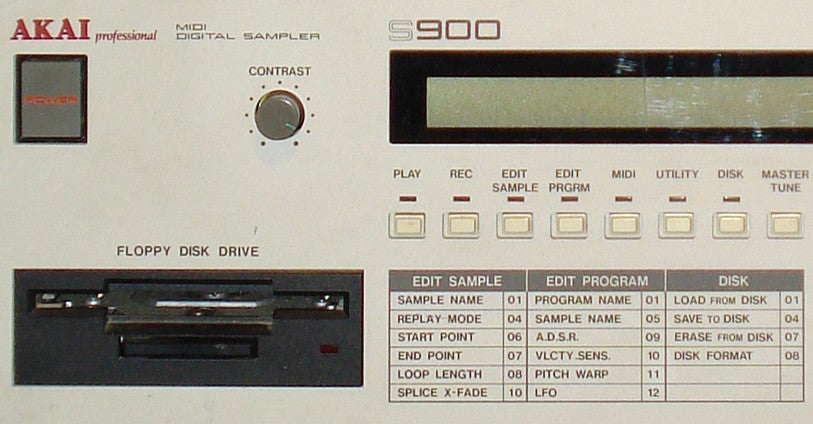
Six years later, in 1985, the first affordable digital sampler emerged from a collaboration between Akai and Roger Linn (maker of the legendary ‘LinnDrum’ drum machine): the Akai S900, a 19” rack module that could make 12-bit samples of just over 11 seconds with a 40 kHz sample rate. This gave the phenomenon of sampling its definitive breakthrough in the late 80s, and Akai unknowingly unleashed a true revolution in the music world. The S900 and its 16-bit successor, the S1000, made it possible to sample and loop complete beats and instrumental hooks at high quality—which not only formed the basis for new music genres like hip-hop in the US and jungle in the UK, but… also for countless copyright claims worldwide.
Sampling and copyright
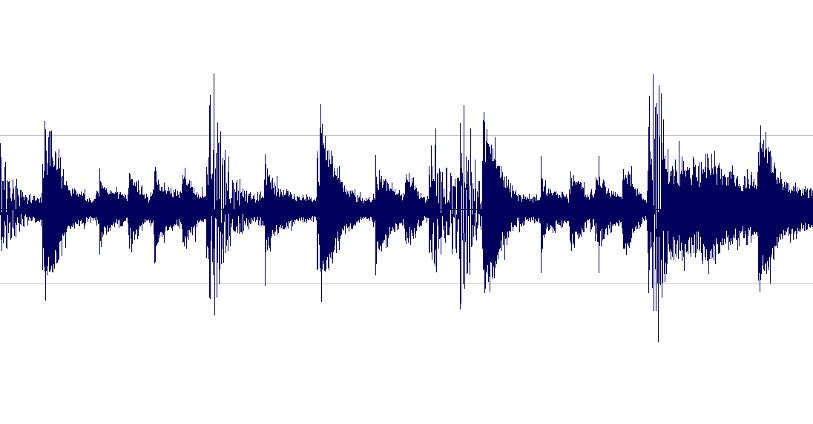
The average hobbyist probably won’t lose much sleep over copyright and the laws around it. But if you have ambitions for your music, sampling can be a bit tricky. A musical fragment—such as a vocal line or guitar riff—is protected by copyright by default. Contrary to the stubborn urban myth that grew into a widely held belief, the length of a sample in seconds is NOT a deciding factor and therefore completely irrelevant. While the idea “the shorter the sample, the smaller the risk” sounds logical and almost self-evident, case law isn’t entirely consistent—so it’s still wise to be careful. You simply need permission from the rights holder, which in almost all cases is the record label that released the track in question. This is called ‘clearing’. And you can bet that, for example, the barely three-second snippet of Voodoo Child in the chorus of The KLF’s 90s hit Justified & Ancient had to be cleared. Blimey… that makes me feel old. Music whose original author has been dead for more than 70 years is, by the way, fair game.
Sampling today
Although new hardware samplers are still released every year—and nothing beats real-time freak-outs with physical faders on a mixing desk, as I once got to experience for a week back in 1993 with a borrowed Akai S2000 from a local school band—many producers switched around the turn of the millennium to the built-in sampling functionality of their DAWs. Sampling itself, on the other hand, is impossible to imagine away from contemporary music and, as I briefly mentioned earlier, even formed the basis for a number of now-mainstream genres and subcultures. The clearest examples of this are the Apache Break from Apache by The Incredible Bongo Band (hip-hop) and the Amen Break from Amen Brother by The Winstons (jungle/drum-’n-bass). The role of our early hardware samplers in the creation of those styles is unmistakable!
Do you ever use samples in your productions? Let us know below in the comments!




No comments yet...