
Theory & Playing Technique
-
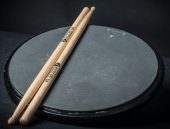
Even if you’ve been drumming for a while, there’s a chance you’ve never thought about the way you hold your drumsticks. Since there are a few rules of thumb that can actually help you hone your skills, we’ve compiled a humble list of stick-based tips and tricks for you in this blog.
-
The way you play your instrument has got just as much to do with the overall sound as the wood that it’s made of and the strings that it has. There are a lot of fundamental things that new players often miss when trying to find a good sound and today, guest blogger Matthew Quilliam shows us five subtle but effective ways to improve your overall tone when playing your ukulele.
-
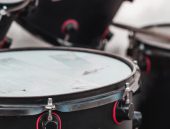
If you’re a drummer, then there’s at least one drum that you can never do without: the snare. While you might be familiar with the array of different percussive sounds you can get out of a snare, if you’re a beginner, you might not necessarily know how to access all of them. Even a small adjustment in your playing can make a snare drum sound completely different, and here, I’ll offer up some essential tips that will help you get to know your snare a little better.
-

Granted, the ideal drum kit set-up is highly personal. But that doesn’t mean there aren’t a few guidelines that you need to follow. To help you find a comfortable, practical and most of all style-matching set-up, I’m going to show you a couple of different takes on the standard drum kit configuration!
-

Throwing in solid drum fills can be pretty difficult for beginners. Some go too fast while others over-complicate things – two habits that are hard to kick without the help of a drum teacher. In addition, not being able to time your fills right can be extremely frustrating, whether you’re rehearsing or just jamming, and not just for you, but for any musicians you’re playing with as well as anyone listening. So, in this blog, I’m going to teach you various simple drum fills and show you some very useful tips!
-

In this blog, we dive deeper into how harmony works by looking at the chords commonly used in jazz and pop: the ninths, elevenths, and thirteenths, and all of their variations. Each of these magic chords can be built by simply stacking more thirds onto a seventh.
-

If you’ve already made it this far, then you’re probably already the proud owner of your very own cajon. You’ve seen or heard a cajon afficionado spitting beats and thought, “I can do that!” But now that you’re sitting astride your brand new percussion box, it’s already looking a little more complication than you first thought. Not to worry! Everyone starts somewhere, and since you’re here, this is where you’re going to start! In this friendly little blog, we’ll guide you through three awesome cajon beats that you can use as a foundation to expand your cajon-based skills. No theoretical knoweldge or the ability to read music required!
-

In this blog, we’re going to talk about playing the blues, show you which ingredients are needed to play typical blues-flavoured sounds on a piano or guitar, and take an in-depth look at blue notes, blues scales, blues-style chord progressions (including that well-known 12-bar blues), straight-versus-swing blues and various other important topics.
Comments Off on Want to Play the Blues? Use These Chords, Notes and Tips! | in: Guitarist, Keyboardist, Musician -

Ionic, dorian, phrygian, lydian, mixolydian, aeolian, and locrian: otherwise known as the church modes. These influential scales originated in the church music of the middle ages and are still used today in classical music, pop, jazz, rock, and even metal. So, if you want to try something new or take in a little musical history, it’s worth learning a few church modes. In this blog, you’ll get an idea of how these modal scales work, an impression of the kind of sound they can produce and learn to play them in any key.
-

Accompanying a vocalist on the guitar is a skill that is sometimes overlooked by guitarists, especially when the attention is usually on playing the fastest shred licks possible or how many effects pedals one can fit on their pedalboard. One skill that’s very important as a performing guitarist, and is something that will lead to many more gigs, is the ability to make a vocalist feel comfortable and supported, especially in the context of an acoustic duo which will be much more stripped back than a full band setting, and be more exposing for all parties. In this article, guest blogger and professional guitarist Cameron Hayes tells you all about how to achieve the skill of accompanying a vocalist.
-

This blog covers the widely used blues scale. Even if you wouldn’t call yourself a blues musician, this magic scale is something that every musician should know, since it not only helps build the fundamentals of blues, but pretty much everything that followed it – including pop, rock, and everything in between.
-
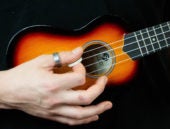
Great, so you know how to tune your ukulele and maybe you’ve even learnt a handful of basic chords already – now it’s time to learn your first strumming patterns! In this blog, we’ll be teaching you how to play various rhythms by starting out with something simple and increasing the complexity as we go. Good luck and have fun!
Comments Off on Ukulele Rhythms: Learn Them Here! | in: Musician