
Theory & Playing Technique
-

The harmonica is a small and seemingly easy to play wind instrument. They’re also pretty cheap, and in the right hands, can wield incredible power, not to mention masses of expression. This humble little instrument is sometimes referred to as a blues harp and has managed to weed its way into a broad array of genres, and in this blog, you’ll learn about the illustrious history of the harmonica, the various forms a harmonica can take, as well as some of its essential playing techniques.
2 responses | in: Musician -

If you’ve been playing the guitar for a while now, the standard EADGBE tuning might feel a bit like a musical straitjacket. If you want to go beyond standard tuning however, you’ll need to get off the beaten path. Open tunings open up a whole new world and can make playing guitar feel like an adventure again. “You’re forced to learn how to play guitar from scratch again,” says fingerstyle guitarist Hans Laduc.
-

Sharp outfits mean nothing if you’re not a sharp, tight band. Good timing is the essence of playing in a band, and if you don’t have it, then you risk sounding like a shambles. So, how do you hone your skills to make sure you’re hitting every beat and that you’re part of a super-tight band? We offer up fifteen exercises and some handy tips to help you get there.
Comments Off on Want to Play Tight? Then Nail These Exercises | in: Musician -

Do you get irked whenever you hear a successful producer proclaim: “and I didn’t even know any music theory”? Say they’re telling the truth (usually, it’s far from the truth), so what? Not everyone is going to be a natural, and just think, how good would those same producers be if they had bothered to learn music theory. Right here, right now, Guestblogger Daddynervs tells us why every producer, even humble beat producers, should arm themselves with some good old fashioned music theory – and what music theory actually is.
Comments Off on Why Every (Beat) Producer Needs to Know Music Theory | in: Guest Blogs, Music Theory, Studio & Recording -

While there’s plenty to learn when it comes to singing alone there’s just as much to learn when you start adding more voices to create harmonies. With just one extra voice, you can already sing awesome harmonies, so just imagine what happens when you start adding even more!
-

If you’ve already devoured our blog about Rhythm, Tempo & Measure and feel ready to dive in a little deeper, here’s everything you need to know about time signatures, bar lines and repeat signs. Whether you’re here to learn to read music or just want to get a better feel for timing, you’ll find useful information here.
2 responses | in: Music Theory -

If you’re about to put on your songwriting pants for the first time, it’s worth knowing that most songs consist of building blocks like the verse, chorus and bridge. In this blog, we’ll tell you all you need to know about how songs are structured and why.
Comments Off on Pop Song Structuring: Verse, Chorus, Bridge and More Explained | in: Songwriting & Composing -

By simply adding the right cymbals, any drum kit will sound entirely unique compared to other kits, and that’s exactly why drummers spend quite a bit of time and effort finding the perfect set of cymbals. The fact is that at some point, just like us mortals, cymbals will one day reach the end of their life. In this crash course on cymbal maintenance, I’ll let you in on a few secrets and show you how you can delay the inevitable.
-

The internet is already stacked with the ready-made chord arrangements of countless songs, but what if you can’t find the song you’re looking for? No problem. There are also apps that you can download and use to pick out the right chords for you. But… regularly figuring out the chords of a song is actually a far better idea. Why? Because it’s a great opportunity to train your ear. In this blog, we explain how it’s done and how to use lead sheets.
-

Whether caused by a bad habit or a passionate performance, the injuries related to being a musician can range from a gradually niggling and continuous beep in one ear, to chronic and unbearable wrist pain. If you want to play comfortably for the rest of your life, then it’s more than worth learning to listen to your body, practise some good-old self care, and avoid long-term injury, hearing damage, and dreaded RSI!
-

In our blog explaining how chords work, we already touched on the diminished, augmented, and seventh chords. Here, we dive a little deeper into the inner workings of these chords and their function, covering everything from a normal seventh chord (the dominant seventh), to minor sevenths and major sevenths, and the difference between a diminished and half-diminished chord. We’ll also explain terms like ‘diatonic’, ‘modal’, and ‘enharmonic’, setting you up with a bank of knowledge to help you get writing.
-
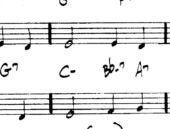
In our blog covering chord theory, we looked at how chords are built, and here, we’ll see what happens when you place one chord after another to build a chord progression and why some combinations work better than others. We’ll talk about intervals, how to build tension, what leading notes do, resolutions and sus-chords. There will be a bit of studying involved, but in the end, it’ll only speed up your writing process.